StockGenie, an AI Stock Analysis App Built in React Native
Four people. Two months. An app that reads the financials, charts and news for any NSE listed company, then explains what they mean in plain English and Hindi. It's live on Google Play with a 4.5 rating and more than 4,000 installs.
This one came to us as a hard brief. Take the kind of research an analyst does by hand and make it fast enough that someone can do it on a phone during a lunch break. We built it with React Native so one codebase could serve both platforms.
Talk to Our Team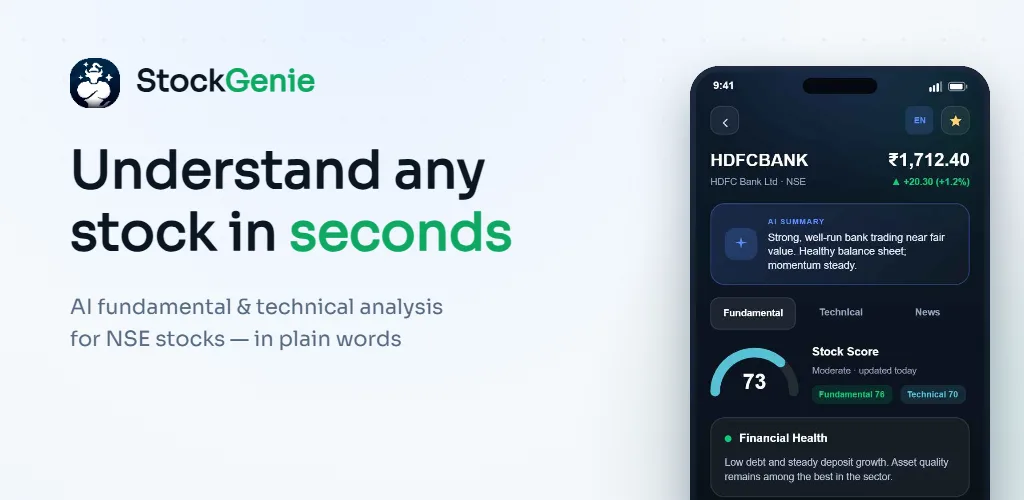
What the StockGenie App Does
Retail investors in India have no shortage of data. What they lack is a way to read it. Open most stock apps and you get a wall of ratios with no indication of which ones matter for the company you're looking at.
StockGenie pulls the financials, price history and news for any of roughly 2,000 NSE listed companies and turns all of it into something a person can actually follow. There's a single Stock Score that blends the fundamental and technical picture. Tap it and you see the reasoning behind the number rather than just the number itself.
The feature users seem to like most is Ask Me. Someone types a question in ordinary words, something like "is this company carrying too much debt", and gets an answer built from the same data the score uses. It works in Hindi too, which matters more than you'd think for a finance app in India. Financial vocabulary is where most translations fall apart.
The app is free to start with a daily analysis limit, and a paid tier removes the cap and adds pattern detection and alerts.
Getting Real Time Market Data Right
Everyone assumes the AI was the difficult bit. It wasn't. The data was.
Prices move every second the market is open. Corporate actions like splits and bonus issues quietly rewrite years of price history, so a chart that was correct yesterday can be wrong today if you don't handle them. Different sources disagree with each other on the same figure more often than you'd expect.
And a finance app gets exactly one chance here. Show a user a share price that's off by two rupees and they close the app and don't come back. Trust in this category is thin and it doesn't rebuild.
So a good share of those two months went into the layer between the market feed and the screen, checking values before they were allowed to reach a user. Not glamorous work. It's the reason the ratings held up after launch.
Building the AI Behind the Stock Score
Three separate jobs run under the AI banner in this app, and they needed different treatment.
The first is the plain language explanation. Take a set of ratios and produce two sentences a beginner understands, without softening the picture or inventing anything the numbers don't support. Every claim in a summary has to trace back to a real figure. That constraint shaped most of the design.
The second is the Stock Score, which combines fundamental and technical inputs into one number between zero and a hundred, then splits it back out so a user can see which side is carrying the result. HDFC Bank showing 73 overall with 76 fundamental and 70 technical tells a more useful story than 73 on its own.
The third is news. Headlines get summarised and rated for impact, tagged positive, neutral or negative against the specific company rather than the market in general. An RBI rate decision means something different for a bank than it does for a manufacturer.
Teaching the App to Read Chart Patterns
Chart pattern detection was the piece that took the most iteration. Traders look at a price chart and recognise shapes, a double top, a breakout above resistance, a consolidation. Getting software to see the same shapes reliably is harder than it sounds, because the definitions are loose and two experienced traders will disagree about borderline cases.
The failure mode to avoid is a system that finds patterns everywhere. A detector that flags something on every chart is worse than no detector, because it teaches users to ignore it. We tuned it to stay quiet unless the signal was clear.
It sits behind the paid tier now, which is a reasonable place for it. Casual users get the score and the summaries. People who read charts get the pattern work.
Screens from the StockGenie App
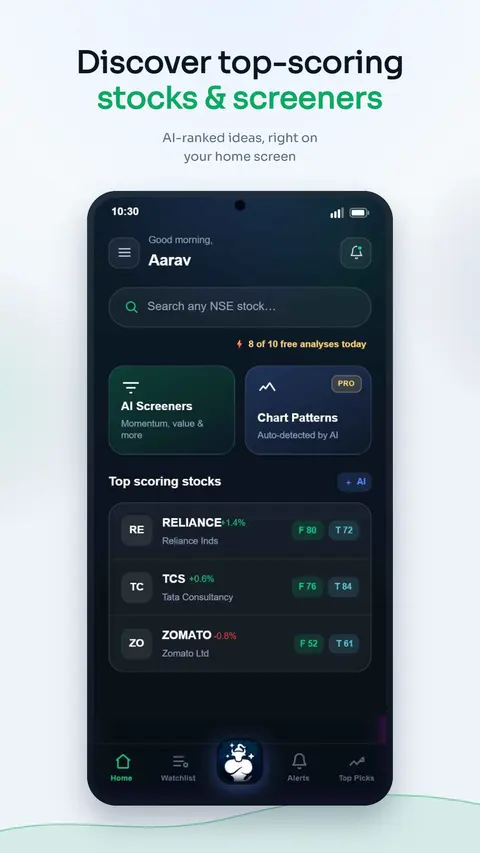
The home screen puts search, AI screeners and the day's top scoring stocks in one place. The free tier counter sits right under the search bar.
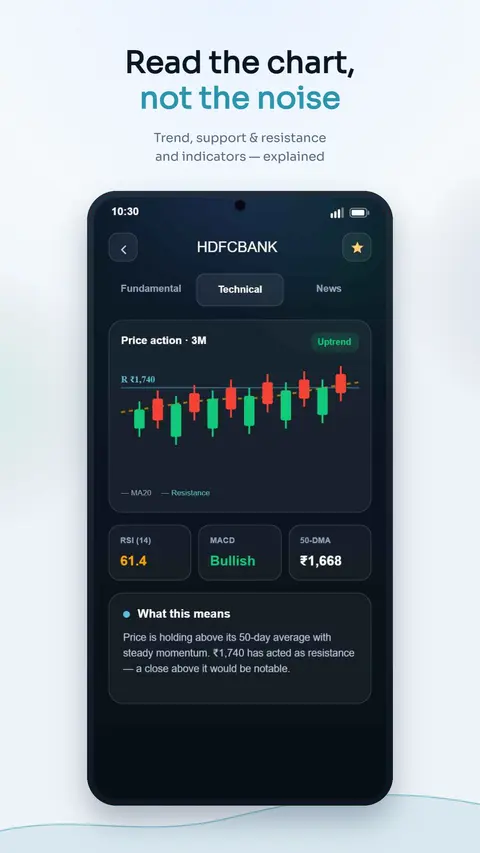
Technical analysis with RSI, MACD and moving averages, followed by a short explanation of what the indicators actually mean.
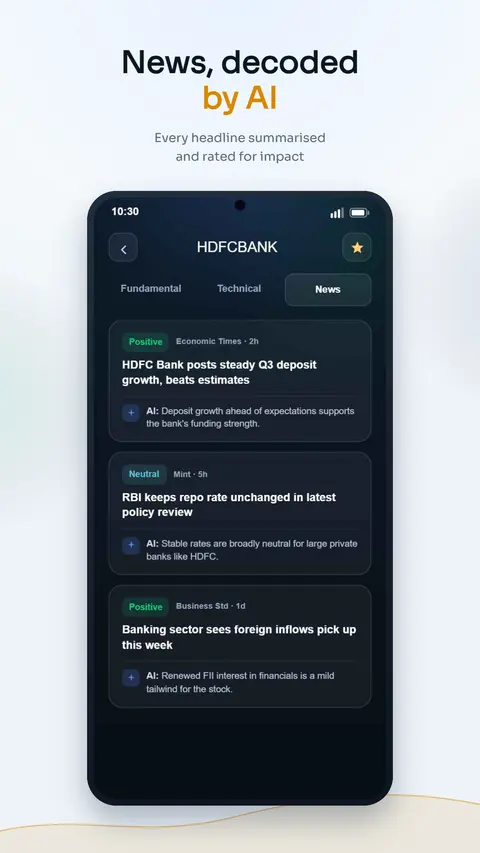
Every headline gets summarised and tagged for impact, so a user can scan a week of news in about thirty seconds.
Two Months with a Team of Four
Two months is fast for an app with this much going on, and it's fair to ask how. A few things made it possible.
React Native meant one codebase instead of two. With a team of four, splitting into separate Android and iOS tracks would have cost us most of the schedule. That single decision is the biggest reason the timeline worked.
The team stayed small on purpose. Four people who talk to each other all day move faster than eight who need meetings to stay aligned. Nobody was waiting on a handover.
We also cut hard. The first release covered NSE only, Android only, with a focused feature set. iOS is in progress. Getting a real app in front of real users beat spending another two months guessing what they wanted.
Where the App Stands Today
StockGenie is live on Google Play, holding a 4.5 rating with more than 4,000 installs and around 2,000 NSE stocks covered in two languages. For a finance app, where users are quick to leave a one star review over a wrong number, the rating is the result we're most pleased with. The iOS build is on the way.
Build Your Fintech App with Our Pune Team
We built StockGenie from our office in Pune, and we've done similar work for companies around Magarpatta City and the Hinjewadi IT park. If you're working on something with real time data, an AI layer, or both, we've been through the parts that usually go wrong.
Have a look at how we approach fintech app development and React Native app development, or see what a build like this typically costs in our guide to app development cost in India. More of our work is in the portfolio.
Start Your App Project