Planning a mobile app in 2026? Knowing what it actually costs saves you from sticker shock later. India has become a go-to base for app development, with pricing that undercuts Western rates while holding the line on quality. This guide breaks down what you’ll pay and why.
Two things to know before the tables. The ranges are for the software, and several categories carry a cost outside them that is larger than any feature line, covered further down. And the number attached to your project depends more on scope than on category, so the most useful hour you can spend is writing down what a user should be able to do before asking anyone to price it. Our walkthrough of the development process covers what that looks like properly.
Key Takeaway: A mobile app in India typically costs ₹1 to 3 Lakhs for a simple app, ₹5 to 15 Lakhs for medium complexity, and ₹15 to 40 Lakhs or more for complex enterprise builds. The final price depends on features, platform choice, and integrations.
Why India for Mobile App Development?
A few reasons companies around the world send their app work to India:
- Cost-Effective: development here runs 40 to 60% cheaper than in Western countries
- Skilled Talent Pool: over 5 million software developers who know the current tech
- Quality Standards: Indian firms work to international standards and agile methods
- Time Zone Advantage: work hours that overlap with most major business regions
- English Proficiency: communication with global clients stays clear
Mobile App Development Cost Overview
What you pay swings a lot depending on the build. Here’s the broad picture.
| App Complexity | Cost Range (INR) | Cost Range (USD) | Timeline |
|---|---|---|---|
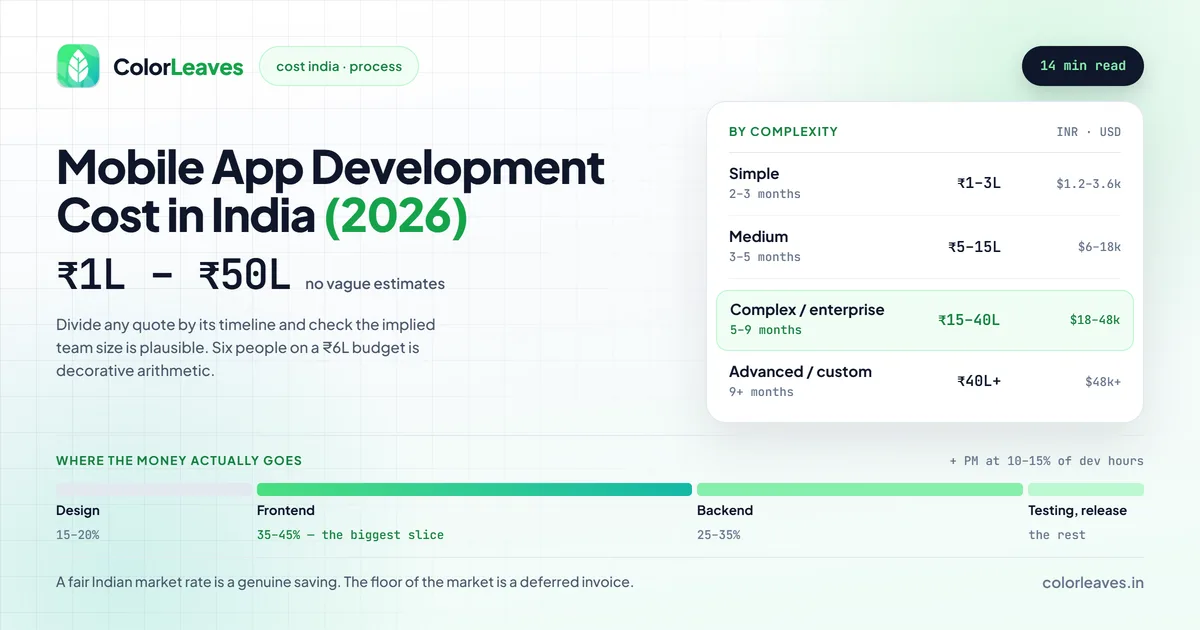
| Simple App | ₹1-3 Lakhs | $1,200-3,600 | 2-3 months |
| Medium Complexity | ₹5-15 Lakhs | $6,000-18,000 | 3-5 months |
| Complex/Enterprise | ₹15-40 Lakhs | $18,000-48,000 | 5-9 months |
| Advanced/Custom | ₹40+ Lakhs | $48,000+ | 9+ months |
Where the Money Actually Goes
The totals are more useful once you know how they split, because a quote that looks low is usually low by exactly the amount of one of these.
Roughly speaking, design takes 15 to 20 percent, frontend development 35 to 45, backend 25 to 35, and testing and release the remainder. Project management sits on top at 10 to 15 percent of development hours in most agency engagements.
That split is why two quotes for the same app can differ by lakhs without either being dishonest. One includes design and a QA engineer; the other assumes you have design and that the developers will test their own work. Ask each firm what sits outside the number before comparing totals, which our guide to choosing a development company covers in more detail.
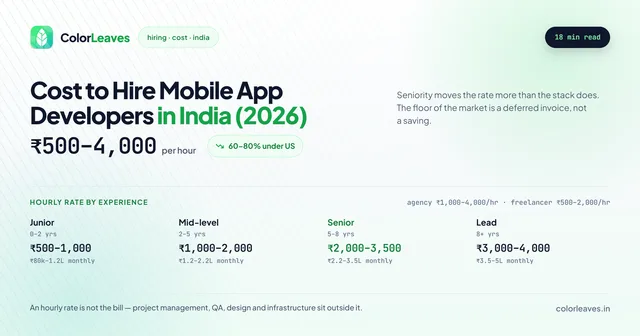
A useful arithmetic check: divide the quote by the timeline and see whether the implied team size is plausible at Indian rates. Our cost to hire developers guide gives you the per-person figures to do that with. A ₹6 lakh quote over three months implies about one and a half people full time, so a proposal describing a team of six is decorative arithmetic.
Factors Affecting App Development Cost
1. App Complexity and Features
How many features you want, and how hard they are to build, drives the cost more than anything else.
Basic Features (Lower Cost)
- User registration and login
- Profile management
- Basic navigation
- Push notifications
- Simple database operations
Advanced Features (Higher Cost)
- Real-time chat and messaging
- Payment gateway integration
- GPS and mapping
- Social media integration
- Video streaming
- AI/ML capabilities
- Augmented Reality (AR)
- IoT integration
2. Platform Choice
The platform you target moves the budget a fair bit.
- Single platform development: ₹1-20 Lakhs
- Larger user base in India
- More device fragmentation to handle
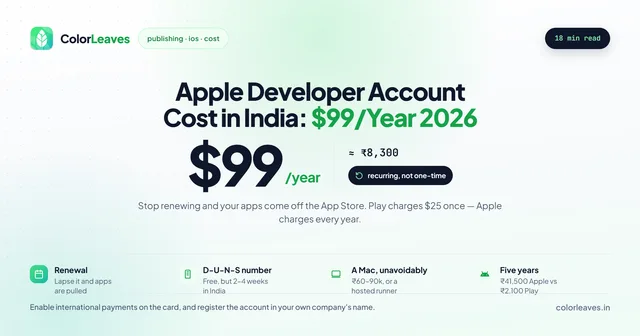
- Google Play Store fees: $25 (one-time) (Google)
- Single platform development: ₹4-25 Lakhs
- Premium user segment
- Stricter App Store guidelines
- Apple Developer Program: $99/year (Apple)
Cross-Platform Development (React Native/Flutter)
- Both platforms: ₹5-25 Lakhs
- 30-40% cost savings compared to native
- Single codebase for Android and iOS
- Faster time to market
3. UI/UX Design Complexity
Design pricing tracks how custom you go.
| Design Level | Cost Range | What’s Included |
|---|---|---|
| Basic | ₹50,000-1 Lakh | Standard templates, basic customization |
| Custom | ₹1-3 Lakhs | Unique designs, custom animations |
| Premium | ₹3-8 Lakhs | Complex interactions, micro-animations, prototyping |
4. Backend Development
What your backend costs comes down to how much it has to do:
- Simple Backend: ₹2-5 Lakhs (basic APIs, user management)
- Medium Backend: ₹5-10 Lakhs (payment processing, third-party integrations)
- Complex Backend: ₹10-25 Lakhs (real-time features, scalable architecture, microservices)
5. Third-Party Integrations
Here’s what the common ones tend to add:
- Payment Gateways (Razorpay, PayU): ₹50,000-1.5 Lakhs
- Social Login (Google, Facebook, Apple): ₹30,000-60,000
- Maps Integration (Google Maps): ₹40,000-1 Lakh
- SMS/Email Services: ₹20,000-50,000
- Analytics (Firebase, Mixpanel): ₹30,000-80,000
- Chat SDK (SendBird, Twilio): ₹1-3 Lakhs
Cost Breakdown by App Type
E-commerce App
| Component | Cost Range |
|---|---|
| Product Catalog | ₹1-2 Lakhs |
| Shopping Cart | ₹80,000-1.5 Lakhs |
| Payment Integration | ₹1-2 Lakhs |
| Order Management | ₹1-1.5 Lakhs |
| User Reviews | ₹50,000-80,000 |
| Wishlist | ₹30,000-50,000 |
| Total | ₹5-15 Lakhs |
Two items are missing from that table and both decide profitability rather than budget. A returns flow with reason codes, pickup scheduling and refund routing runs ₹1.5 to ₹3 lakhs and touches all three layers. And cash on delivery brings return-to-origin rates of 15 to 30 percent, where you pay shipping both ways and get nothing, plus a reconciliation module once volume arrives. Our ecommerce cost guide covers both properly, and the ecommerce development page covers the build.
On-Demand Service App (Uber/Swiggy Clone)
| Component | Cost Range |
|---|---|
| Customer App | ₹4-8 Lakhs |
| Service Provider App | ₹3-6 Lakhs |
| Admin Panel | ₹2-4 Lakhs |
| Real-time Tracking | ₹1-2 Lakhs |
| Payment System | ₹1-2 Lakhs |
| Rating System | ₹50,000-1 Lakh |
| Total | ₹12-25 Lakhs |
The running costs are the ones that catch people here. Google Maps Platform charges per API call, so a ride-hailing product can run ₹4 to ₹15 per completed ride at list pricing, which is ₹1.2 to ₹4.5 lakhs a month at a thousand rides a day. Add SMS, call masking and payouts to providers. Our on-demand cost guide covers those and the regulatory side, including the state aggregator licence ride-hailing needs, and the on-demand development page covers the three-app build.
Healthcare/Telemedicine App
| Component | Cost Range |
|---|---|
| Patient App | ₹4-7 Lakhs |
| Doctor App | ₹3-5 Lakhs |
| Video Consultation | ₹2-4 Lakhs |
| Appointment Booking | ₹1-2 Lakhs |
| Health Records | ₹1.5-3 Lakhs |
| Prescription Management | ₹1-2 Lakhs |
| Total | ₹15-30 Lakhs |
Healthcare is the category where compliance shapes the architecture rather than sitting on top of it, so the table understates it if you treat consent, retention and audit trails as add-ons. A penetration test before launch runs ₹1 to ₹4 lakhs and sits on the critical path, because hospital procurement and insurance partners increasingly ask for the report before integrating. Our healthcare development guide covers the obligations by market and the healthcare app development page covers the build. The same is true of fintech, where RBI requirements, eKYC and data localisation are covered in our fintech cost guide.
Social Networking App
| Component | Cost Range |
|---|---|
| User Profiles | ₹1-2 Lakhs |
| News Feed | ₹2-4 Lakhs |
| Messaging System | ₹2-4 Lakhs |
| Media Sharing | ₹1.5-3 Lakhs |
| Notifications | ₹50,000-1 Lakh |
| Search & Discovery | ₹1-2 Lakhs |
| Total | ₹10-20 Lakhs |
Hidden Costs to Consider
These line items slip past most first-time budgets, so factor them in:
1. App Store Fees
- Google Play: $25 one-time registration
- Apple App Store: $99/year developer program
2. Ongoing Maintenance
- Bug fixes and updates: 15-20% of initial cost annually
- Security patches and OS updates
- Server maintenance
3. Infrastructure Costs
- Cloud hosting (AWS, Google Cloud, Azure): ₹5,000-50,000/month
- Database hosting
- CDN for media delivery
- SSL certificates
4. Marketing and Launch
- App Store Optimization (ASO)
- Initial marketing campaign
- User acquisition costs
5. Legal and Compliance
- Privacy policy and terms
- GDPR/data protection compliance
- Industry-specific compliance (healthcare, fintech)
6. The Ones Specific to Your Category
The tables above price software. Several categories carry a cost that dwarfs a feature line and never appears in a development quote.
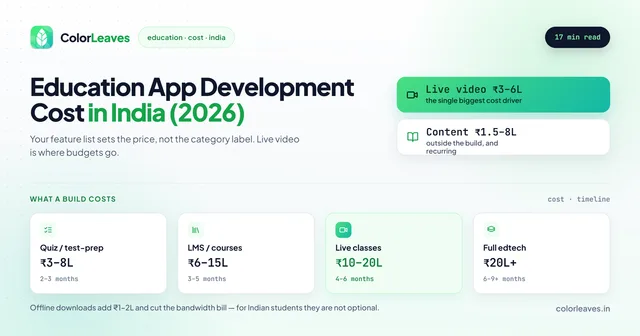
Education products need content. A usable question bank is 3,000 to 10,000 questions with worked solutions, and studio video runs ₹8,000 to ₹25,000 per finished hour, so a 40 hour course is ₹3 to ₹10 lakhs before a student watches it. It also recurs as syllabuses change, and our education app development page covers the build alongside it.
Property marketplaces need listings. A listing app with no listings is a blank screen, so budget for agent onboarding as a sales cost, plus a moderation layer at ₹1.5 to ₹3 lakhs for duplicate detection, reporting and listing expiry. Our real estate app development page covers the rest.
Anything with live video or heavy media carries per-minute or per-gigabyte running costs that scale with success rather than with the build.
The pattern is that the app is often the cheaper half. Work out the recurring cost per user or per transaction before you set pricing, because plenty of products discover the unit economics do not work at exactly the moment volume arrives.
7. Getting Through Review, and Staying There
Apple rejects roughly one in four submissions, so budget a review cycle rather than a review and read why apps get rejected before submitting rather than after. Store accounts should be registered to your company from the start, which our Apple Developer and Play Console guides cover, and setting them up early matters because the D-U-N-S number takes two to four weeks in India.
Then it keeps costing. Both stores change requirements annually, so at least one compliance release a year is mandatory before a single feature is added. Our maintenance cost guide covers the annual figure and a defined support arrangement covers who does it.
How to Reduce App Development Costs
1. Start with MVP
Build a Minimum Viable Product first:
- Ship only the core features
- Prove the idea works before you pour in the full budget
- An MVP runs about 40 to 50% of a full app
- Get real user feedback early
Launching a startup or testing a fresh idea? Our MVP app development services get you live faster for a fraction of what a full-featured app costs.
2. Choose Cross-Platform Development
Look at React Native or Flutter:
- One codebase covers both platforms
- 30 to 40% cost savings
- Faster builds
- Easier to maintain
3. Use Ready-Made Solutions
Lean on what already exists:
- Pre-built UI component libraries
- Third-party APIs and SDKs
- Open-source tools where they fit
- Backend-as-a-Service platforms
4. Prioritize Features
Use the MoSCoW method:
- Must Have: Essential features for launch
- Should Have: Important but not critical
- Could Have: Nice-to-have features
- Won’t Have: Future considerations
5. Choose the Right Development Partner
Work with a developer who:
- Understand your business goals
- Offer transparent pricing
- Have proven track record
- Provide post-launch support
The saving that never works is going to the bottom of the market. Below a certain rate the only way anyone delivers is juniors with nobody reviewing them, and what arrives runs on the developer’s machine and falls over on a three year old handset. The bill turns up later as a rebuild, which costs more than the original because somebody has to understand the existing code first. A fair Indian market rate is a genuine saving; the floor of the market is a deferred invoice.
Four things to settle before the first payment, none of which are about price: that IP assigns to your company at each invoice, that the repository sits in your organisation from the first commit, that the app publishes under your own store accounts, and what you receive if either side walks away. Our guide to who owns your code covers the first two and the contract checklist covers the rest.
If you are still shortlisting, how to hire app developers in India covers the process for overseas buyers and hiring an app developer in Pune covers doing it locally.
Why Choose Color Leaves for Your App Development?
As a trusted mobile app development company in Pune, here’s what you get:
- Competitive Pricing: clear quotes, no hidden costs
- Expert Team: 10+ years in, 50+ apps delivered
- Quality Assurance: thorough testing and QA
- Pune-Based: local support and no timezone gaps
- Full-Service: from first idea through launch and after
Got an app idea? Contact us for a free consultation and a detailed estimate.
Related Guides
Want costs for a specific kind of app? Our e-commerce app development cost guide gives feature-by-feature pricing for shopping apps. New to all this? The step-by-step guide to building your first mobile app walks you through the whole thing. And once the app is built, there’s the publishing costs for Play Store and App Store, a step most cost guides skip entirely.
Planning your schedule? Our app development timeline guide lays out realistic timelines by complexity.
Comparing quotes from different cities? We’ve broken down app development cost in Pune against Bangalore and Mumbai, including what the Tier-1 premium actually buys. And for a sector most cost guides ignore entirely, see what manufacturing companies need from a factory app.
Conclusion
App development in India runs from ₹1 Lakh for a simple app to ₹40+ Lakhs for a complex enterprise build. Where you land depends on your requirements, your platform, your feature set, and who builds it.
Chasing the lowest price rarely works out. Aim for the right trade-off between cost, quality, and time instead. A good development partner helps you spend wisely and still ship something that does what your business needs.
Frequently Asked Questions
How much does a basic app cost in India?
A basic app with standard features (login, profile management, simple functionality) costs ₹1 to 3 Lakhs in India.
Is it cheaper to build an Android or iOS app?
Android comes in a touch cheaper because the dev environment costs less, but the gap is small, around 10 to 15%. For covering both platforms, cross-platform gives you the best value.
How long does it take to develop an app in India?
Simple apps take 2 to 3 months. Medium ones run 3 to 5 months. Complex apps can stretch to 6 to 9 months or beyond.
Should I build an MVP first?
Yes. An MVP lets you test the idea on real users at 40 to 50% of the full cost before you commit to the whole build. Our MVP development cost guide has the pricing and tips on which features to ship first.
What ongoing costs should I budget for?
Budget for annual maintenance (15 to 20% of the initial cost), server hosting (₹5,000 to 50,000 a month), and app store fees. Marketing and user acquisition come on top of that.
Where to Go From Here
The number that matters most is the one attached to your actual scope, not a range in an article. If you’re ready for that conversation, pick the route that fits what you’re building.
Most projects land on cross-platform, and the hybrid app development overview explains why one codebase costs less to maintain than two. From there, React Native suits teams who already write React, while Flutter wins when the interface is your differentiator. If your users are mostly on iPhone, native iOS development is worth costing separately. Businesses buying from within India should look at our Pune development pages, which are priced in rupees.