On-demand apps run a big chunk of daily Indian life now. People order dinner, book a cab, call a plumber, and get groceries in ten minutes, all from their phone. If you’re planning to build the next Swiggy, Uber, or Urban Company style app, the first thing you want to know is the price tag. The honest answer is that it depends on the type of service, the features you ship, and how complex your matching logic gets. But the ranges are predictable once you understand what’s actually being built.
This guide breaks down what an on-demand app costs in India in 2026, sorted by category, with a feature-wise table and a realistic timeline so you can plan your budget and your launch.
At roughly ₹83 to the dollar, those ranges run from about $8,400 to $30,000, which is well under what the same build costs through a US agency. Our breakdown of app development costs in India covers where that gap comes from, and how to hire app developers in India covers what to check before committing to anyone.
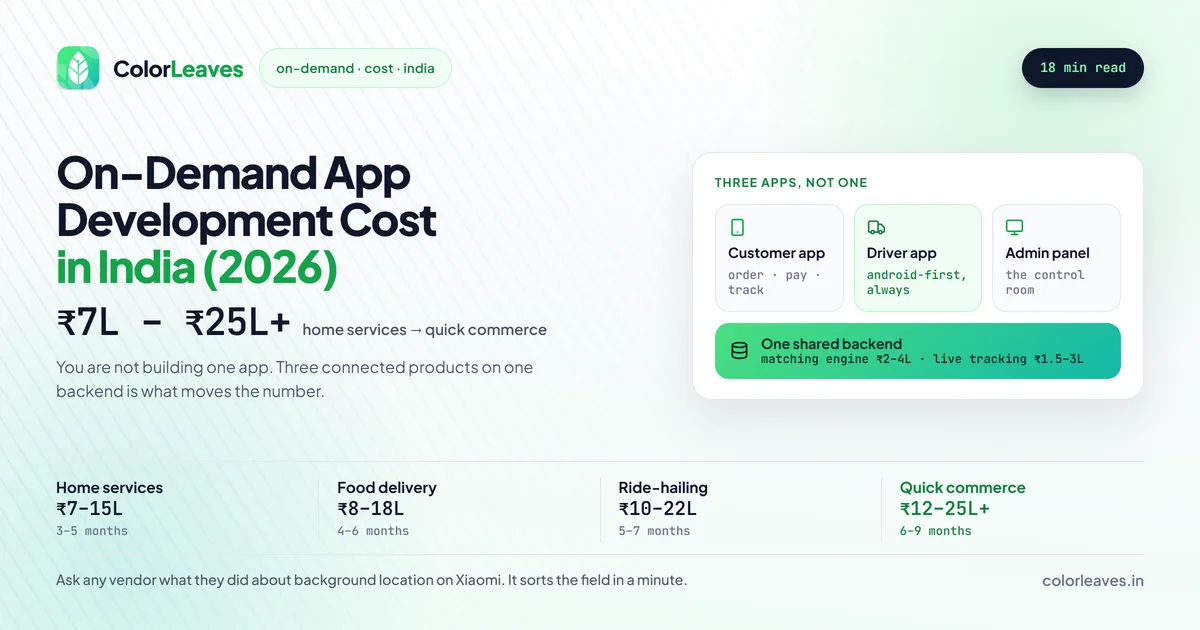
Key Takeaway: An on-demand app in India costs roughly ₹8 to 18 lakhs for a food delivery app, ₹10 to 22 lakhs for a ride-hailing app, ₹7 to 15 lakhs for a home services app, and ₹12 to 25 lakhs or more for grocery and quick commerce. Almost every on-demand product needs three apps, not one, which is what pushes the cost up.
On-Demand App Cost by Type
Every on-demand business solves the same core problem. It connects someone who wants a service with someone who can deliver it, then handles payment and tracking in between. The cost difference comes from the logistics complexity sitting under that simple idea. A cab has to be matched to a rider in real time and tracked across the city. A grocery order has to be picked, packed, and delivered from a dark store in minutes. Those are very different engineering jobs.
Here’s the quick view before we go deeper:
| App Type | Example | Complexity | Estimated Cost | Timeline |
|---|---|---|---|---|
| Home Services | Urban Company | Medium | ₹7 to 15 lakhs | 3 to 5 months |
| Food Delivery | Swiggy, Zomato | Medium to High | ₹8 to 18 lakhs | 4 to 6 months |
| Ride-Hailing | Uber, Ola | High | ₹10 to 22 lakhs | 5 to 7 months |
| Grocery / Quick Commerce | Zepto, Blinkit | High | ₹12 to 25 lakhs+ | 6 to 9 months |
Food Delivery Apps
A Swiggy or Zomato style app costs around ₹8 to 18 lakhs to build. You’re managing three sides at once. Customers browse restaurants and place orders. Restaurants accept and prepare. Delivery partners pick up and drop off. The tricky parts are live order tracking, smart assignment of delivery partners based on distance, and keeping menus and pricing in sync across hundreds of restaurants.
The lower end gets you a clean single-city app with the core ordering flow. The higher end adds scheduled orders, group ordering, loyalty programs, and a recommendation engine.
Ride-Hailing Apps
Ride-hailing is the most demanding category, and the cost reflects that at ₹10 to 22 lakhs. The whole product lives or dies on real-time location. You’re tracking dozens or hundreds of drivers moving across a city, matching them to riders in seconds, calculating fares by distance and time, and applying surge pricing when demand spikes. Maps integration, accurate ETAs, and a driver app that works on patchy mobile networks are all non-negotiable.
If you want features like ride pooling, scheduled rides, or multi-stop trips, you’re looking at the upper part of that range. For a sense of how these numbers compare to apps in general, our complete app development cost guide has the wider picture.
Home Services Apps
An Urban Company style app sits at ₹7 to 15 lakhs, which makes it the most approachable on-demand category to start with. The logistics are gentler. A customer books a service like cleaning, salon, or appliance repair, picks a time slot, and a verified professional shows up. There’s no minute-by-minute GPS race like a cab ride.
What you do need is solid scheduling, a professional verification and onboarding flow, service categorization, and a rating system that builds trust. The cost climbs if you add features like real-time professional tracking on the day of service, in-app chat, or a subscription model for repeat bookings.
Grocery and Quick Commerce Apps
Quick commerce is the priciest at ₹12 to 25 lakhs and up, because the ten-minute promise demands serious backend work. You’re not just connecting two people. You’re running dark stores, tracking inventory in real time, optimizing pick-and-pack workflows, and routing riders for the fastest possible delivery.
This category overlaps a lot with e-commerce. If your model leans more toward a catalog and cart than instant delivery, our e-commerce app development cost guide breaks down those numbers in detail, and our ecommerce app development page covers what that build involves. The dividing line is inventory. If you hold stock and promise a delivery window measured in minutes, you are running logistics. If you list what somebody else holds and promise it in days, you are running a marketplace, and the engineering is considerably cheaper.
The Three-App Architecture
Most first-time founders underestimate this part. When you say “I want to build a food delivery app,” you’re not building one app. You’re building three connected products plus a shared backend. This is the single biggest reason on-demand projects cost more than a standard app.
Customer App
The app your users download. It handles browsing, search, ordering or booking, payments, live tracking, ratings, and support. This is the polished, design-heavy side because it directly shapes whether people come back. It usually takes the largest share of the design budget.
Provider / Driver App
The app for the people fulfilling the service. Drivers, delivery partners, or service professionals use it to receive jobs, accept or reject them, navigate to the destination, update status, and see their earnings. It needs to be fast, battery-friendly, and reliable on weak networks. People often forget this app entirely when they budget, and it’s roughly as much work as the customer app.
Build it Android-first and mean it. Delivery partners and drivers in India are overwhelmingly on budget Android handsets, frequently three or four years old with 3 or 4GB of RAM, and an iOS-first driver app is solving a problem almost nobody has. Our comparison of which platform to launch first covers the general decision, but for the provider side of an on-demand product it is not really a decision.
Admin Panel
The control room. From here your team manages users, providers, orders, pricing, commissions, promotions, disputes, and analytics. It’s usually a web dashboard rather than a mobile app. A weak admin panel will cripple your operations even if both mobile apps are great, so don’t treat it as an afterthought.
All three talk to one backend that holds your business logic, database, payment integration, and the matching engine. Building three coordinated clients on a shared backend is exactly why on-demand sits above a simple single-app project on the cost ladder.
Feature-Wise Cost Breakdown
The features below are what separate a basic booking app from a real on-demand platform. Pricing each one helps you decide what goes into your first version and what waits for later.
| Feature | Cost Range | Notes |
|---|---|---|
| Real-time GPS tracking | ₹1.5 to 3 lakhs | Live location for orders and providers, ETA calculation, map integration |
| Dispatch / matching engine | ₹2 to 4 lakhs | Auto-assigns the nearest driver or provider based on distance and availability |
| Surge / dynamic pricing | ₹1 to 2 lakhs | Adjusts price by demand, time, and zone |
| In-app payments | ₹1 to 2 lakhs | UPI, cards, wallets, COD, plus provider payouts |
| Ratings & reviews | ₹40K to 80K | Two-way ratings for customers and providers |
| Push notifications | ₹40K to 70K | Order status, promotions, driver alerts |
| In-app chat / call masking | ₹80K to 1.5 lakhs | Connects customer and provider without sharing real numbers |
| Scheduling & slot booking | ₹1 to 2 lakhs | Mostly for home services and grocery |
When you bundle these together rather than building them piecemeal, you typically save 15 to 20 percent thanks to shared infrastructure and reusable components. The matching engine and live tracking are the two features that quietly eat the most budget, so plan for them early.
Live tracking is also the feature most likely to disappoint users, because GPS drift and unreliable device hardware make the data messier than the map suggests. We went into why in our look at Pune’s transit apps, where the same problem plays out publicly across thousands of reviews.
The Failure Mode That Kills Driver Apps
This deserves its own section because it is the single most common reason an on-demand product looks broken while every server metric says it is fine.
Your driver app needs to report location continuously in the background. Android manufacturers do not want it to. Xiaomi, Oppo, Vivo, Realme and Samsung each layer aggressive power management on top of Android, and background location is exactly the workload they kill first, often within minutes of the app leaving the foreground.
What the customer sees is a delivery partner frozen on the map. What the driver sees is jobs not arriving. What your support inbox sees is both of them blaming you.
The mitigations are partial and every serious on-demand team knows them. A foreground service with a persistent notification is far harder for the system to kill than background work. Push messages should drive job assignment rather than the app polling. And the driver has to be walked through disabling battery optimisation for your app during onboarding, per manufacturer, because the setting lives somewhere different on each one.
Then you test on actual Xiaomi and Oppo hardware, because no emulator reproduces this. Our piece on Android device fragmentation covers building a device matrix that catches it, and getting driver builds onto real partner phones early through a Play internal testing track is worth more than any amount of office testing.
Budget for this explicitly. It is usually two to four weeks of engineering that nobody quoted for, and skipping it produces an app that demos beautifully and fails in the field.
What It Costs to Run
On-demand apps carry heavier running costs than almost any other category, and these are the numbers that decide whether the business works.
Maps and geolocation. The big one. Google Maps Platform charges per API call across geocoding, directions, distance matrix and map loads. A ride-hailing app calling directions repeatedly during every trip can run ₹4 to ₹15 per completed ride at list pricing. At a thousand rides a day that is ₹1.2 to ₹4.5 lakhs a month. Teams reduce it by caching aggressively, batching distance matrix calls, and moving some routing to open alternatives like OpenStreetMap and OSRM. Design for this at the start, because retrofitting it means rewriting the part of the product that matters most.
SMS and OTP. Roughly ₹0.12 to ₹0.25 per message in India, and an on-demand product sends a lot of them: login OTPs, order confirmations, delivery codes, driver alerts. Ten thousand daily orders at three messages each is ₹1 to ₹2 lakhs a month.
Call masking. Connecting customer and provider without exposing real numbers runs ₹0.50 to ₹1.50 per masked call through providers like Exotel or Knowlarity. Necessary, and it adds up.
Payments and payouts. Gateway fees around 2 percent on collection, plus the cost of paying providers out, which for daily settlement to thousands of delivery partners becomes its own operational system. Anything touching wallets or stored value pulls you into regulated territory, which our fintech development guide covers and our fintech team page covers from the build side.
Servers and maintenance. Real-time systems cost more to run than request-response ones, since connections stay open. Budget ₹30,000 to ₹1.5 lakhs monthly depending on scale, plus 15 to 20 percent of the build cost annually for maintenance or a defined support arrangement.
Work out your cost per completed order before you set commission rates. Plenty of on-demand startups have discovered that every order loses money at exactly the moment volume arrives.
Regulation, Which Is Not Optional in India
Skipped by most cost guides and capable of stopping a launch outright.
Ride-hailing falls under the Motor Vehicles Aggregator Guidelines. Aggregators need a licence from the state transport authority, and the rules cover commission caps, surge limits, driver working hours, and insurance for both driver and passenger. This is state-by-state, so operating in three cities can mean three processes.
Food delivery brings FSSAI into it. The platform registers, and you are expected to verify that listed restaurants hold valid licences. Displaying licence numbers on listings is standard practice for a reason.
Gig worker obligations are tightening. The Code on Social Security brings aggregators into contributing toward worker welfare, and several states have added their own requirements. Whatever your view of it, it is a real cost line and it belongs in the model rather than in a surprise.
None of this is a reason not to build. It is a reason to talk to somebody who knows the sector before you finalise the budget, because a licence you did not plan for is more expensive than any feature on the table above.
Development Timeline
Knowing the timeline lets you line up marketing, hiring, and funding around the launch. On-demand apps take longer than standard apps because of the three-app structure and the real-time systems underneath.
| App Type | Discovery & Design | Development | Testing & QA | Total |
|---|---|---|---|---|
| Home Services | 4 to 6 weeks | 8 to 12 weeks | 2 to 3 weeks | 3 to 5 months |
| Food Delivery | 5 to 7 weeks | 12 to 16 weeks | 3 to 4 weeks | 4 to 6 months |
| Ride-Hailing | 6 to 8 weeks | 14 to 20 weeks | 4 to 5 weeks | 5 to 7 months |
| Quick Commerce | 6 to 9 weeks | 16 to 24 weeks | 4 to 6 weeks | 6 to 9 months |
These assume a dedicated team working on all three apps in parallel. Add a 20 to 30 percent buffer for revisions and the scope changes that always show up once people see the first working build. For a phase-by-phase look at how a project moves from idea to launch, read our mobile app development timeline guide.
A smart way to control both cost and time is to launch in one city with one service category first. Prove the model, fix what breaks, then expand. You don’t need surge pricing and ride pooling on day one. Our MVP costing guide covers scoping that first version so it answers a question rather than just shipping.
One piece of good news on the commercial side. Because you are selling real-world services and physical goods rather than digital content, Apple’s 30 percent in-app purchase cut does not apply to you. Use a normal payment gateway. Teams sometimes implement in-app purchase here out of caution and get rejected for it, which is a genuinely avoidable delay.
Why Build Your On-Demand App in Pune
Pune gives you strong engineering talent at noticeably lower rates than Bangalore or Mumbai, often 40 to 60 percent cheaper for comparable quality, and our city by city rate comparison shows where that difference sits. The IT hubs in Hinjewadi, Kharadi, and Magarpatta have a deep pool of mobile and backend developers. That matters for on-demand apps, where real-time and backend experience makes or breaks the product.
At Color Leaves, we’ve spent over a decade building mobile apps from Pune, including delivery, booking, and marketplace style products. Our on-demand app development team handles all three apps and the backend together, so the matching engine, live tracking, and payments actually work as one system instead of three pieces stitched up at the end. StockGenie is a useful reference point on the real-time side, where getting live data right over unreliable connections was most of the work.
Comparing a few firms first is sensible. Our list of Pune app development companies includes competitors, and how to choose a development company covers what to ask each of them. For on-demand specifically, ask what they did about background location on Xiaomi devices. The answer sorts the field in about a minute.
Frequently Asked Questions
How much does it cost to build an app like Swiggy or Zomato?
A food delivery app in the Swiggy or Zomato style costs roughly ₹8 to 18 lakhs in India. That covers the customer app, the delivery partner app, the restaurant or admin panel, and the backend with live tracking and order assignment. The lower end is a focused single-city launch. The higher end adds loyalty programs, scheduled orders, and recommendation features.
Why is an on-demand app more expensive than a regular app?
Because you’re building three apps, not one. A typical on-demand product needs a customer app, a provider or driver app, and an admin panel, all running on a shared backend. On top of that, real-time GPS tracking and a matching engine are genuinely hard engineering problems. That combination is what lifts the price above a standard single-app project. Our walkthrough of the development process covers how those pieces get sequenced so three clients and a backend arrive together rather than one at a time.
What’s the cheapest on-demand app to start with?
Home services apps in the Urban Company style are the most budget-friendly at ₹7 to 15 lakhs. The logistics are simpler because bookings happen by time slot rather than minute-by-minute GPS matching. It’s a good category to validate an on-demand model without taking on the full cost of ride-hailing or quick commerce.
Do I need real-time GPS tracking for every on-demand app?
Not always. Ride-hailing and food delivery depend on it completely. Home services can launch without live tracking and add it later, since the customer mainly needs to know the professional’s arrival window. Skipping it in your first version is a legitimate way to trim cost and ship faster.
How long does it take to build an on-demand app?
Plan for 3 to 5 months for a home services app, 4 to 6 months for food delivery, 5 to 7 months for ride-hailing, and 6 to 9 months for quick commerce. These include design, development across all three apps, and testing. Launching in one city first can shorten the path to your first real users.
Ready to Build Your On-Demand App?
Maybe you’ve got a delivery idea for your city, or you’re scaling an existing service business onto mobile. Either way, the cost is manageable when you scope it right and launch lean.
We’ll help you map out the customer app, the provider app, and the admin panel, pick the right features for your first version, and build a backend that handles real-time tracking and payments without falling over under load.
Get a free project estimate. Tell us about your on-demand idea, and we’ll send back a detailed proposal with feature-wise pricing and a timeline.
Want to see what we’ve built? Browse our portfolio.
Which Framework Suits Delivery Apps
On-demand products lean hard on live location, background tracking and push. Both cross-platform frameworks handle these well now, though background location on iOS needs care, because the system suspends apps more aggressively than most teams expect.
React Native suits teams with React engineers already on staff. Flutter suits products where the map and tracking interface is the thing customers judge you on. Flutter versus React Native works through the decision properly, and the cross-platform overview covers what either team looks like.
One caveat specific to this category. Background location is the area where cross-platform frameworks lean hardest on native code, so whichever you pick, confirm your team can write and debug a platform channel or native module. That is a question worth asking during interviews rather than discovering in month four, and if you are staffing rather than buying a build, what it costs to hire developers in India covers the rate bands.