Most guides on hiring developers in India are written by people selling developers in India, which is worth remembering while you read this one too. We run an app development team in Pune, so treat the recommendations accordingly and check them against what other vendors tell you. The apps we’ve actually shipped are installable, and you should demand the same proof from everyone else on your list.
What follows is the process we would use if we were on your side of the table, including the parts that make our own sales conversations harder. If you have never shipped a mobile app before, read how an app actually gets built first. Hiring gets much easier once you know what the stages are, because you stop buying job titles and start buying the stage you’re stuck on.
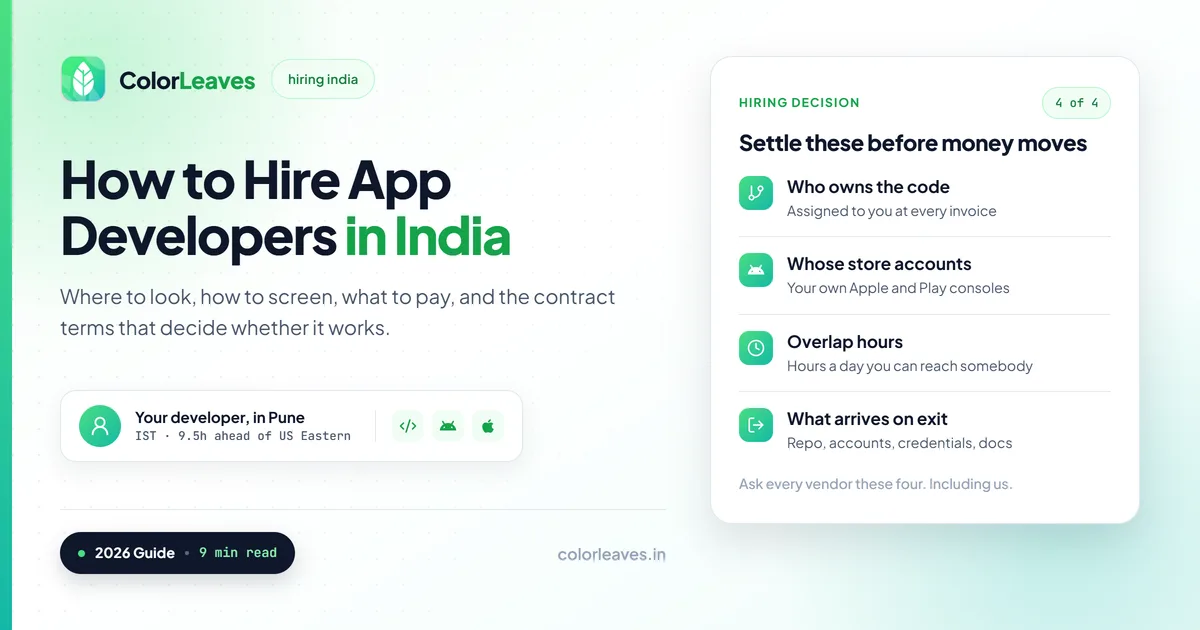
Key Takeaway: The rate is the least useful thing to compare vendors on. Who holds the repository, whose store accounts the app publishes under, how many hours a day you can reach someone, and what you receive on the day you leave will decide the outcome far more than the hourly figure. Get all four in writing before money moves.
Decide What You Are Actually Buying
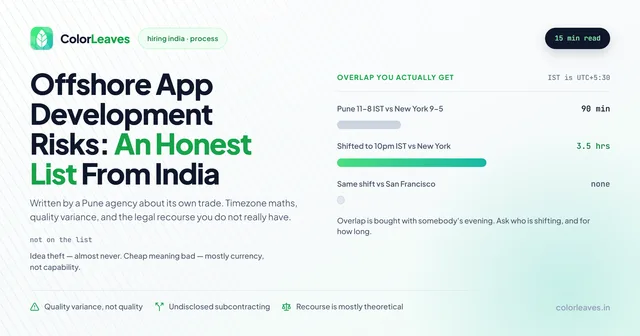
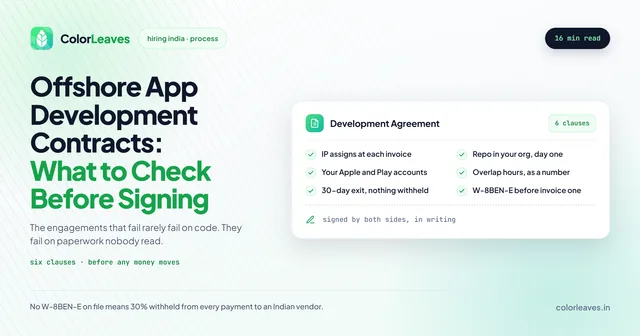
Before any of this, it is worth reading the risks of offshore development written from this side of the arrangement, because a few of them cannot be engineered away and are better known up front. The contract checklist covers what to do about the ones that can.
Three arrangements get described using the same words, and they behave nothing alike. Worse, the same vendor will slide between them inside a single call depending on which one sounds better at that moment. Ask which arrangement the quote covers, then ask what sits outside it. Design work and store submission are the two things most often quoted separately, once you have agreed a number and no longer have anything to bargain with.
A freelancer is one person you engage directly. Cheapest, most flexible, least reliable. Fine for a contained piece of work, or for keeping an existing app alive, which is where most maintenance budgets go. The failure mode is disappearance, because a freelancer with a better offer takes it and nobody owes you a replacement.
A dedicated developer works inside your team on your backlog, employed by somebody else. You direct the work, they handle payroll, hardware and cover. This suits a product with a continuing roadmap and someone technical to point it. Most of the teams we staff for overseas clients run this way.
Fixed-scope delivery hands the whole build to an agency. You buy an outcome rather than hours. This is the right shape when you have no engineering leadership internally, because somebody has to own delivery and it will not be you. In that case how you pick the agency matters more than the rate you negotiate.
Getting this wrong is the most expensive mistake on the list. Companies with no CTO who hire a dedicated developer end up with a capable engineer receiving no direction, and blame the engineer. If you’re still testing whether the idea works at all, scope an MVP first and hire against what you learn.
Where to Look
Marketplaces like Upwork and Guru give you volume and near-zero screening. You are the filter, and if you cannot technically assess a candidate you will pick on price and presentation.
Agencies cost more per hour and pre-screen for you, whether you approach an Android specialist, an iOS shop, or a cross-platform team. The honest tradeoff is that their screening exists to fill seats, so you should still interview.
Referrals from other founders remain the highest-signal route and the slowest. Ask anyone in your network who has shipped an app who built it and whether they would do it again. The second question matters more.
Check the Company Is Real Before You Check the Developer
This step takes twenty minutes and almost nobody does it.
Every Indian company has a Corporate Identity Number, a 21 character string issued at registration. Ask for it, then look it up on the Ministry of Corporate Affairs portal. You’ll see the incorporation date, the registered address and whether filings are current. A firm claiming a decade of work with a CIN issued last year is telling you something useful for free.
Ask for the GST registration number too. It confirms the entity actually transacts, and your accountant will want it on every invoice anyway.
Then compare the team size on the website against the employee count on LinkedIn. A site advertising 50 engineers with 11 people findable is running a subcontractor model, which is not automatically bad but changes who you’re really hiring. Ask directly whether any of the work goes to another firm. The answer to that question, and how quickly it comes, is worth more than the answer itself.
Directory profiles on Clutch and GoodFirms carry verified reviews where the reviewer was contacted independently. Those are worth reading. The unverified ones are worth exactly what any testimonial is worth. Our own listing of app development companies in Pune includes competitors for the same reason, which is that a list containing only us would tell you nothing.
Finally, ask for one client who left. Every vendor has them. A firm that names one and lets you call them is confident about the handover, and handover is where offshore relationships actually fail.
Screen for the Things That Actually Predict Outcomes
Interview the person who will do the work, not an account manager. If a vendor will not put you in front of the engineer, that is the end of the conversation. You are being sold a resource pool.
Ask for shipped work you can open. Not a portfolio grid, an actual store listing you can install. Anyone claiming years of experience with nothing installable behind it is claiming something else.
Run a live session rather than a take-home. Take-homes measure who has free evenings. A live exercise where requirements change halfway tells you how somebody thinks, which is what you are hiring. We keep a set of interview questions for mobile developers that survive this format, and you’re welcome to use them against us.
Ask about a failure. Every engineer who has shipped has a story about a release that went wrong, and they tell it readily. App store rejections are the most common version, and the way somebody describes theirs tells you how they handle a deadline nobody controls. A candidate whose projects all went smoothly has either not shipped much or is managing your impressions.
Test written English deliberately. Most of a remote relationship happens in writing across a large time gap. Someone who cannot write a clear pull request description or escalate a problem without three rounds of clarification will cost you more than their rate suggests, however good the code is.
What It Costs, and Why the Cheapest Quote Is Not
You will see Indian developers advertised from around eight dollars an hour. That number is real and it is worth understanding rather than celebrating.
At the bottom of the market you are buying a junior with nobody senior reviewing their work, because review costs more per hour than the code did. What arrives is software that runs on the developer’s machine and falls over on a three year old handset, which is why testing across real Android devices is the first line item cheap quotes drop. The bill turns up later as a rebuild, and rebuilds cost more than originals because somebody has to understand the existing code first.
Offshore rate surveys for 2026 put Indian firms 50 to 70 percent below US agencies for equivalent work, and our breakdown of app development costs in India shows where that gap actually comes from. It’s cost of living rather than corner cutting. Rates also move by city, which the Pune, Bangalore and Mumbai comparison sets out. The distinction worth holding is between a fair Indian market rate and the floor of the market. The first is a saving. The second is a deferred invoice.
Seniority moves the figure more than anything else. A junior is good value on defined tickets with review. Mid-level suits owning a feature end to end. Senior earns its cost when there is nobody technical above them, or when the product does something genuinely hard. Most teams ask for senior and need mid-level. Our cost to hire mobile app developers in India guide works through the bands in detail.
The Contract Terms That Decide Everything
This section is boring and it matters more than the rest of the page combined.
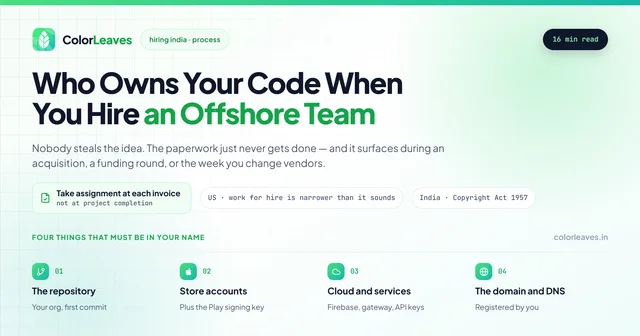
Who owns the code. It should be assigned to your company at each invoice on work-for-hire terms, with the repository in your own organization from the first commit. Paying for code is not the same as owning it in either country, which is worth understanding before you sign, and who owns your code works through why. If code lives with the vendor until handover, you are dependent on a handover that may not go smoothly.
Whose store accounts. Your app should publish under your own Apple Developer account and your own Google Play Console. Both cost less than an hour of development to set up. Publish under an agency’s and the listing, the ratings history, the install base and the right to ship an update belong to them. Leaving means starting over with zero reviews. Ask this question of every vendor including us.
Overlap hours, in your timezone. India is nine and a half to twelve and a half hours ahead of the US depending on coast and season. A vendor working standard India hours overlaps with US Eastern by roughly nothing. Ask how many hours you can actually reach somebody, and ask what happens at 2am their time when production breaks, because that is a support arrangement rather than a development one and it gets priced separately or not at all.
Replacement, with a number attached. Goodwill is not a term. Ask what happens if the fit is wrong, how long a replacement takes, and who pays for the handover between the two people.
What arrives when you leave. Ask what the last departing client received. The answer tells you whether handover is a real process or an improvisation. Vague answers here become your problem later.
W-8BEN-E, if you are American. Your finance team needs this form to pay a foreign vendor without withholding 30 percent of every payment. A vendor who has genuinely worked with US clients has it ready. One who has not heard of it is learning on you.
How the Money Actually Moves
Nobody explains this part until the first invoice is late.
International wires through your bank are the default and the worst option. They take two to five working days, cost 30 to 50 dollars a transfer, and both banks take a cut of the exchange rate that never appears as a fee. On a monthly retainer that’s a rounding error. On weekly payments it’s real money.
Wise and similar services settle in a day at close to the mid-market rate, and most Indian development firms already hold accounts that accept them. Ask before you assume. A vendor who insists on wires when cheaper rails exist is either not set up properly or is making margin on the spread.
Never pay the full amount up front. Never accept a demand to. Splitting payment across milestones is standard, and a reasonable shape is 20 to 30 percent to start, the balance released against working software you can install rather than against a status report. Tie at least one milestone to something in a store’s test track, because a build you can put on your own phone is the only progress report that cannot be written optimistically.
For a first engagement with a firm you don’t know, escrow through the marketplace you found them on is worth the fee. You lose four to five percent and you remove the single largest downside. After a successful project, drop it.
One thing that surprises US buyers: Indian firms invoice in dollars but book in rupees, so a quote held for three months can move by several percent on the exchange rate alone. Fix the currency in the contract, and fix which side absorbs the movement. It’s a two line clause and it prevents an argument. The full cost picture for hiring in India has the rate bands these payments sit against.
The First Month Is the Real Test
Week one produces almost nothing and should. The developer reads code, sets up environments and asks questions. Pushing for output here buys guesses about your conventions instead of understanding of them. If you’re starting from nothing rather than joining them to an existing codebase, the development process sets the order this normally runs in.
Week two should be small real tickets, sized deliberately short. Get a build into TestFlight or Play internal testing this week, even if it does almost nothing, because the release pipeline is the thing that breaks quietly and you want it broken now. The point is not the tickets. It is finding where your onboarding documentation is wrong, because it is wrong somewhere, and better to learn that on a two hour task.
Weeks three and four are the actual assessment. Give them something with genuine ambiguity in it and watch whether they ask or assume. Assuming quietly is the most expensive habit in remote work, and it surfaces here or it surfaces in month four at ten times the cost.
By the end of the month you should be able to answer three questions without hesitating. Does their code clear review without heavy rework. Do they flag problems before you find them. Would you give them something important. If any answer is no, act then.
One month in you’ll also have a real sense of pace, which is the input every schedule after this depends on. Compare what you saw against a normal app development timeline rather than against your own hopes.
Which Stack to Hire For
This depends on your product rather than on fashion. If you haven’t settled it yet, work through choosing a mobile platform before you write a job description, because the wrong answer here costs more than any hiring mistake below it.
Hire React Native developers if you already employ React web engineers. It is the only mobile stack where your existing team can properly review the offshore work, which removes most of the usual offshore risk. Agencies that specialise in it are easy to find, and a React Native company in India will usually quote below a native team for the same scope.
Hire iOS developers when your users are mostly American, since iOS carries roughly 59 percent of that market and monetizes at over twice the rate per install. Swift talent prices higher in India than anything else on this list because the pool is smaller.
Hire Android developers when you are selling internationally, serving price-sensitive users, or shipping to enterprise hardware in the field. India’s Android pool is the deepest of any mobile stack, so these roles fill fastest.
If you genuinely cannot decide, Android or iOS first argues it out on revenue rather than preference.
If both platforms are coming inside a year, one cross-platform engineer usually beats two native ones by a wide margin, because every feature gets written once rather than twice for the life of the product. The choice within that is narrower than it looks, and Flutter versus React Native comes down to what your team can already read. Firms that run Flutter in India tend to have deeper benches than the React Native equivalents, mostly because Google pushed it hard through the Indian training market.
Frequently Asked Questions
These come up in almost every first call. If you’re hiring locally rather than offshore, hiring an app developer in Pune covers the same ground for a market where you can meet people in person.
How long does it take to hire an app developer in India?
Through an agency with people already on staff, about a week for common stacks and longer for anything niche. Recruiting from scratch takes four to eight weeks. Anyone guaranteeing any engineer within 48 hours is either paying people to sit idle or sending whoever is free.
Should we hire a freelancer or an agency?
Freelancer for small contained work where a disappearance would be survivable. Agency when the work runs for months, when continuity matters, or when you want a contractual replacement obligation. The saving on a freelancer rarely survives the first time one vanishes mid-sprint.
How do we manage a developer across a ten hour time gap?
Insist on a shifted schedule that produces real overlap, put every decision-shaped conversation inside it, and make everything else async by default. Written standups, pull requests with context in the description, and recorded walkthroughs instead of live demos. The gap is manageable. Pretending it does not exist is not.
What does it cost to hire an app developer in India?
It depends far more on seniority and stack than on any published rate card. Native Swift and Kotlin price higher in India than cross-platform because the pools are smaller. What we can say is that a rate materially below the Indian market average is a signal rather than a bargain.
Can we start small and scale up?
Yes, and you should. A two week paid pilot on real backlog work tells you more than any interview. Scoping that pilot as an MVP with a defined cost keeps it honest. If you plan to scale later, say so early so the first engineer documents conventions as they go rather than keeping them in their head.
What happens to the app after launch?
Somebody has to keep shipping. Operating systems update twice a year, certificates expire, and libraries you depend on get abandoned. Budget for it from the start, because retro-fitting a support arrangement after the build team has moved on costs more than keeping one person engaged would have.
Where to Start
If you know the stack you need, go straight to the relevant page above. If you are not sure yet, our hire app developers in India guide covers the arrangements, the red flags and the process in more depth, and includes the questions worth asking any vendor before you sign.
If you’d rather just talk it through, tell us what you’re building and we’ll tell you whether we’re the right fit. Sometimes we aren’t, and it’s cheaper for everyone to find that out on a call.