The development company you pick decides whether your app ships on time or drags on for a year. Thousands of firms call themselves the best, so the hard part is telling the genuinely capable ones apart. This guide walks you through how to do that.
If you already know you want a Pune team, hiring an app developer in Pune covers that market specifically, including where the candidates actually are. This guide is the general version, and the four questions near the end are the ones worth asking whoever you end up talking to.
Key Takeaway: Pick a mobile app development company by checking five things: a portfolio of shipped apps in your category, a clear development process, responsive communication, transparent pricing, and reliable post-launch support. Spend a few weeks vetting partners against these before you commit.
Why Your Choice of Development Company Matters
The mobile app development company you choose directly impacts:
- Product quality - A skilled team builds reliable, performant apps
- Timeline - Experienced companies deliver on schedule
- Budget - Poor choices lead to cost overruns and rework
- Long-term success - The right partner provides ongoing support and updates
A bad choice wastes money, sure, but it also burns months you won’t get back, and a buggy app in front of real users can dent your reputation. Spending a few weeks vetting partners properly pays for itself many times over.
Key Factors When Choosing a Mobile App Development Company
1. Experience and Track Record
Look for companies with proven experience in your app category:
Questions to consider:
- How many apps have they built and launched?
- Do they have experience in your industry (healthcare, e-commerce, fintech)?
- How long have they been in business?
- What’s their client retention rate?
A company with 50+ apps under their belt has likely encountered and solved problems similar to yours. They’ve learned from mistakes and refined their processes over time.
Industry experience is worth probing specifically, because the hard parts of a build are usually domain rather than technical. A team that has shipped fintech knows what RBI compliance does to a schedule. A team that has shipped healthcare knows what a consent flow has to capture and why deletion is harder than it sounds. The same holds for ecommerce and returns, education and content production costs, on-demand and background location on Android, real estate and RERA fields. General app experience is not a substitute for any of it.
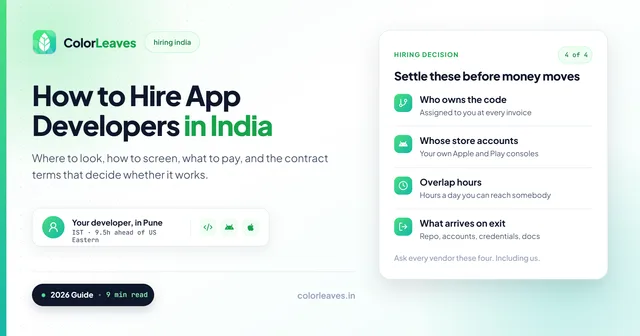
Verify the company exists as a legal entity while you are at it. Every Indian company has a Corporate Identity Number and its filings are public through the Ministry of Corporate Affairs. It takes twenty minutes and almost nobody does it. Our guide to hiring app developers in India walks through that check alongside comparing claimed headcount against what you can actually find on LinkedIn.
2. Portfolio Quality
Don’t just count projects. Test them:
- Download their apps from the App Store or Play Store
- Test the user experience - Is it smooth? Intuitive?
- Check ratings and reviews - What do real users say?
- Look for variety - Can they handle different types of apps?
A strong portfolio proves more than any sales pitch ever will. If their published apps feel polished, yours probably will too. Ask to see their portfolio. Any reputable company will be glad to show off its best work.
Then go one step further than most people do. Install one, use it for ten minutes, and ask them what they would fix. A team that cannot criticise its own shipped work either has not thought about it since delivery or was not really responsible for it. Ours is StockGenie, and we will happily tell you what we would do differently.
3. Technical Expertise
Ensure they have the right skills for your project:
For Android apps:
- Kotlin and Java proficiency
- Material Design implementation
- Android SDK and Jetpack components
For iOS apps:
- Swift and SwiftUI expertise
- Human Interface Guidelines knowledge
- App Store submission experience
For cross-platform apps:
- React Native or Flutter expertise
- Native module integration capability
- Platform-specific optimization skills
Ask about their technology stack and why they recommend specific solutions. A good company explains technical choices in terms you understand, not jargon meant to impress. Watch for the firm that recommends the same stack to everyone, which usually means they are selling what they have rather than what you need. Flutter versus React Native covers the tradeoffs well enough that you can tell a reasoned answer from a habit.
You can assess this yourself without being technical. Our interview questions for mobile developers are written to be usable by someone who cannot read code, and the trick is grading on specificity rather than correctness. Strong answers carry names, numbers and consequences. Weak ones stay general.
4. Team Composition
Understand who will actually work on your project:
- Dedicated project manager - Your single point of contact
- UI/UX designers - Creating the visual experience
- Developers - Building the functionality
- QA engineers - Testing for quality
- DevOps specialists - Managing deployment and infrastructure
Be wary of companies that assign one person to do everything. Quality apps require specialized skills that no single person possesses. Design in particular is a different discipline from engineering, and a developer producing their own screens is usually a false economy that shows up in the finished product.
Ask two follow-ups here. Who else has worked on this account in the last year, because rotation is the thing agencies do not volunteer and a project that has passed through four engineers has lost most of its context. And what happens if the person assigned to us leaves, with a number attached to the answer rather than an assurance.
5. Development Process and Methodology
Professional companies follow structured processes:
Look for:
- Clear project phases (discovery, design, development, testing, launch)
- Regular milestone deliveries
- Agile or Scrum methodology for flexibility
- Defined QA and testing procedures
- Documentation standards
Ask them to walk you through how they’d approach your project. If they can’t clearly explain their process, that’s a warning sign. Our walkthrough of the development process sets out what should happen at each phase, so you have something to compare their answer against rather than taking it on trust.
Two specifics worth asking about, because they are where corners get cut. What does your testing look like, and does it involve real devices rather than emulators, since Android fragmentation causes most of the problems that generate one star reviews. And do you run a beta before submission, because a proper beta is the cheapest quality step available and the first one dropped when a build runs late.
Ask for documentation from a finished project too. Not a template, an actual one. A firm that produces none is running on memory, and memory leaves when people do.
6. Communication and Transparency
Good communication prevents problems:
- Response time - How quickly do they reply to inquiries?
- Communication channels - Slack, email, video calls?
- Update frequency - Weekly demos? Daily standups?
- Reporting - Progress reports and documentation?
During your initial conversations, note how they communicate. Are they clear and responsive? Do they ask good questions about your needs? First impressions often reflect how the entire engagement will go.
7. Pricing and Value
Understand their pricing model:
| Model | Best For | Considerations |
|---|---|---|
| Fixed Price | Well-defined projects | Less flexibility for changes |
| Time & Material | Evolving requirements | Requires close monitoring |
| Dedicated Team | Long-term projects | Higher commitment |
Important: The cheapest option is rarely the best. Extremely low quotes often mean inexperienced developers, poor quality, or hidden costs later. Focus on value rather than just price. Judge a quote against what the market actually charges rather than against the other quotes in front of you, which our app development cost guide and the Pune, Bangalore and Mumbai comparison both help with.
How to Read a Proposal
Comparing proposals is the part everyone finds hardest, mostly because firms do not present the same things.
Look at what is excluded rather than what is included. Design revisions, store submission, the backend, third-party service fees and post-launch support are the five things most often quoted separately after a headline number has been agreed. Ask for each explicitly.
Check the change request mechanism, because you will use it, on every project, usually within six weeks. How is a change priced, at what rate, and do you see an estimate before work starts. A proposal silent on this is not simpler, it is vaguer.
Look for caveats. An estimate with no assumptions attached is a warning rather than confidence. Compare the timeline you are given against a realistic development timeline and treat anything dramatically shorter as a question rather than an advantage.
Check whether the number matches the scope. If your requirements are still loose, a fixed price is priced for the worst case or it is priced for a scope you have not agreed. Scoping deliberately as an MVP is the honest way to make fixed price work, and our MVP development page covers how those run.
How to Actually Check a Reference
Most people ask for references, take the call, hear something positive and move on. The call is only useful if you ask better questions.
Ask what went wrong, because something did. Ask how it was handled and how long it took. Ask whether the team that started the project is the team that finished it. Ask what the handover looked like at the end. And ask the one that produces the most honest answer: would you use them again for something bigger.
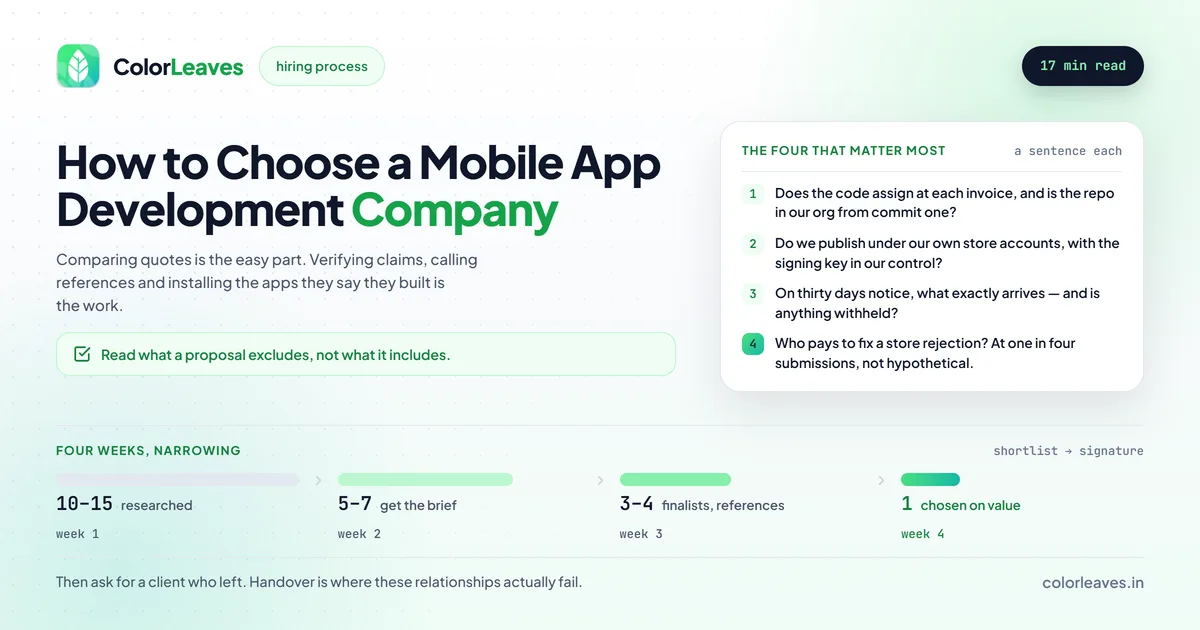
Then ask for a client who left. Every firm has them. A company that names one and lets you call them is confident about the handover, and handover is where these relationships actually fail.
Evaluation Checklist: Step by Step
Step 1: Research and Shortlist (Week 1)
- Define your project requirements clearly
- Set your budget range
- Research 10-15 potential companies
- Review their websites and portfolios
- Shortlist 5-7 companies for outreach
Step 2: Initial Contact (Week 2)
- Send your project brief to shortlisted companies
- Evaluate their responses (speed, quality, questions asked)
- Narrow down to 3-4 serious candidates
- Schedule discovery calls
Step 3: Deep Evaluation (Week 3)
- Conduct detailed discussions with each finalist
- Request and review proposals
- Check references from past clients
- Ask for case studies relevant to your project
- Evaluate their cultural fit with your team
Step 4: Final Selection (Week 4)
- Compare proposals on value, not just price
- Negotiate terms if needed
- Review contract carefully
- Make your selection
- Start the engagement with clear expectations
Red Flags to Avoid
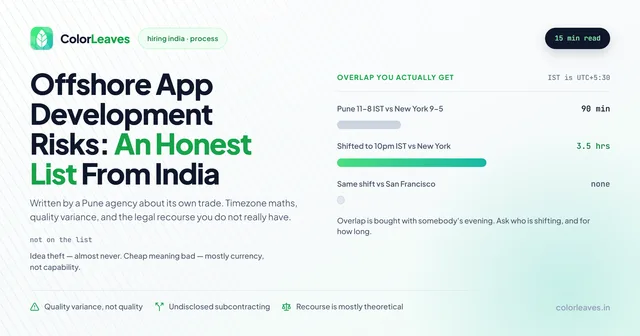
If the company you are considering is offshore, the risks specific to that arrangement are worth reading alongside this list.
Be cautious if you notice:
Warning Signs in Communication
- Slow or unprofessional responses
- Vague or evasive answers to direct questions
- Pressure tactics to sign quickly
- No direct access to technical team
Portfolio Concerns
- No live apps to demonstrate
- Claims of building famous apps without proof
- Reluctance to provide client references
- Very recently established company
Business Practice Issues
- Unrealistically low quotes (too good to be true)
- Demanding full payment upfront
- No formal contract or unclear terms
- Hidden costs revealed after signing
Technical Red Flags
- One-size-fits-all recommendations regardless of requirements
- No questions about your specific needs
- Overpromising features or unrealistic timelines
- Lack of testing or QA process
Questions to Ask Potential Partners
About Their Experience
- How many mobile apps have you developed and launched?
- What industries do you specialize in?
- Can you share case studies similar to my project?
- What’s your team’s average experience level?
About Your Project
- How would you approach building this app?
- What technology stack do you recommend and why?
- What’s your estimated timeline?
- What could affect the timeline or budget?
About Their Process
- How do you handle requirement changes mid-project?
- What’s your testing and QA process?
- How often will we have progress meetings?
- What documentation do you provide?
About Business Terms
- What’s included in your pricing?
- What’s the payment schedule?
- What happens if the project goes over budget?
- What post-launch support do you offer?
The Four That Matter Most
None of the questions above decide whether you own what you paid for. These do, and they take a sentence each to answer.
Does the code assign to us at each invoice, and will the repository sit in our organisation from the first commit? Assignment at project completion sounds reasonable until you consider when ownership actually matters, which is a dispute at month four. Paying an invoice does not transfer copyright by itself in either US or Indian law, and our guide to who owns your code explains why.
Will the app publish under our own store accounts, with the signing key in our control? Register the Apple Developer account and the Google Play Console in your company’s name before development starts. It costs the same either way and takes ten minutes at the beginning. Published under an agency’s account, the listing, ratings history and right to ship an update belong to them.
On thirty days notice, what exactly do we receive, and is anything withheld pending payment? Ask what the last departing client actually got. A concrete answer means handover is a process; a vague one means it is an improvisation.
Who pays to fix a store rejection? At roughly one in four submissions this is not hypothetical, and fixing a guideline violation should sit inside the engagement rather than arrive as a change request. Our guide to why apps get rejected covers what those violations usually are, and most of them are things a competent team would have caught before submitting.
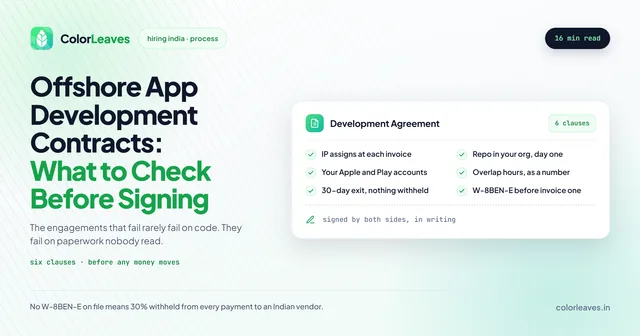
Our contract checklist covers all four alongside the commercial terms. It is written for offshore engagements and every item applies equally to a local one.
Company vs Freelancer vs Agency
| Factor | Freelancer | Small Agency | Established Company |
|---|---|---|---|
| Cost | Lowest | Medium | Higher |
| Skill Range | Limited | Moderate | Full in-house |
| Reliability | Variable | Moderate | High |
| Scalability | Low | Medium | High |
| Support | Limited | Moderate | Contracted |
| Best For | Simple apps | Small projects | Complex apps |
For serious business applications, an established development company typically offers the best balance of reliability, quality, and long-term support. Learn more about hiring options, or hiring app developers in India if you are outside the country and weighing an offshore team.
The honest caveat on that table is that the categories leak. Plenty of small agencies subcontract to cover a skill they lack, which turns them into a broker without saying so. Ask directly, in writing, whether any part of the work will be done by anyone outside the company you are contracting with. Reputable firms answer this without hesitating, and the reaction to being asked is informative on its own.
Why Choose Color Leaves
As a leading mobile app development company in Pune, we embody the qualities you should look for in a mobile app development company:
Proven Experience
- 10+ years in mobile app development
- 50+ successful apps launched
- Clients across e-commerce, healthcare, logistics, and more
Technical Excellence
- Expert Android, iOS, and React Native developers
- Modern development practices and clean code
- Thorough testing on real devices
Transparent Process
- Clear project phases and milestones
- Weekly demos and progress updates
- Detailed documentation
Pune Advantage
- Local presence for face-to-face meetings
- Competitive pricing with high quality
- No timezone communication issues
Post-Launch Support
- Bug fixes and maintenance packages
- Performance monitoring
- Feature updates and enhancements
Ready to discuss your app idea? Contact us for a free consultation. We’ll help you understand the scope, timeline, and investment needed to bring your vision to life. You can also browse our portfolio to see the quality of work we deliver before getting in touch.
Conclusion
Comparing quotes is the easy part. The work that actually protects you is verifying claims, calling references, and downloading the apps a company says it built. Do that before you sign anything.
A good partner acts like part of your team. They ask sharp questions, tell you when an idea won’t work, and ship on schedule. A bad one drains your budget, blows past deadlines, and hands you an app your users won’t keep. The difference usually shows up in the first few conversations, so pay attention early.
Related Guides
For a ranked list of Pune-based options, see our top 10 mobile app development companies in Pune. If you’re considering hiring individual developers instead, read how to hire app developers in Pune. And once you’ve picked a partner, our step-by-step guide to building your first app will help you prepare for the development journey.
Frequently Asked Questions
How do I choose a mobile app development company?
Evaluate five things: their portfolio of shipped apps, their development process, how well they communicate, their pricing, and their post-launch support. Check references and test their existing apps before you commit.
What should I look for in an app development company’s portfolio?
Look for variety in app types, apps that are live on app stores with good ratings, smooth user experiences, and projects similar to yours. Download and test their apps yourself rather than just looking at screenshots.
How much does it cost to hire a mobile app development company?
In India, costs range from Rs. 1-3 lakhs for simple apps to Rs. 15-40 lakhs for complex applications. Focus on value rather than finding the cheapest option, as quality directly impacts your app’s success. Our cost to hire developers in India guide covers the rate bands if you would rather staff a team than buy a build.
What ongoing support should we expect after launch?
At minimum, bug fixes for an agreed warranty period and a compliance release each year, since both stores raise their requirements annually whether or not it suits your roadmap. Budget 15 to 20 percent of the build cost per year, which our maintenance cost guide breaks down, and agree a defined support arrangement with response times before launch rather than during an incident. A proposal that ends at launch has quietly made all of this your problem.
Should I choose a local or remote development company?
Both can work well. Local companies offer easier face-to-face communication, while remote companies may offer cost advantages. The key is finding a company with strong communication practices regardless of location.
How long does it take to develop a mobile app?
Timelines range from 2-3 months for simple apps to 6-9 months for complex applications. An experienced company provides realistic estimates and explains factors that could affect the timeline.