If you’re getting quotes for an app in India, you’ve probably noticed the same build coming back at noticeably different prices depending on which city the agency sits in. A quote from Koramangala reads higher than a quote from Baner for what looks like identical work.
The gap is real. It’s smaller than most people assume, it has almost nothing to do with engineering quality, and understanding what drives it will tell you a lot about which quote in front of you is actually the good one.
Here’s what the difference looks like in 2026, where it comes from, and when paying the premium is the right call.
If you’re reading this from outside India, skip to the section near the end written for you. The city gap matters to Indian buyers and is close to noise against the gap between India and the West, so the decision you are actually making is a different one, and our guide to hiring app developers in India covers it.
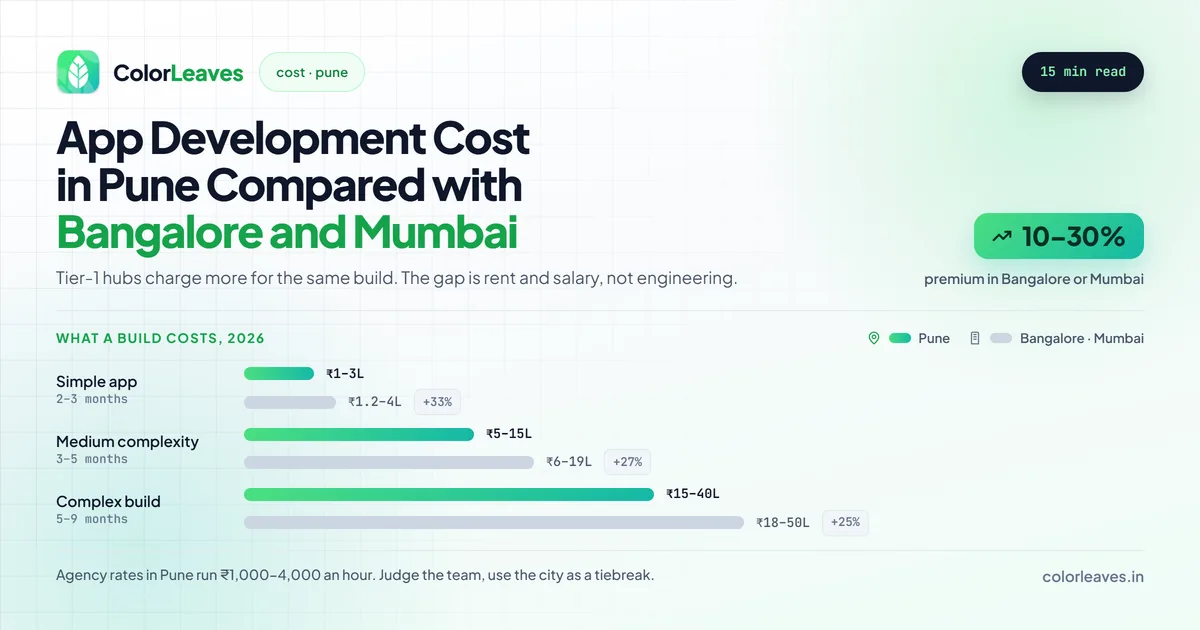
Key Takeaway: Agencies in Bangalore and Mumbai typically charge 10 to 30% more than agencies in Pune for comparable work. The gap is driven by salary and office costs in those cities, not by capability. A medium complexity app that runs ₹5 to 15 lakhs in Pune will usually land somewhere between ₹6 and 19 lakhs in a Tier-1 hub.
The Actual Numbers
These are our published Pune ranges, which are in line with what the market here charges. The Tier-1 column applies the premium those cities are documented to carry.
| App type | Pune | Bangalore or Mumbai | Timeline |
|---|---|---|---|
| Simple app | ₹1 to 3 lakhs | ₹1.2 to 4 lakhs | 2 to 3 months |
| Medium complexity | ₹5 to 15 lakhs | ₹6 to 19 lakhs | 3 to 5 months |
| Complex or enterprise | ₹15 to 40 lakhs | ₹18 to 50 lakhs | 5 to 9 months |
| Advanced or custom | ₹40 lakhs and up | ₹48 lakhs and up | 9 months and up |
On an hourly basis, agency rates in Pune generally run ₹1,000 to ₹4,000 per developer depending on seniority and stack. Freelancers sit lower, roughly ₹500 to ₹2,000. Equivalent agency rates in Bangalore and Mumbai sit above that band by a similar 10 to 30%.
Treat every one of these as a starting point rather than a price. Two agencies quoting the same number can mean very different things by it, which is the section further down that matters more than this table.
One thing the table does not show is the split within a project. Roughly speaking, design takes 15 to 20 percent, frontend 35 to 45, backend 25 to 35, and testing and release the rest. That matters when you compare quotes, because a number that looks low is often low by exactly the amount of one of those. Our app development cost guide for India breaks the same ranges down feature by feature, and what it costs to hire developers covers the rate side of the same equation.
The Other Tier-2 Cities
Pune is not the only option below the Bangalore and Mumbai line, and a comparison that pretends otherwise is not much of a comparison.
Ahmedabad, Indore, Jaipur, Coimbatore and Kochi all have real development industries and generally price at or below Pune. Hyderabad and Chennai sit in between, closer to Bangalore on rate but usually a little under it. If your only criterion is the lowest hourly number, several of those will beat a Pune quote.
What Pune has, and it is a genuine rather than a marketing difference, is depth per rupee. The city hosts large engineering operations for a long list of multinationals, which means a steady supply of engineers who have worked to enterprise standards before joining smaller studios. It also has an unusual concentration of domain-heavy work because of the manufacturing belt to the north, so teams here have more exposure to industrial, logistics and offline-first problems than a purely consumer market would produce.
The honest summary is that Pune sits at a good point on the curve rather than at the bottom of it. If you want the cheapest possible hourly rate in India, you can find it elsewhere. If you want the best ratio of capability to cost, Pune is a strong answer and so are one or two of the others. Judge the team, and use the city as a tiebreak.
Why Bangalore and Mumbai Cost More
The premium isn’t arbitrary, and it isn’t margin. It’s mostly salary.
Software engineers in Bangalore earn roughly ₹20 to 35 lakhs a year on average, with the city carrying a documented premium of 30 to 40% over the national average. Mumbai sits at about ₹18 to 30 lakhs. Pune runs closer to ₹15 to 25 lakhs. An agency has to pay those salaries before it can quote you anything, so the difference lands in your invoice whether or not anyone mentions it.
Office cost does the rest. Commercial rent in central Bangalore and in Mumbai is among the highest in the country. Pune’s IT corridors, Hinjewadi, Kharadi, Magarpatta, cost meaningfully less per square foot, and that shows up in overhead.
There’s a third factor nobody puts in a proposal. Attrition in Bangalore is high because the density of employers makes switching easy. An engineer who leaves mid-project takes context with them, and the replacement spends weeks getting up to speed on your codebase. You pay for that in schedule rather than in rupees, and it’s a genuine risk on longer builds.
Ask about it directly rather than assuming a city-level statistic applies to the specific firm in front of you. Ask what their attrition looks like, how long the people assigned to you have been there, and what happens when somebody leaves. Treat “that doesn’t happen here” as a poor answer, because it happens everywhere. It’s on our list of offshore risks as one of the more manageable ones, and the structural defence is that the work should not depend on anybody remembering things.
What the Premium Does Not Buy
This is the part worth being blunt about, because a lot of buyers assume price signals quality.
The talent pool is substantially the same. Pune’s engineering colleges, COEP, MIT, Symbiosis and the rest, feed the same national market that Bangalore hires from. The large IT services firms in Hinjewadi are the same companies with offices in Whitefield. Engineers move between these cities constantly, often several times in a career. There is no meaningful Pune version of a React Native developer that differs from a Bangalore version.
The tooling is identical. Everyone is using the same frameworks, the same cloud providers, the same CI pipelines. Nothing about a Bangalore postcode changes what Flutter can do, and the Flutter versus React Native decision has the same answer in every city.
So on a straightforward build, a shopping app, a booking platform, a field service tool, a marketplace, the premium buys you very little that you can point at. StockGenie is a reasonable example of the point: a React Native finance app built from Pune in two months, live with a 4.5 rating, and nothing about it would have been different from a more expensive postcode.
When Paying More Actually Makes Sense
Being fair about the other side of this.
Bangalore has genuinely deeper pools in a few specialist areas. If you need people who’ve built at serious scale, tens of millions of users, or you’re doing something unusual in machine learning, or you want a team that has shipped inside a regulated fintech at size, the density of that specific experience is higher there. Not unavailable elsewhere, just easier to find. Note the qualifier though: at size. The compliance work our fintech cost guide describes, RBI requirements, eKYC, security audits, is done routinely by teams in every Indian city. What concentrates in Bangalore is experience of doing it at a scale most products never reach.
Mumbai has an advantage if your product lives close to the financial sector or to media and entertainment, simply because the domain knowledge and the client relationships concentrate there.
And if your investors, your board or your key customers are in one of those cities and expect regular in-person contact, that’s a real consideration. Proximity has value even in 2026.
Outside those cases, the premium is buying you a postcode.
The Comparison That Matters More Than City
Here’s the thing that catches out most first-time buyers. Two quotes for “a mobile app” at ₹8 lakhs and ₹14 lakhs are often not quotes for the same work at all, and the difference between them will dwarf any city premium.
Check these before you compare anything else.
What’s actually in scope. Does the number include design, or is that separate? Backend and admin panel, or just the app? One platform or both? An ₹8 lakh quote for Android only against a ₹14 lakh quote for Android, iOS, backend and an admin dashboard is not a price difference. Store submission is the other item routinely left out, and our app publishing cost guide covers what that involves.
Who is on the team, and for how long. A quote built on two junior developers and a quote built on a senior developer with a designer and a QA engineer will produce different software. Ask for the composition, not just the total. Then ask to meet them, and use our interview questions even if you are not technical, since grading on specificity works without reading code.
Who owns the code. Get it in writing, assigning at each invoice rather than at project completion, with the repository in your organisation from the first commit. This still goes wrong often enough to be worth the sentence, and who owns your code explains why paying an invoice does not move copyright by itself.
What happens after launch. Bug fixes for how long, at what cost, and does anyone answer the phone in month four? Post-launch support is where cheap quotes usually recover their margin. Our guide on app maintenance cost covers what to budget, and a defined support arrangement agreed before launch costs less than one negotiated during an incident.
How change is handled. Every project changes. An agency with no answer for how scope changes get priced is an agency that will surprise you later. Ask at what rate, whether you see an estimate before work starts, and who is allowed to approve one, which our contract checklist covers along with the rest of the commercial terms.
Whether the timeline is real. A quote promising a complex build in six weeks is either misunderstanding the work or planning to cut something you’ll notice. Our timeline guide sets out what each phase actually takes.
Which platform approach it assumes. A cross-platform build covering both Android and iOS from one codebase prices differently from two native apps, and the quote should say which it is. If it does not, that is worth resolving before you compare anything, and our guide to choosing a mobile platform covers which is right for your case. A quote assuming native Android only and a quote assuming both platforms are answering different questions.
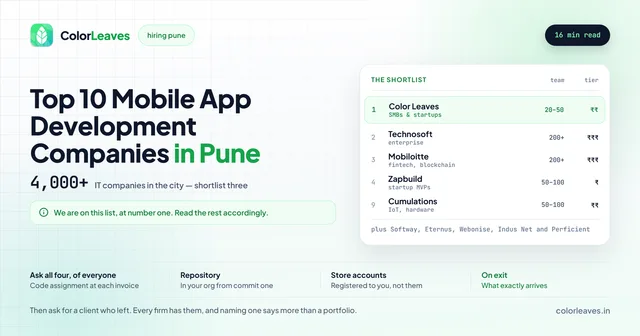
If you want the fuller version of this, we’ve written a longer piece on how to choose a mobile app development company, and a Pune-specific one on hiring an app developer here. We also maintain a comparison of the top app development companies in Pune if you’re building a shortlist.
Does the City Even Matter Anymore?
Less than it used to, honestly. Most agencies work with clients remotely as a matter of course now, and a competent team delivers fine over video calls and shared boards.
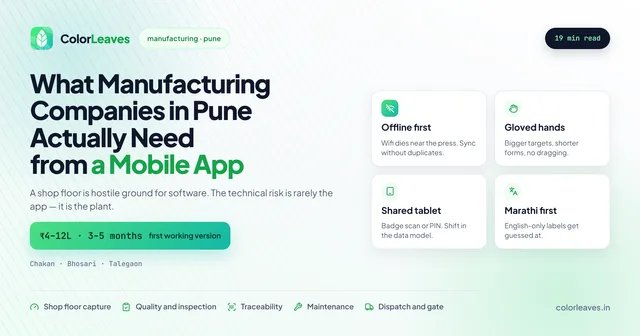
Where being local still counts is when the work needs someone physically present. Factory and warehouse apps where a developer has to watch the actual process. Retail rollouts across stores. Anything involving hardware, scanners, kiosks or devices mounted in a real environment. Field trials with your actual staff. If your project involves any of that, a team in your city saves you real time, and we’ve written separately about what manufacturing companies in Pune need from an app where this comes up constantly.
For a standard consumer or business app, pick the team, not the city.
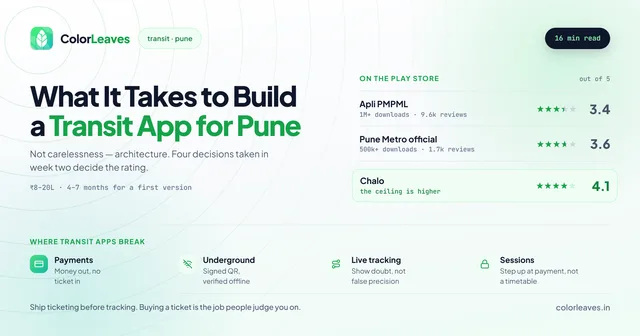
There is one more case where being local pays, and it applies more often than the hardware examples. If your product needs testing with people who resemble your actual users, being able to put a build in front of them in person is worth a great deal. Our piece on Pune’s transit apps covers a category where that is the entire difference between a 3.4 star app and a 4.1 star one, and running a proper beta covers how to do it wherever your team sits.
If You Are Reading This From Outside India
The city comparison above is a domestic question, and the numbers change shape entirely once you are converting from dollars or pounds.
At roughly ₹83 to the dollar, that medium-complexity band of ₹5 to 15 lakhs is about $6,000 to $18,000 in Pune and $7,200 to $22,900 in Bangalore. Both sit 60 to 80 percent below what a comparable US agency quotes. Against that, a 10 to 30 percent difference between Indian cities is a rounding error, and optimising for it is the wrong thing to spend your attention on.
What deserves your attention instead is everything that has nothing to do with rate. How many hours a day you can actually reach the team, which for the US is bought with somebody’s evening. Whether the code assigns to you at each invoice. Whose store accounts the app publishes under. What arrives if you walk away. Our honest list of offshore risks covers the ones no clause removes, and hiring app developers in India covers how a dedicated arrangement actually runs.
The one thing worth taking from the city comparison is that a quote from a Tier-1 Indian city is not better work, so do not read a higher Indian price as a quality signal the way you might at home.
Common Questions
Is app development in Pune cheaper than Bangalore? Usually by 10 to 30% for comparable work. The gap comes from salary and office costs rather than from any difference in engineering standards.
Does a lower price mean lower quality? Not between cities. It can absolutely mean lower quality between agencies, which is why comparing what’s in the scope matters far more than comparing which city the invoice comes from.
What does a simple app cost in Pune? Around ₹1 to 3 lakhs over 2 to 3 months for something focused with a small feature set. Our full app development cost guide for India breaks it down by feature.
Should I use a freelancer instead to save money? For a small, well-defined piece of work, often yes. For a full product with a backend, ongoing releases and someone accountable when something breaks at 11pm, the saving usually reverses within a year. We compared the two properly in our piece on the cost to hire app developers in India.
Can I start smaller to reduce the number? Yes, and most people should. Building a focused first version, seeing how real users behave, then expanding is both cheaper and less risky than specifying everything upfront. That’s the reasoning behind an MVP build.
Are Pune agencies smaller than Bangalore ones? On average, yes, though the range is wide. Whether that matters depends on your project. A smaller team usually means the people who sold you the work are the people doing it, which most clients end up preferring.
What We’d Suggest
Get three quotes. Make sure all three are quoting the same scope, which usually means writing the scope down yourself first rather than letting each agency define it. Then compare team composition, ownership terms and post-launch commitments before you compare totals.
Writing that scope is the most valuable hour you will spend on this, and most buyers skip it because they expect the agency to do it. The problem is that three agencies scoping independently produce three different projects, and then you are comparing prices for different things. It does not need to be technical. A list of what a user can do, screen by screen, in plain language, is enough to make quotes comparable. Our walkthrough of the development process covers what a proper discovery phase adds on top of that, and if the answer is that you do not know the scope yet, that is a reason to start with an MVP rather than a reason to let somebody else decide it.
If two quotes come back genuinely equivalent and one is 20% cheaper because it’s from Pune rather than Bangalore, take the cheaper one. That gap is rent and salary, not capability.
We build apps from Pune for clients here and across India. If you want a straight estimate for what you’re planning, with the scope written out so you can compare it properly against anyone else’s, tell us what you’re building and we’ll put one together. You can also look through our work to see the kind of projects we take on.