Every week, we talk to founders who have a brilliant app idea but a limited runway. They want to build everything in version one: chat, payments, analytics, social features, AI recommendations. And every time, our advice is the same: don’t. Build an MVP first.
An MVP (Minimum Viable Product) is the leanest version of your app that solves a real problem for real users. It’s not a demo. It’s not a prototype. It’s a working product with just enough features to validate your core idea, get early users, and start learning what actually matters.
In this guide, we’ll break down what an MVP costs in India in 2026, what features to include (and which to skip), the tech stack choices that make sense, and realistic timelines so you can plan your budget without guessing.
There are two sections most guides leave out, and they matter more than the price table: deciding what result would count as success before you launch, and knowing what happens in each of the three ways this can end. Both are further down.
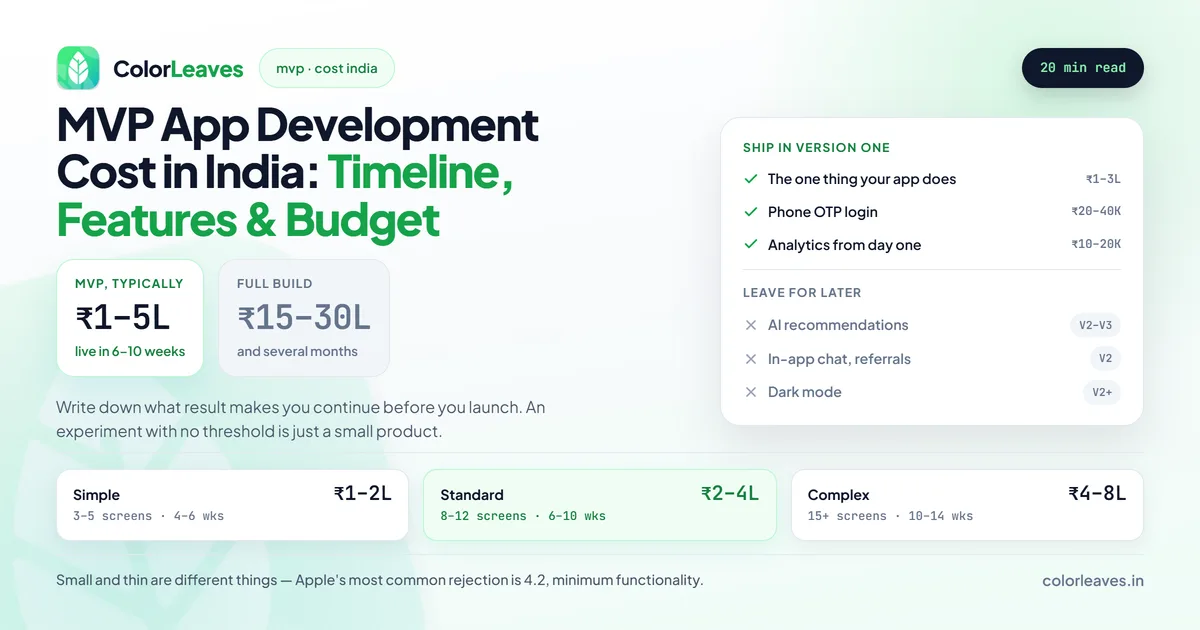
Key Takeaway: An MVP app in India typically costs ₹1 to 5 Lakhs and launches in 6 to 10 weeks, compared to ₹15 to 30 Lakhs and several months for a full build. You ship the smallest version that validates your core idea, then iterate from real user feedback.
What Exactly Is an MVP, and What It Isn’t
There’s a lot of confusion around this term, so let’s clear it up.
An MVP is:
- A functional app that delivers your core value proposition
- Something real users can download, use, and give feedback on
- Built with production-quality code that you can scale later
- A tool for learning, not just launching
An MVP is NOT:
- A buggy half-finished app you push out to save money
- A clickable prototype or wireframe
- A full product with every feature you can think of
- Something you build once and never update
The whole point of an MVP is speed to market combined with validated learning. You build the smallest thing that proves (or disproves) your hypothesis about what users need. Then you iterate based on data, not assumptions.
If you’ve ever used the first version of apps like Swiggy, Ola, or Razorpay, you’d barely recognize them compared to what they are today. They all started with a razor-thin feature set and expanded based on real usage patterns.
The third bullet in that first list is the one people underestimate. Production-quality code is not a luxury you add later, because an MVP that succeeds becomes the thing you build on for years, and one written to be thrown away rarely gets thrown away. Our walkthrough of a real build covers a first version shipped in two months that still runs, and the difference between that and a disposable prototype is mostly decisions taken in week one. It costs very little extra at the start and a great deal to retrofit.
Why Startups Should Always Start With an MVP
We’ve seen both approaches play out dozens of times: founders who build MVPs, and founders who try to build the “full vision” from day one. The results are predictable.
Founders who build MVPs:
- Launch in 6-10 weeks instead of 6-10 months
- Spend ₹1-5 Lakhs instead of ₹15-30 Lakhs upfront
- Get real user feedback before burning through their runway
- Pivot quickly when something isn’t working
- Have a working product to show investors (not a pitch deck)
Founders who skip the MVP:
- Run out of budget before launch (this happens more than you’d think)
- Build features no one uses
- Take so long that the market moves on or a competitor launches first
- Get emotionally attached to features instead of outcomes
The math is simple. If your idea works, you’ll have time and funding to build everything else. If it doesn’t, you’ll be glad you didn’t blow ₹20+ Lakhs finding that out.
Those timelines assume a team working on it properly rather than fitting it around other projects, which our development timeline guide sets out phase by phase. If you would rather direct the work yourself and have somebody technical to do it, what it costs to hire developers in India covers the rate bands, and hiring an app developer in Pune covers doing it locally.
Features to Include in Your MVP (And What to Skip)
This is where most founders struggle. Everything feels essential when it’s your idea. Here’s a practical framework we use with our clients.
Include in Your MVP
These are features that directly enable your app’s core function:
| Feature | Why It’s Essential | Estimated Cost |
|---|---|---|
| User registration & login (email/phone + OTP) | Users need accounts to use your app | ₹20K-40K |
| Core functionality (your main value proposition) | This IS your MVP, the one thing your app does | ₹1-3 Lakhs |
| Basic UI/UX with clean navigation | Users won’t tolerate confusing interfaces | ₹50K-1.5 Lakhs |
| Push notifications | Re-engage users, share updates | ₹15K-30K |
| Basic analytics integration (Firebase/Mixpanel) | You need data on how people use the app | ₹10K-20K |
| Payment integration (if applicable) | If your model involves transactions, this is core | ₹40K-80K |
| Basic admin panel | You need to manage content, users, or orders | ₹50K-1.5 Lakhs |
Skip for Version 1
These features are nice to have but won’t make or break your MVP:
| Feature | Why It Can Wait | Add in Version |
|---|---|---|
| Social login (Google, Apple, Facebook) | Email/phone OTP works fine initially | V1.1 |
| In-app chat or messaging | Use WhatsApp or email for early support | V2 |
| AI-powered recommendations | You don’t have enough data yet anyway | V2-V3 |
| Multi-language support | Launch in one language, add others when you scale | V2 |
| Advanced analytics dashboards | Basic Firebase analytics covers your early needs | V2 |
| Referral and loyalty programs | Focus on core value first, growth loops later | V2 |
| Complex search with filters | Simple search or category browsing is enough to start | V1.1 |
| Dark mode | Seriously, this can wait | V2+ |
The rule of thumb: if removing a feature means your app can’t deliver its primary value, keep it. Everything else is V2.
MVP App Development Cost Breakdown
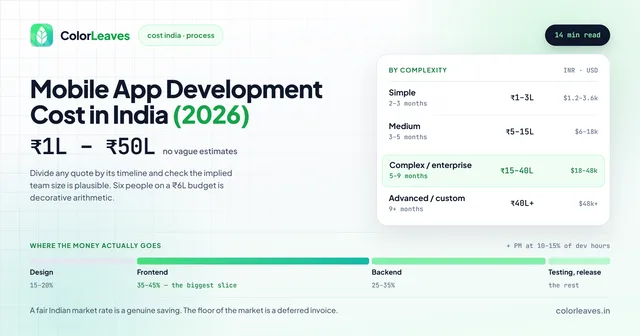
Here’s what MVP development actually costs in India in 2026, broken down by complexity level. For a broader look at general app development pricing, check our app development cost in India guide.
| MVP Type | Features | Cost Range | Timeline |
|---|---|---|---|
| Simple MVP | 3-5 screens, single core feature, basic backend | ₹1-2 Lakhs | 4-6 weeks |
| Standard MVP | 8-12 screens, 2-3 features, user accounts, payments | ₹2-4 Lakhs | 6-10 weeks |
| Complex MVP | 15+ screens, multiple user roles, real-time features, admin panel | ₹4-8 Lakhs | 10-14 weeks |
What Goes Into That Cost
Let’s break it down by development phase:
| Phase | % of Budget | Simple MVP | Standard MVP | Complex MVP |
|---|---|---|---|---|
| Discovery & Planning | 10% | ₹10K-20K | ₹20K-40K | ₹40K-80K |
| UI/UX Design | 15-20% | ₹15K-40K | ₹40K-80K | ₹60K-1.5 Lakhs |
| Frontend Development | 30-35% | ₹30K-70K | ₹70K-1.4 Lakhs | ₹1.2-2.8 Lakhs |
| Backend Development | 25-30% | ₹25K-60K | ₹50K-1.2 Lakhs | ₹1-2.4 Lakhs |
| Testing & QA | 10-15% | ₹10K-30K | ₹20K-40K | ₹40K-80K |
| Deployment & Launch | 5% | ₹10K-15K | ₹10K-20K | ₹20K-40K |
These numbers are based on what development teams across India (including us here in Pune) actually charge for MVP projects. Rates vary by city. Bangalore and Mumbai tend to run 15-20% higher, while smaller cities can be 10-15% lower. Pune sits in the sweet spot of competitive pricing and strong talent.
Real-World MVP Cost Examples
To make this more concrete, here’s what common MVP types cost:
| App Category | Key MVP Features | Estimated Cost | Timeline |
|---|---|---|---|
| Food Delivery | Menu browsing, ordering, payment, order tracking, restaurant panel | ₹3-5 Lakhs | 8-10 weeks |
| Marketplace | Listings, search, user profiles, messaging, basic admin | ₹3-5 Lakhs | 8-12 weeks |
| Fitness/Health | Workout plans, progress tracking, reminders, basic social features | ₹2-3.5 Lakhs | 6-8 weeks |
| E-commerce (D2C) | Product catalog, cart, checkout, payment, order management | ₹2.5-4 Lakhs | 6-10 weeks |
| EdTech | Course listing, video player, quizzes, progress tracking | ₹2.5-4 Lakhs | 8-10 weeks |
| Social/Community | Profiles, feed, posts, comments, notifications | ₹2.5-4 Lakhs | 8-10 weeks |
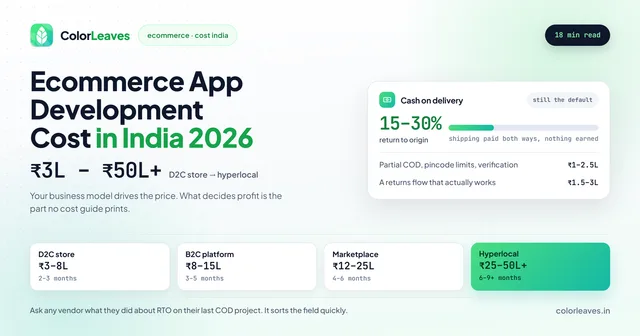
For a detailed look at e-commerce specifically, our e-commerce app development cost guide covers that category in depth.
Choosing the Right Tech Stack for Your MVP
Your tech stack choice has a direct impact on cost, timeline, and how easily you can scale later. Here’s our honest take.
Frontend: Go Cross-Platform
For MVPs, cross-platform development is almost always the right call. You get both Android and iOS from a single codebase, which cuts your frontend development cost by 30-40%.
Flutter. Our top pick for most MVPs. Fast development with hot reload, performance that feels native, and a mature ecosystem of packages. Most of our MVP clients go with Flutter.
React Native. A solid alternative, especially if your team already writes JavaScript or you’re planning a web version alongside the mobile app. Facebook, Instagram, and Discord use React Native.
We’ve written a detailed comparison in our Flutter vs React Native guide if you want to dig deeper.
Native (Kotlin/Swift). Only worth it if your app leans heavily on platform-specific hardware like AR, Bluetooth LE, or complex camera processing. For 90% of MVPs, this is overkill and doubles your budget. If you’re set on Android-first, here’s our mobile app development company in Pune page for reference.
Backend: Keep It Simple
- Node.js + Express. Fast to develop, great for real-time features, huge package ecosystem. Our default for MVPs.
- Firebase. Even faster to launch. Handles authentication, database, hosting, and push notifications out of the box. Good for very simple MVPs where speed matters most.
- Python (Django/FastAPI). The better choice if your MVP involves data processing, ML features, or complex business logic.
Database
- PostgreSQL. If your data is structured (users, orders, products), this is the reliable choice.
- MongoDB. If your data schema is still evolving (which is common in MVPs), the flexibility helps.
- Firebase Firestore. Zero-setup, real-time sync, works great with mobile clients. Good for MVPs with straightforward data needs.
Hosting
- AWS/GCP. Scalable, but it needs setup and management. Better for standard and complex MVPs.
- Firebase Hosting + Cloud Functions. Near-zero DevOps overhead. Launch fast and migrate later if needed.
- Vercel/Railway. Modern alternatives for lean backends that just need to work.
Our recommendation for a typical MVP: Flutter + Node.js + PostgreSQL + AWS. This stack gives you speed, performance, and a clear upgrade path when you scale.
MVP Development Timeline: Week by Week
Here’s a realistic timeline for a standard MVP (8-12 screens, basic backend, cross-platform):
| Week | Phase | What Happens |
|---|---|---|
| Week 1 | Discovery | Finalize features, user flows, technical architecture |
| Week 2-3 | Design | Wireframes, UI design, design review and iterations |
| Week 4-6 | Core Development | Build main screens, set up backend APIs, database |
| Week 7-8 | Integration | Connect frontend to backend, payment gateway, push notifications |
| Week 9 | Testing & QA | Bug fixes, performance testing, device testing |
| Week 10 | Launch Prep | App store submissions, final review, soft launch |
Total: 8-10 weeks for a well-scoped MVP.
Add 2-3 weeks if your app has real-time features, complex user roles, or if you’re still making decisions about features during development (scope creep is the number one timeline killer).
For more detail on each development phase, our step-by-step app building guide walks through the entire process. If you want to see what this looks like on a real project, our StockGenie case study covers a first version shipped in two months, including what got cut to make that possible.
7 MVP Mistakes That Cost Founders Money
We’ve worked with enough startups to see the same mistakes repeated. Here’s what to avoid:
1. Building Too Many Features
The most common mistake by far. Every extra feature adds cost and delays your launch. If your “MVP” has 25+ screens and three user roles, it’s not an MVP anymore. It’s a full product.
2. Skipping the Discovery Phase
Founders who jump straight into development without proper planning always end up paying more. A ₹20K-40K discovery phase saves you ₹2-5 Lakhs in rework later. Our walkthrough of the development process covers what discovery should actually produce, and the test is simple: could somebody who was not in the room build from it.
3. Obsessing Over Design Before Validation
A clean, functional UI is necessary. A pixel-perfect, award-winning design is not, at least not for V1. Spend enough on design to be usable and professional, but don’t blow 40% of your budget on animations and micro-interactions. What does matter is that the core flow is obvious without explanation, since a confusing MVP produces a false negative: users leaving tells you nothing about whether the idea works. Agree how many rounds of design revision are included before design starts, because it is the easiest part of a project to iterate on forever.
4. Choosing Native Development for an MVP
Building separate Android and iOS apps doubles your frontend cost. Unless you have a specific hardware-dependent reason, cross-platform (Flutter or React Native) is the way to go for MVPs. Our guide to choosing a mobile platform covers the decision properly, including the reassuring point that it is more reversible than it feels: moving from cross-platform to native later keeps your backend, your API contracts and everything you learned.
5. Not Planning for Post-Launch
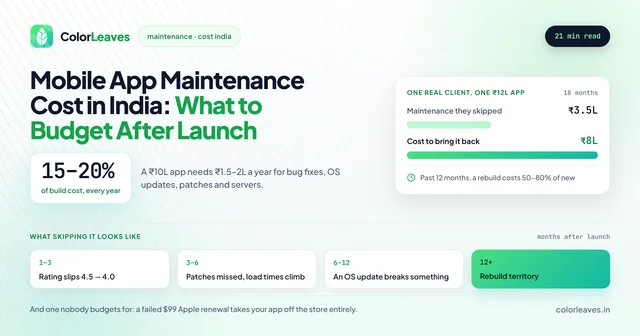
Your MVP budget should include at least 2-3 months of maintenance and iteration costs. Launching is just the beginning. Budget ₹20K-50K per month for bug fixes, minor updates, and server costs, which our app maintenance cost guide breaks down properly, or arrange a defined support arrangement rather than calling somebody when it breaks.
Two dates to know about. Apple’s developer membership renews annually and your app is pulled if the payment fails, and Google raises the target API level every year. Both apply to an MVP exactly as they apply to a mature product.
6. Hiring the Cheapest Option
Freelancers charging ₹50K for a “complete app” will deliver exactly what you’d expect at that price. You’ll spend more fixing and rebuilding than you would have spent doing it right the first time. Look for a team with a proper development process, not just the lowest quote. Our guide to choosing a development company covers what to check, and the list of Pune app development companies includes our competitors because a shortlist of one is not a shortlist.
7. Not Tracking Metrics From Day One
If you launch an MVP without analytics, you’ve wasted the entire point of building an MVP. Set up event tracking, monitor user flows, and measure retention from the first week. Firebase Analytics is free and takes a day to integrate, so there’s no excuse.
Decide What Success Looks Like Before You Launch
An MVP is an experiment, and an experiment without a stated hypothesis is just a small product. This is the step founders skip most often, and it costs them the entire value of building small.
Write down, before launch, what result would make you continue and what result would make you stop. Not “we want lots of users”. Something you can check against a number in eight weeks.
The metrics that actually tell you something are narrower than the dashboard suggests. Activation, meaning the share of people who install and reach the point where the app has done its job once. If most people never get there, your problem is the product rather than the market. Week-four retention, because anybody can get a first open. Frequency, meaning whether the people who stay come back at the rate the business model needs. And the one action that matters, whichever it is for you: a booking, a purchase, a completed lesson.
Vanity numbers to ignore: downloads, page views, time in app. Downloads measure your marketing. Time in app can mean somebody is engaged or that they cannot find anything.
Set the honest thresholds while you still have no data, because afterwards you will rationalise whatever you get. And set a date. An experiment with no end runs forever and quietly becomes the thing you were trying to avoid building.
Get real people onto builds before public launch too. A Play internal testing track or TestFlight puts the app in front of twenty people who match your intended audience, and their behaviour in week one usually predicts what the launch will look like. Test on hardware they actually own rather than yours, which our piece on Android device fragmentation covers.
What Happens After the MVP
Three outcomes, and the plan should account for all three rather than assuming the first.
It works and you scale. The pleasant problem. Now you find out what your build actually bought you. An MVP built properly extends; an MVP built cheaply gets rewritten. That is the real difference between a ₹1.5 lakh app and a ₹5 lakh one, and it shows up here rather than at launch. Budget for a period of paying down shortcuts that were correct decisions at the time, and expect version two to cost more than you hoped because you now have users who cannot be disrupted.
It half works and you pivot. The most common outcome. Some part of the idea landed and a different part did not. This is where owning your own code and infrastructure pays off, since pivoting means reusing the backend, the auth, the payments and the accounts while changing the product on top.
It does not work and you stop. The outcome an MVP exists to reach cheaply. Losing ₹2 lakhs and ten weeks to find out is the system working, not failing. Founders who spent ₹25 lakhs to learn the same thing are the reason this article exists.
Two practical points for founders specifically. If you plan to raise money, an investor’s technical diligence will ask who owns the code, whether the assignment is signed, whose store accounts the app publishes under, and whether any copyleft-licensed library is linked into the product. Our guide to who owns your code covers all of it, and the contract checklist covers the clauses to get right before development starts rather than during a funding round. We have watched a round stall six weeks over a repository still sitting in an agency’s GitHub organisation, with nothing actually in dispute.
How to Reduce Your MVP Cost Without Cutting Corners
There are legitimate ways to bring costs down:
- Ruthlessly prioritize features. Every feature you cut saves development time and money. Be honest about what’s truly essential for launch.
- Use cross-platform frameworks. Flutter or React Native saves you 30-40% compared to building native apps for both platforms.
- Lean on existing services. Use Firebase for auth, Razorpay for payments, AWS S3 for storage. Don’t build what you can integrate.
- Start with one platform. If budget is really tight, launch on Android first (larger market in India) and add iOS in V1.1. Our comparison of which platform to launch first covers when that is wrong, which is mainly when your users or your revenue are American.
- Use a design system. Pre-built UI component libraries speed up development and reduce design costs.
- Keep scope in writing. A detailed scope document prevents scope creep, which is the biggest hidden cost in app development.
Getting Started With Your MVP
If you’re reading this and thinking “okay, I’m ready to build,” here’s the process we follow at Color Leaves for MVP projects:
Step 1: Free Consultation (30 minutes) We get on a call and learn your idea, target audience, and business model. No pitches, no pressure, just an honest conversation about whether an MVP makes sense for your situation.
Step 2: Discovery & Scoping (1 week) We define the feature set, create user flows, estimate costs, and give you a detailed proposal. This phase costs ₹15K-30K and is worth every rupee.
Step 3: Design (1-2 weeks) Clean, functional UI design focused on usability. We share designs in Figma for your review before any code is written.
Step 4: Development & Testing (4-8 weeks) Our Pune-based development team builds your app using Flutter (or React Native depending on your needs), sets up the backend, integrates third-party services, and handles QA.
Step 5: Launch & Iterate We submit your app to the Play Store and App Store, help with the initial launch, and stay on for post-launch support and iteration. For details on publishing costs, check our app publishing cost guide.
Set the store accounts up in week one rather than at the end. An Apple organisation account needs a D-U-N-S number that takes two to four weeks to obtain in India, and a new personal Play account has to run a 14-day closed test before it can publish publicly. Our Apple Developer account and Play Console guides cover both, and started early they cost nothing. Started late they add three weeks to a ten-week project.
Leave slack for review as well. Apple rejects roughly a quarter of submissions, and the most common reason is guideline 4.2, minimum functionality, which an MVP is more exposed to than a mature product. Small and thin are different things: small means one job done properly with real native capability, thin means a login screen wrapped around a web view. Our guide to why apps get rejected covers where that line sits.
We’ve helped startups, small businesses, and enterprise teams across Pune and the rest of India turn app ideas into launched products. Our MVP app development services are specifically designed for founders who want to validate fast without overspending. Whether your MVP budget is ₹1.5 Lakhs or ₹8 Lakhs, we’ll help you figure out the smartest way to spend it.
Ready to build your MVP? Get in touch with us for a free consultation. Tell us your idea, your budget, and your timeline, and we’ll tell you exactly what’s possible.
The Fastest Route to a First Release
An MVP needing both platforms almost always argues for cross-platform. Two native codebases double the build and then double every iteration after it, which is the opposite of what a product still searching for fit needs.
The hybrid app development page sets out the framework choice. If you have technical leadership in house and would rather direct the work yourself, hiring a dedicated developer usually costs less than a fixed-scope build.