Pune has grown into one of India’s biggest IT hubs, with thousands of skilled mobile app developers and dozens of capable studios. Finding options isn’t the problem. Picking the right one out of so many is. This guide shows you how to run that search and land on a team you can trust.
It assumes you want somebody local, which is a different decision from hiring offshore. If you are outside India and weighing a vendor here, how to hire app developers in India is the guide you want instead, since the questions that matter there are timezone overlap, contract terms and payment rails. This one is about the advantages you get from being able to drive to their office, and about actually using them.
Key Takeaway: To hire the best app developer in Pune, evaluate candidates on relevant portfolio work, technical skills, communication, and pricing, then source them through Pune’s IT hubs, established studios, referrals, and developer communities. Vet a shortlist carefully before signing.
Why Hire App Developers from Pune?
Pune offers several advantages as an app development destination:
Strong IT Ecosystem
- 4,000+ IT companies and startups
- Major tech parks and IT hubs
- Strong engineering talent from premier colleges
- Established outsourcing industry
Cost Advantage
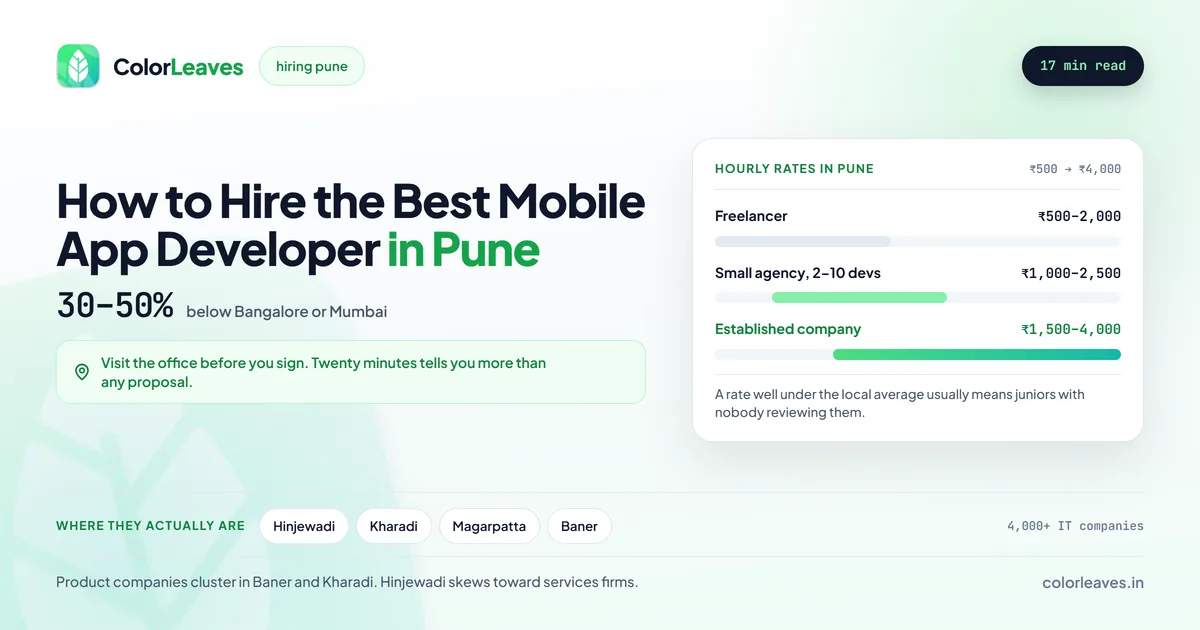
- 30-50% lower costs than Bangalore or Mumbai
- Competitive with global outsourcing destinations
- High quality-to-cost ratio
- Affordable living costs attract top talent
Talent Pool
- Multiple engineering colleges producing skilled graduates
- Access to developers from surrounding regions
- Mix of experienced professionals and fresh talent
- Strong community of tech professionals
Connectivity
- Good infrastructure and connectivity
- Multiple business districts
- Easy accessibility for meetings
- Growing startup ecosystem
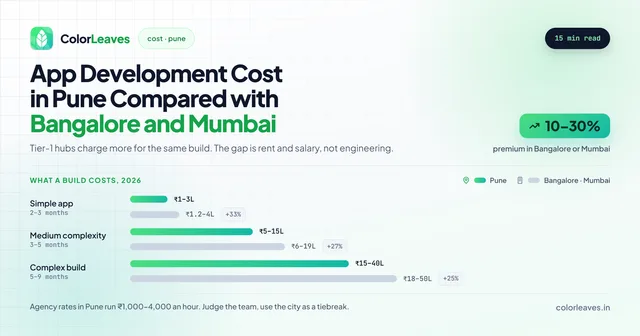
The cost figure deserves a caveat. Pune running 30 to 50 percent below Bangalore and Mumbai is real, and our city by city rate comparison sets out where the difference actually comes from. It is mostly salaries and office costs rather than a discount on capability. What it is not is a licence to chase the bottom of the Pune market, where the same dynamics apply as anywhere else and a rate well under the local average usually means juniors with nobody reviewing them.
Where to Actually Look
Most guides tell you to evaluate carefully and never say where to start. Here is where the candidates actually are.
The IT corridors. Hinjewadi is the largest concentration, with Kharadi, Magarpatta and Baner behind it. Product companies cluster in Baner and Kharadi, while Hinjewadi skews toward services firms. If you want a small team that has built its own products, look at the first two before the third.
Referrals from other Pune founders. The highest signal route and the slowest. Ask anyone locally who has shipped an app who built it and, more usefully, whether they would use them again. The second answer is the one worth having.
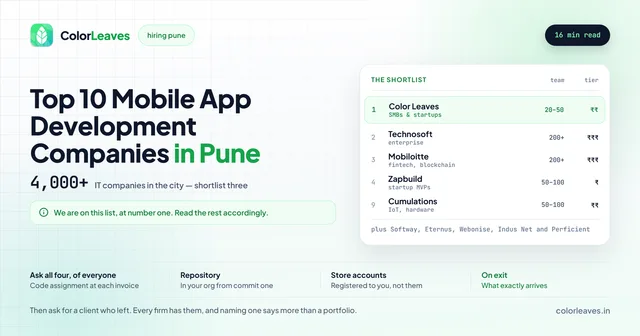
Directory listings with verified reviews. Clutch and GoodFirms contact reviewers independently, which makes those reviews worth more than testimonials on a company website. Our own list of app development companies in Pune includes our competitors, because a shortlist of one is not a shortlist.
Local tech communities. Pune has active meetup groups around Android, Flutter and React Native. Turning up to one tells you who the serious engineers in the city are faster than a month of searching, and it costs an evening.
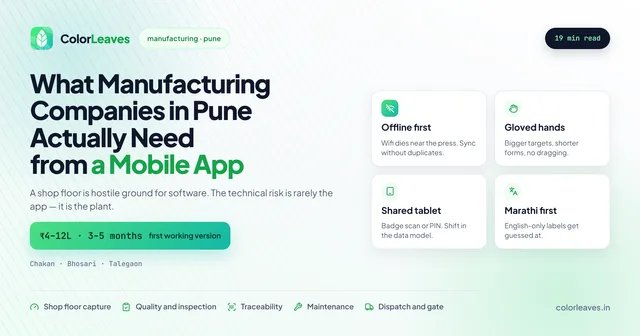
Existing local products. If you have seen a Pune-built app you admire, find out who made it. Some of the more interesting work here is in unglamorous places, like the manufacturing belt around Chakan and Bhosari and the city’s transit apps, and the teams behind those have solved harder problems than most consumer work demands.
Hiring Options: Freelancer vs Agency vs Development Company
Option 1: Freelance Developers
Pros:
- Lower hourly rates
- Direct communication
- Flexible engagement
Cons:
- Single point of failure
- Limited skill coverage
- No project management support
- Availability issues
Best for: Simple apps, small budgets, or extending existing teams
Cost Range: ₹500-2,000/hour
Option 2: Small Agencies (2-10 developers)
Pros:
- More affordable than large companies
- Personal attention
- Flexible processes
Cons:
- Limited scalability
- May lack specialized skills
- Variable quality standards
Best for: Small to medium projects, startups
Cost Range: ₹1,000-2,500/hour (project rates vary)
Option 3: Established Development Companies
Pros:
- Full-service teams (designers, developers, testers)
- Proven processes and methodologies
- Reliable delivery and support
- Long-term partnership potential
Cons:
- Higher costs
- May have minimum project size
- Less flexibility for small changes
Best for: Complex apps, enterprise projects, long-term relationships
Cost Range: ₹1,500-4,000/hour (project rates vary)
Whichever you pick, the pricing model matters as much as the rate. Fixed price transfers risk to them, which means they price that risk in and resist every change, and that is correct behaviour under that contract rather than obstruction. Time and materials keeps you flexible and puts the overrun on you. Fixed price suits a well specified build; time and materials suits a product still finding its shape. Our MVP costing guide covers scoping a first version tightly enough that fixed price is actually sensible, and the MVP development page covers how we run those.
Use the Local Advantage, Because It Is the Whole Point
If you are paying for a Pune team rather than a cheaper one somewhere else, the value is proximity. Most clients never use it.
Visit the office before you sign. Not a video call. Turn up. You will learn more in twenty minutes about how many people actually work there and what the atmosphere is like than from any number of proposals. A firm that finds a reason to avoid this is telling you something.
Meet the engineers who will do the work. Not the account manager, not the founder who will hand you off after signing. If a company will not put you in front of the specific people, you are being sold a resource pool. Our interview questions for mobile developers are written to be usable even if you cannot read code, and they work as well across a table as over a call.
Do design reviews in person. UI and UX work is where in-person time pays off most, because a forty minute session with the designer and a whiteboard replaces two weeks of comment threads.
Sit with them during testing. Watching somebody use your app while you are in the room surfaces things no bug report captures. Get a build onto real phones early through a Play internal track or TestFlight and bring in a few people who resemble your actual users.
No timezone gap is the underrated part. A question asked at 3pm gets answered at 3pm. That sounds minor until you compare it with the alternative, where two ambiguous questions in a row can cost two days.
Key Skills to Look For
Technical Skills
For Android Development:
- Kotlin (primary language)
- Java (legacy and some use cases)
- Android SDK and Android Studio
- Jetpack Compose for modern UI
- MVVM architecture
- Room database, Retrofit for networking
- Firebase integration
For iOS Development:
- Swift (primary language)
- SwiftUI for modern UI
- UIKit for complex interfaces
- Xcode proficiency
- Core Data, Combine
- App Store Connect experience
For Cross-Platform:
- React Native: JavaScript/TypeScript, React concepts
- Flutter: Dart programming, widget-based UI
- State management (Redux, Provider, Riverpod)
- Native bridge implementation
Pune has a growing pool of cross-platform specialists in both major frameworks. If your project needs JavaScript expertise and tight web integration, look for teams with dedicated React Native development experience. If you care more about custom UIs and multi-platform support, a team that specializes in Flutter development can deliver polished results across Android, iOS, and even web from one codebase.
Soft Skills
Beyond technical expertise, look for:
- Communication: Clear, timely, and professional
- Problem-solving: Creative solutions to challenges
- Collaboration: Works well with your team
- Time management: Meets deadlines consistently
- Adaptability: Handles changing requirements
How to Evaluate App Developers
Step 1: Review Portfolio
A strong portfolio should demonstrate:
- Variety of projects: Different industries and app types
- Quality of work: Well-designed, polished apps
- Live apps: Download and test their published apps
- Client diversity: Experience with different client types
Questions to ask:
- Which projects are you most proud of?
- What was your specific role in these projects?
- What challenges did you face and how did you solve them?
Do not just look at the portfolio, install something from it. Use it for ten minutes, then ask them what they would fix. Anyone who cannot criticise their own shipped work either has not thought about it since or was not really responsible for it. Ours is on our portfolio page, including StockGenie, and we will happily tell you what we would do differently.
Industry experience is worth probing specifically, because the hard parts are usually domain rather than technical. A team that has built fintech knows what RBI compliance does to a schedule. A team that has built healthcare knows what a consent flow has to capture. The same applies to ecommerce and returns, education and content costs, on-demand and background location, real estate and RERA fields. General app experience is not a substitute for any of that, and asking about it separates the firms who have done your kind of work from the ones who will learn on you.
Step 2: Check Technical Competence
Assess technical skills through:
- Technical discussion: Ask about their approach to your project
- Code review: Request sample code or GitHub profile
- Architecture discussion: How would they structure your app?
- Technology recommendations: Do they suggest appropriate solutions?
Step 3: Verify References
Contact previous clients to learn:
- Was the project delivered on time and budget?
- How was communication throughout the project?
- Were there any major issues? How were they resolved?
- Would they work with this developer again?
Step 4: Evaluate Process and Methodology
A good development partner should have:
- Clear project management: Defined phases and milestones
- Regular communication: Scheduled updates and demos
- Documentation: Requirements, designs, and technical docs
- Quality assurance: Dedicated testing processes
Step 5: Assess Cultural Fit
Consider how well they’ll work with your team:
- Communication style compatibility
- Work hour overlap
- Flexibility and responsiveness
- Long-term partnership potential
Questions to Ask Before Hiring
About Their Experience
- How many mobile apps have you developed?
- Do you have experience in my industry?
- What’s the largest team you’ve managed?
- How long have you been developing apps?
- What’s your experience with [specific technology]?
About Your Project
- How would you approach building this app?
- What technology stack would you recommend?
- How long do you estimate this project will take?
- What could increase or decrease the timeline?
- How do you handle scope changes?
About Their Process
- What development methodology do you follow?
- How often will we have progress meetings?
- How do you handle project documentation?
- What’s your testing process?
- How do you manage code quality?
About Business Terms
- What’s your pricing model (hourly/fixed/retainer)?
- What’s included in your quote?
- What’s your payment schedule?
- What happens if the project goes over budget?
- What are your support terms after launch?
The Four Nobody Asks
These matter more than the twenty above combined, and hiring locally does not make them optional. Being able to drive to somebody’s office is not a substitute for owning what you paid for.
Who owns the code, and when does it transfer? It should assign to your company at each invoice rather than at project completion, with the repository in your own organisation from the first commit. Paying an invoice does not move copyright by itself in Indian law, which our guide to who owns your code explains.
Whose store accounts will the app publish under? Yours. If it goes live under an agency’s Apple Developer or Google Play account, the listing, the ratings history and the right to ship an update belong to them. Leaving means starting from zero reviews.
What arrives if we part ways? Ask what the last departing client actually received. A concrete answer means handover is a process. A vague one means it is an improvisation and you will be the one improvising.
Who pays to fix a store rejection? Roughly one in four submissions gets rejected, so this is not hypothetical. It should sit inside the engagement rather than arriving as a change request. Our contract checklist covers all four alongside the commercial terms, and while it is written for offshore engagements, every item applies to a local one.
Red Flags to Watch Out For
Be cautious if you notice:
Communication Issues
- Delayed responses to inquiries
- Unclear or evasive answers
- Poor English proficiency (if required)
- No direct contact with developers
Portfolio Concerns
- No live apps to show
- Claims of building popular apps without proof
- Unwillingness to share references
- Very recent company formation
Business Practices
- Unrealistically low quotes
- No formal contract or agreement
- Demand for full payment upfront
- Pressure to commit quickly
Technical Red Flags
- One-size-fits-all technology recommendations
- No questions about your requirements
- Overpromising on features or timeline
- Lack of understanding of app store requirements
That last one is easy to test. Ask what the last store rejection they dealt with was. Anyone who has genuinely shipped will describe it immediately and with visible irritation, and our guide to why apps get rejected covers the guidelines behind the usual answers. A claim of never having been rejected means they have not shipped much.
The overpromising one has a companion worth watching for. A team that agrees to everything is not being accommodating, they are avoiding a difficult conversation now in exchange for a worse one later. Watch what happens the first time you suggest something technically unwise. A team that pushes back in week two will push back in month six, when it matters considerably more.
An estimate with no caveats attached is a warning rather than confidence. Compare what you are told against a realistic development timeline before deciding whose number to believe.
The Hiring Process: Step by Step
Week 1: Research and Shortlist
- Define your project requirements
- Set your budget range
- Research potential developers/companies
- Create a shortlist of 5-10 candidates
- Prepare your project brief
Week 2: Initial Outreach
- Send project brief to shortlisted candidates
- Review initial responses and proposals
- Narrow down to 3-5 serious candidates
- Schedule introductory calls
Week 3: Deep Evaluation
- Conduct detailed discussions
- Request detailed proposals
- Check references
- Review portfolios in depth
- Evaluate technical approaches
Week 4: Final Selection
- Compare final proposals
- Negotiate terms if needed
- Review contract and agreement
- Make final selection
- Kick off project
Working Successfully with Your Developer
Set Clear Expectations
- Document all requirements thoroughly
- Define acceptance criteria for features
- Establish communication protocols
- Set realistic timelines with buffers
- Clarify roles and responsibilities
Maintain Regular Communication
- Weekly or bi-weekly status meetings
- Dedicated communication channels (Slack, Teams)
- Regular demos of work in progress
- Quick response to queries and blockers
- Document all decisions and changes
Provide Timely Feedback
- Review deliverables promptly
- Give specific, actionable feedback
- Approve designs before development
- Test builds as they’re delivered
- Address issues early
Build a Partnership
- Treat developers as partners, not vendors
- Share business context and goals
- Be open to technical suggestions
- Plan for long-term relationship
- Invest in mutual success
Agree What Happens After Launch
The single most common gap in a Pune engagement, and it costs more than anything on the list above.
An app is not finished when it ships. Apple and Google both change their requirements annually, so every app needs at least one compliance release a year before a single feature is added. Libraries get abandoned. Operating systems update twice a year and break things.
Settle this before the build starts rather than at handover, when the team has already moved on to other work. Budget 15 to 20 percent of the build cost annually, which our app maintenance cost guide breaks down, and agree a defined support arrangement with response times rather than relying on goodwill. A proposal that ends at launch has quietly made all of this your problem.
If you want to understand what you are buying before you buy it, our walkthrough of the development process covers what should happen at each stage, and the step by step build guide covers it from the beginning.
Why Choose Color Leaves
As a top app development company in Pune, we check all the boxes you should look for in an app development partner:
Experience & Track Record
- 10+ years in mobile app development
- 50+ apps successfully delivered
- Diverse portfolio across industries
- Long-term client relationships
Technical Excellence
- Expert Android, iOS, and cross-platform developers
- Modern technology stack
- Clean code practices
- Thorough testing
Professional Process
- Agile development methodology
- Regular communication and demos
- Detailed documentation
- Post-launch support
Pune Advantage
- Local presence for meetings
- No timezone issues
- Competitive pricing
- Easy collaboration
Ready to discuss your project? Contact us for a free consultation and let’s explore how we can bring your app idea to life.
Conclusion
Good hiring in Pune comes down to checking the things that matter: technical skill, a portfolio you can actually test, a sane process, and a team that clicks with yours. Call the references. Download the apps. Don’t rush it.
And the cheapest quote rarely wins over the long run. Pay for a partner who does solid work, keeps you in the loop, and sticks around after launch.
Related Guides
Also helpful: how to choose a mobile app development company (evaluation criteria and red flags), top 10 app development companies in Pune, and app development costs in India so you know what rates to expect.
Frequently Asked Questions
How much do app developers charge in Pune?
Freelancers charge ₹500-2,000/hour, agencies charge ₹1,000-2,500/hour, and established companies charge ₹1,500-4,000/hour. Project-based pricing varies by complexity, and seniority moves the figure more than anything else. Our cost to hire mobile app developers in India guide breaks the bands down properly.
Should I hire freelancers or a development company?
For simple projects with limited budget, freelancers work well. For complex apps requiring multiple skills (design, development, testing), a development company offers more reliable delivery. The saving on a freelancer rarely survives the first time one disappears mid-sprint, which is the main risk with that route.
Do I need a native or cross-platform team?
Depends on the product rather than on fashion. Cross-platform covers both stores from one codebase and suits most apps, while Android or iOS native makes sense when you are pushing hardware, heavy graphics or platform-specific capability. Flutter versus React Native settles the choice within cross-platform.
How do I verify a developer’s portfolio?
Download their published apps, contact references, ask for live demos, and verify their specific contribution to showcased projects.
What’s the typical engagement model?
Common models include fixed-price (for well-defined projects), time & material (for evolving requirements), and dedicated team (for long-term projects).
How long should the interview process take?
Plan for 2-4 weeks from initial research to final selection. Rushing the process often leads to poor decisions.