India’s e-commerce market is on a tear. With over 900 million smartphone users, UPI transactions crossing 16 billion per month, and consumers buying everything from groceries to gold on their phones, mobile commerce isn’t a trend anymore. It’s the default. If you’re a business thinking about building an e-commerce app in 2026, the real questions are how much it will cost and what you’ll need.
In this guide, we break down e-commerce app development costs in India feature by feature, compare your technology options, and help you figure out the right approach for your budget and business model.
Two costs get left out of almost every guide like this one, and both are covered below because they decide profitability rather than budget: cash on delivery returns, and returns generally. If you are new to building software at all, our step by step guide to building an app is the better place to start.
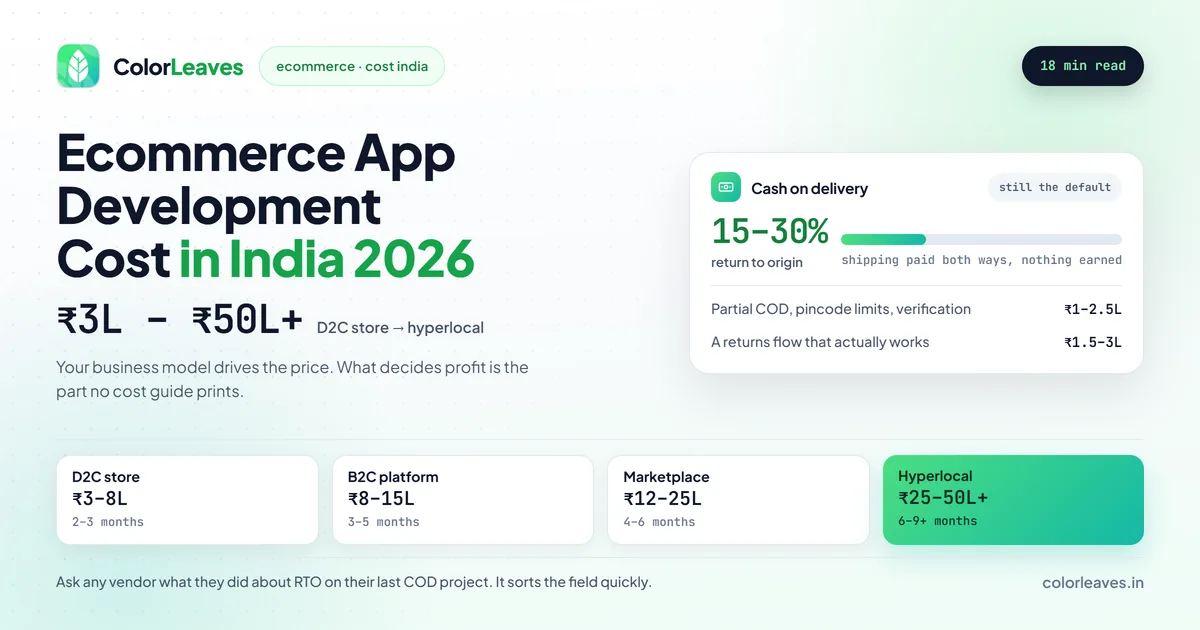
Key Takeaway: Building an e-commerce app in India costs ₹3 to 8 Lakhs for a D2C store, ₹8 to 15 Lakhs for a B2C platform, ₹12 to 25 Lakhs for a marketplace, and ₹25 to 50 Lakhs or more for hyperlocal quick commerce. Your business model drives the cost.
Types of E-Commerce Apps
Not all e-commerce apps are built the same. The type of app you need directly determines your development cost, timeline, and feature set. Here are the four main models we see in India:
B2C (Business-to-Consumer): Think Amazon or Flipkart. A single company selling products directly to consumers. You control the inventory, pricing, and shipping.
D2C (Direct-to-Consumer): Brands like Mamaearth, boAt, and Lenskart have their own apps. No middlemen. You own the customer relationship and data. This is the fastest-growing segment right now.
Marketplace (Multi-Vendor): Meesho, Etsy-style platforms where multiple sellers list products on your platform. You take a commission. More complex because you’re managing vendor onboarding, payouts, and disputes.
Hyperlocal (Quick Commerce): Zepto, Blinkit, Swiggy Instamart. Location-based delivery within minutes. The most complex model. It requires real-time logistics, rider management, and warehouse integration.
| App Type | Complexity | Estimated Cost Range | Timeline |
|---|---|---|---|
| D2C Store | Low-Medium | ₹3-8 Lakhs | 2-3 months |
| B2C Platform | Medium | ₹8-15 Lakhs | 3-5 months |
| Marketplace | Medium-High | ₹12-25 Lakhs | 4-6 months |
| Hyperlocal | High | ₹25-50+ Lakhs | 6-9+ months |
Must-Have Features and Their Individual Costs
One of the most useful things we can share is what each feature actually costs to build. This helps you prioritize and plan your MVP intelligently. For a detailed look at general app costs, check out our complete app development cost breakdown.
Customer-Facing Features
| Feature | Cost Range | Notes |
|---|---|---|
| Product catalog & search | ₹1-2 Lakhs | Includes filters, categories, and search with auto-suggest |
| Shopping cart & wishlist | ₹80K-1.5 Lakhs | Cart persistence, quantity management, save-for-later |
| Payment integration (UPI/Razorpay) | ₹1-2 Lakhs | UPI, cards, wallets, net banking, COD |
| User profiles & order history | ₹50K-1 Lakh | Registration, login, past orders, reorder functionality |
| Push notifications | ₹30K-60K | Order updates, offers, abandoned cart reminders |
| Product reviews & ratings | ₹40K-80K | Star ratings, text reviews, photo reviews |
| Address management | ₹30K-50K | Multiple addresses, default selection, pincode validation |
Admin-Side Features
| Feature | Cost Range | Notes |
|---|---|---|
| Admin dashboard | ₹1.5-3 Lakhs | Overview metrics, sales data, user stats |
| Inventory management | ₹1-2 Lakhs | Stock tracking, low-stock alerts, variant management |
| Order management & tracking | ₹1-2 Lakhs | Status updates, shipping integration, return handling |
| Analytics & reports | ₹80K-1.5 Lakhs | Sales reports, customer analytics, product performance |
| Coupon/discount management | ₹50K-1 Lakh | Percentage/flat discounts, validity periods, usage limits |
These are individual feature costs. When you bundle them together, you typically save 15-20% because of shared infrastructure, reusable components, and development efficiencies.
Cost Breakdown by App Complexity
Here’s the big picture. This is the table most of our clients ask for first:
| Category | Basic D2C Store | Mid-Level Marketplace | Enterprise / Hyperlocal |
|---|---|---|---|
| Scope | Single vendor, essential features | Multi-vendor, advanced features | Complex logistics, real-time tracking |
| Platforms | Android + iOS (cross-platform) | Android + iOS (cross-platform) | Android + iOS + Web admin |
| Key Features | Catalog, cart, payments, basic admin | Vendor management, advanced search, reviews, analytics | Real-time tracking, rider app, warehouse management |
| Design | Clean, functional UI | Custom branded experience | Complex multi-role UX |
| Backend | Standard APIs | Scalable architecture | Microservices, real-time systems |
| Cost Range | ₹3-8 Lakhs | ₹8-20 Lakhs | ₹20-50+ Lakhs |
| Timeline | 2-3 months | 4-6 months | 6-9+ months |
Most D2C brands starting out should aim for the basic tier and scale up. You don’t need every feature on day one. Launch with a solid product catalog, smooth checkout, and reliable payments. Add reviews, wishlists, and advanced analytics in version 2. Our MVP costing guide covers scoping that first version, and the MVP development page covers how those builds run.
If your model leans toward delivery within minutes rather than a catalogue and a courier, you are really building an on-demand product and the economics change substantially. Our on-demand app development page covers the three-app architecture that comes with it.
Cash on Delivery, and the Costs Behind It
Skipped by nearly every cost guide, and it shapes both the build and the business in India more than any feature in the tables above.
A large share of Indian orders are still cash on delivery, more so outside the metros and in first-time-buyer categories. Removing the option costs you sales. Keeping it costs you something else.
Return to origin. COD orders get refused at the door far more often than prepaid ones, and industry RTO rates commonly run 15 to 30 percent depending on category and geography. You pay shipping both ways and get nothing. This is frequently the difference between a profitable order and a loss.
Cash reconciliation. Your courier collects money and remits it later, minus their charges, on their schedule. Somebody has to match those remittances against orders, chase discrepancies, and account for the float. That is an admin module, not a spreadsheet, once volume arrives.
Engineering implications. Partial COD with a small prepaid token, address confidence scoring, pincode-level COD limits, order confirmation calls or WhatsApp verification before dispatch. Each of these exists to reduce RTO and each is real development work. Budget ₹1 to ₹2.5 lakhs if you want more than a checkbox at checkout.
The other side of it is that pushing customers toward prepaid is worth engineering for. UPI made this dramatically easier than it was five years ago, and a small prepaid discount usually pays for itself against the RTO you avoid.
Returns Are a Feature, Not an Exception
Related and equally underbudgeted. Indian shoppers return a lot, particularly in fashion, and the flow has to exist in the app rather than in a support inbox.
A working returns system needs a request flow with reason codes and photo upload, pickup scheduling with your logistics partner, a quality check step before the refund releases, refund routing back to the original payment method or a wallet, and inventory that updates when the item comes back. Expect ₹1.5 to ₹3 lakhs, and expect to touch the admin panel, the customer app and the backend to do it.
Teams that leave this until after launch end up processing returns manually over email for months, which costs more in staff time than the feature would have cost to build.
Technology Stack Recommendations
Choosing the right tech stack matters more than most business owners realize. It affects your app’s performance, scalability, and long-term maintenance costs. Here’s what we typically recommend for e-commerce apps:
Frontend (Mobile App)
For most e-commerce apps, cross-platform development is the smart move. You get both Android and iOS apps from a single codebase, saving 30-40% on development costs.
Whatever you pick, treat performance as a revenue feature rather than a technical one. A shopping app is a scrolling image browser, and product photos are where it falls over. Compress on upload, serve device-appropriate sizes, lazy-load the grid. Get this wrong and the app becomes unusable on the mid-range Android handsets most Indian shoppers carry, which our piece on Android device fragmentation goes into. A slow catalogue costs conversions on exactly the customers you spent money acquiring, and it is the kind of thing you find with real device testing rather than in the office.
Checkout deserves the same scrutiny. Every additional field loses buyers, and that is a design problem before an engineering one.
- Flutter: Great for custom, visually rich shopping experiences. Fast performance, smooth animations for product galleries and cart interactions. Our go-to recommendation for most e-commerce projects.
- React Native: Better if your team already has JavaScript expertise or you need tight integration with a React-based website.
We’ve compared both frameworks in detail in our Flutter vs React Native guide.
Backend
- Node.js: Excellent for real-time features like live inventory updates and chat support. Handles concurrent requests well.
- Python/Django: Solid choice if you need heavy data processing, recommendation engines, or AI-driven personalization.
- Java Spring Boot: Enterprise-grade option for large-scale marketplaces that need rock-solid reliability.
Database
- PostgreSQL: Reliable for structured product data, orders, and transactions.
- MongoDB: Flexible for catalogs with varying product attributes (fashion, electronics, groceries all have different data structures).
Cloud Infrastructure
- AWS: Most popular choice. S3 for images, EC2/ECS for servers, CloudFront for fast delivery across India.
- Google Cloud: Good alternative, especially if you’re using Firebase for push notifications and analytics.
Payment Gateways
- Razorpay: Most popular in India. Clean APIs, supports UPI, cards, wallets, EMI, and international payments.
- Cashfree: Competitive pricing, strong for marketplace payouts with split payment support.
- PhonePe Payment Gateway: Growing option, especially for UPI-heavy businesses.
Two things to settle early. RBI rules mean you do not store card details yourself, you use tokenisation through the gateway, which keeps your PCI scope narrow and is not optional. And if you are running a marketplace paying out to sellers, that is a materially harder problem than collecting payments, involving KYC, settlement cycles and reconciliation. Anything holding funds on someone else’s behalf edges into regulated territory, which our fintech development guide covers and our fintech team page covers from the build side.
What You Do and Do Not Owe Apple
Worth being precise about, because teams get it wrong in both directions.
Physical goods and real-world services sit outside Apple’s in-app purchase system. If you sell products that arrive at a door, you use a normal payment gateway and Apple takes nothing. Implementing in-app purchase here out of caution is itself grounds for rejection, and it happens often enough to be worth naming.
The exception is anything digital. A paid membership giving free delivery and early access to sales is digital content, and Apple’s position is that it goes through in-app purchase at 30 percent, or 15 percent under the Small Business Program. So is a gift card redeemable only within your app, and so are digital downloads if you sell any. Loyalty programmes sit in a grey zone that depends on what the subscription actually unlocks.
Resolve this before you build checkout rather than after a rejection, since payment flows are among the more expensive things to rebuild. Our publishing cost guide covers the store fees, and the rejection rate data covers how often submissions come back and what it costs in schedule.
Custom App vs. Shopify/WooCommerce
This is a question we get in almost every initial consultation: “Should we build a custom app or just use Shopify?”
The answer hinges on where your business is right now and where you want to be in two years.
| Factor | Custom App | Shopify/WooCommerce |
|---|---|---|
| Initial Cost | ₹3-20+ Lakhs | ₹50K-3 Lakhs |
| Monthly Cost | Hosting only (₹5K-30K) | Platform fees + hosting (₹2K-15K) |
| Customization | Unlimited | Limited by platform constraints |
| Scalability | Full control over architecture | Platform-dependent limits |
| Time to Launch | 2-6 months | 2-6 weeks |
| UX Control | Complete | Template-based with modifications |
| Data Ownership | 100% yours | Platform-dependent |
| Third-Party Fees | Payment gateway only | Platform commission + gateway fees |
When to go custom:
- You need a unique user experience that sets you apart from competitors
- You’re planning to scale beyond a few thousand orders per month
- You want full control over your data, customer journey, and checkout flow
- Your business model is complex (marketplace, subscription, hyperlocal)
- You’re spending more on Shopify fees than custom hosting would cost
When Shopify/WooCommerce makes sense:
- You’re testing a product idea and need to launch fast
- Your catalog is small (under 500 products)
- Budget is tight and you need something live within weeks
- You don’t need a mobile app right now, just a mobile-responsive website
Many of our clients start with Shopify to validate their business and then move to a custom app once they hit 500+ daily orders and the platform fees start adding up. That’s a perfectly valid strategy.
Development Timeline by App Type
Understanding the timeline helps you plan your launch and marketing around it. For a deeper dive into how we structure development phases, read our mobile app development timeline guide.
| App Type | Discovery & Planning | Design | Development | Testing & QA | Total |
|---|---|---|---|---|---|
| Basic D2C Store | 1-2 weeks | 2-3 weeks | 4-6 weeks | 1-2 weeks | 2-3 months |
| Mid-Level Marketplace | 2-3 weeks | 3-4 weeks | 8-12 weeks | 2-3 weeks | 4-6 months |
| Enterprise / Hyperlocal | 3-4 weeks | 4-6 weeks | 14-22 weeks | 3-4 weeks | 6-9+ months |
These timelines assume a dedicated development team. Add 20-30% buffer for revisions, scope changes, and the inevitable “can we also add this feature?” conversations (we’ve all been there).
Want to understand each phase in detail? Our complete guide to the mobile app development process walks through every step.
Why Pune for E-Commerce App Development
If you’re evaluating cities for your e-commerce app development, Pune deserves serious consideration.
40-60% lower costs than Bangalore or Mumbai. Developer salaries and office costs in Pune are significantly lower than India’s top-tier tech cities, and this saving gets passed directly to you. Our city by city rate comparison shows where the difference actually comes from. The quality of work, however, is comparable. Many Pune developers have worked at companies like Infosys, TCS, and Persistent before joining smaller firms or starting their own.
Growing IT ecosystem. Pune’s Hinjewadi, Kharadi, and Magarpatta IT hubs are home to thousands of tech companies. The talent pool is deep, especially in mobile development, and it keeps growing as graduates from nearby engineering colleges (and there are many) enter the workforce.
Strong infrastructure. Reliable internet, good connectivity to Mumbai (just 3 hours), and a well-developed coworking culture make Pune an efficient city to work with remotely.
At Color Leaves, we’ve been building mobile apps from Pune for over a decade. Our team has delivered e-commerce apps across D2C, marketplace, and B2C models, from fashion brands to grocery delivery platforms. We offer dedicated e-commerce app development services that cover everything from product catalog design to payment integration and logistics. We understand both the technical and business sides of e-commerce, which means you get an app that actually drives sales, not just one that looks good in a demo.
Check out some of our past work on our portfolio page, including StockGenie, where getting live data right over unreliable connections was most of the project.
Comparing a few firms is the sensible move before committing. Our list of Pune app development companies includes competitors, and how to choose a development company covers what to ask each of them. For e-commerce specifically, ask what they did about RTO on their last COD project. It sorts the field quickly.
Frequently Asked Questions
How much does ecommerce app development cost in India?
In India, ecommerce app development costs ₹3 to 8 Lakhs for a D2C store, ₹8 to 15 Lakhs for a B2C platform, ₹12 to 25 Lakhs for a multi-vendor marketplace, and ₹25 to 50 Lakhs or more for a hyperlocal quick commerce app. Your business model and feature list decide where you land in that range.
How much does a basic e-commerce app cost in India?
A basic D2C e-commerce app with essential features (product catalog, shopping cart, payment integration, user accounts, and a basic admin panel) costs between ₹3-8 Lakhs in India. This gets you a cross-platform app (Android + iOS) with a clean, functional design. If you need only one platform, you can bring the cost down to ₹2-5 Lakhs. Check our detailed cost guide for more specifics.
Should I build a custom app or use Shopify?
Start with Shopify if you’re validating a product idea, have a small catalog, and need to launch within weeks. Move to a custom app when you’re doing 500+ orders daily, need a unique user experience, or when Shopify’s transaction fees start eating into your margins. Many successful D2C brands follow this exact path: test on Shopify, then go custom.
How long does it take to build an e-commerce app?
A basic D2C app takes 2-3 months. A marketplace with vendor management takes 4-6 months. A hyperlocal app with real-time tracking and logistics can take 6-9+ months. These timelines include design, development, and testing. Read our timeline guide for a phase-by-phase breakdown.
What payment gateways work best for Indian e-commerce apps?
Razorpay is the most popular choice: clean documentation, reliable UPI support, and good customer support. Cashfree is strong for marketplace models because of its split payment feature. PhonePe’s payment gateway is growing and works well for UPI-heavy audiences. We typically recommend integrating at least two gateways for redundancy, especially during sale events when one provider might face downtime.
Do I need separate Android and iOS apps for my online store?
No. Cross-platform frameworks like Flutter and React Native let you build one codebase that runs on both Android and iOS. This saves 30-40% on development costs compared to building two native apps separately. For most e-commerce apps, cross-platform is the recommended approach. The performance difference is negligible for shopping apps.
What ongoing costs should I expect after launch?
Plan for these recurring costs after your app goes live:
- Server hosting: ₹5,000-30,000/month depending on traffic
- Payment gateway fees: 1.5-2% per transaction (Razorpay, Cashfree)
- App maintenance: 15-20% of initial development cost per year (bug fixes, OS updates, new features)
- Push notification service: ₹1,000-5,000/month
- App store fees: Google Play ($25 one-time), Apple ($99/year)
- CDN for images: ₹2,000-10,000/month depending on catalog size
Total ongoing cost for a mid-level app is typically ₹30,000-80,000/month, excluding payment gateway commissions. Not on that list, because it is an operational cost rather than a technical one, is RTO on cash-on-delivery orders, which for many Indian sellers is larger than everything above combined. Arranging ongoing support with a defined scope before launch is cheaper than negotiating one during an incident.
Ready to Build Your E-Commerce App?
Maybe you’re a D2C brand launching your first app, or an established business ready to build a full marketplace. Either way, we can help you get there without burning through your entire budget.
At Color Leaves, we’ve delivered 50+ mobile apps over the past decade, including multiple e-commerce projects. We’ll help you identify the right features for your MVP, choose the best tech stack, and build an app that your customers actually want to use.
Get a free project estimate. Tell us about your business, and we’ll send you a detailed proposal with feature-wise pricing and timeline.
Want to see our work first? Browse our portfolio.
Building It Cross-Platform
Most shopping apps do not need two native codebases. Product listings, cart, checkout and order tracking behave near identically on both platforms, which is precisely the case cross-platform was built for. Write it once, and every future feature gets built once too.
If you are weighing frameworks, the hybrid app development overview sets React Native and Flutter against each other on cost and hiring. Teams with React engineers already on staff usually land on React Native, while Flutter suits brands where the shopping interface itself is the differentiator.
If you are staffing a team rather than buying a build, what it costs to hire developers in India covers the rate bands and how to hire app developers in India covers the process end to end.