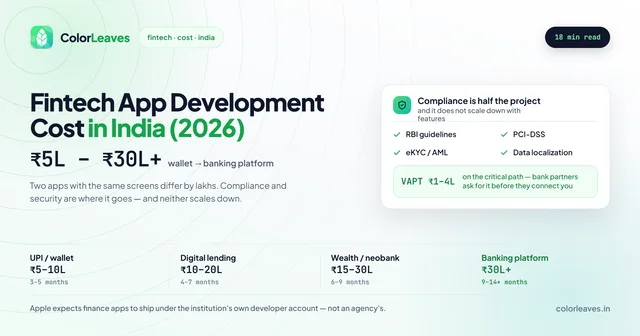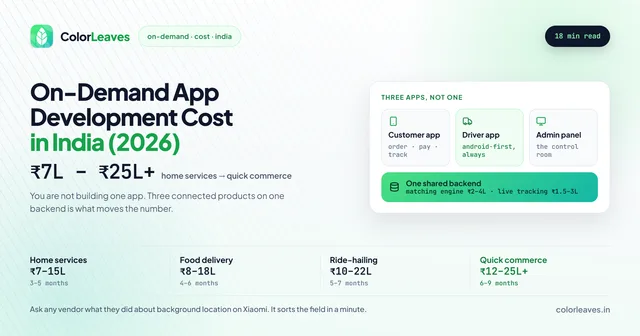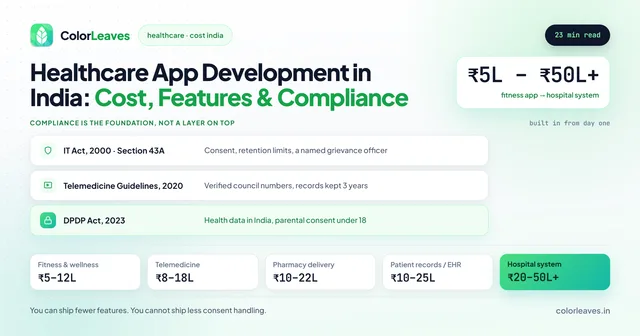
Property buyers in India start their search on a phone now. They scroll listings on the train, save flats during lunch, and message agents at midnight. That shift is why builders, brokers, and proptech founders keep asking us the same thing: what does a real estate app actually cost to build in 2026? The honest answer depends on what you’re building. A simple listing app and a premium platform with 3D walkthroughs sit at very different price points.
It also depends on something most cost guides skip entirely, which is where your listings come from and who keeps them honest. There is a section on that below, because it decides more about whether a property app works than any feature in the tables.
Below we break down real estate app costs by type and by feature, cover the RERA pieces you can’t ignore, and give you realistic timelines so you can plan your launch.
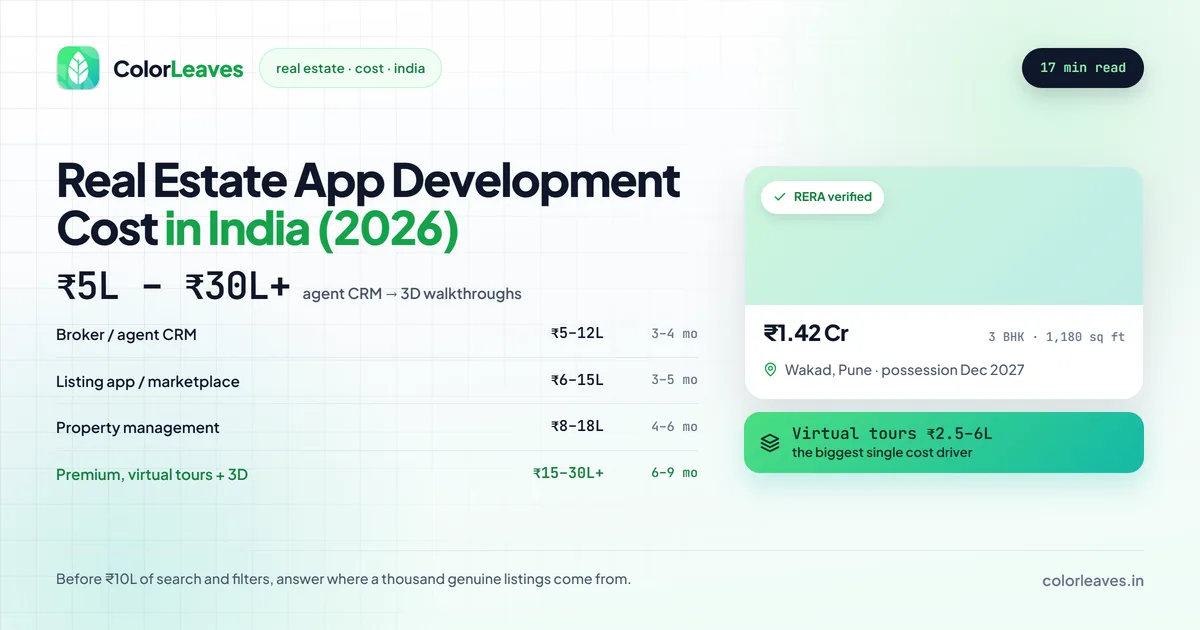
Key Takeaway: A real estate app in India costs about ₹6 to 15 lakhs for a property listing app or marketplace, ₹5 to 12 lakhs for a broker or agent CRM, ₹8 to 18 lakhs for a property management app, and ₹15 to 30 lakhs or more for a premium build with virtual tours and 3D walkthroughs.
Types of Real Estate Apps and What They Cost
The category you pick decides almost everything about your budget. Here are the four models we build most often in India.
Property listing app / marketplace. This is the 99acres or MagicBricks style of app. Buyers and renters browse listings, filter by location and budget, and contact owners or agents. You earn through listing fees, premium placements, or lead sales. The complexity sits in search, maps, and handling a large catalog of properties cleanly.
Broker / agent CRM. Built for agents and small brokerages to manage leads, follow-ups, and their property inventory. Less public-facing, more workflow heavy. The value is in lead tracking, reminders, and closing deals faster, not in flashy design.
Property management app. Used by builders, housing societies, and rental operators to handle tenants, rent collection, maintenance requests, and documents. It mixes payments, ticketing, and resident communication, so the backend gets heavier.
Premium build with virtual tours and 3D. The top tier. Virtual walkthroughs, 3D floor plans, AR furniture placement, and high-end UI. Luxury developers and well-funded proptech startups go here to stand out. It costs more because of the media handling, 3D integration, and the polish buyers expect at that level.
| App Type | Complexity | Estimated Cost Range | Timeline |
|---|---|---|---|
| Property Listing App / Marketplace | Medium | ₹6 to 15 lakhs | 3 to 5 months |
| Broker / Agent CRM | Low to Medium | ₹5 to 12 lakhs | 3 to 4 months |
| Property Management App | Medium to High | ₹8 to 18 lakhs | 4 to 6 months |
| Premium Build (Virtual Tours / 3D) | High | ₹15 to 30 lakhs+ | 6 to 9 months |
Feature-by-Feature Cost Breakdown
Knowing what each feature costs helps you build a smart MVP instead of paying for everything at once. For a wider view of how app pricing works in India, see our complete app development cost breakdown.
| Feature | Cost Range | Notes |
|---|---|---|
| Map-based property search | ₹1.5 to 3 lakhs | Google Maps integration, draw-on-map search, nearby points of interest |
| Advanced filters & sorting | ₹80K to 1.5 lakhs | BHK, budget, locality, furnishing, possession status, amenities |
| Property listings & detail pages | ₹1 to 2 lakhs | Photo galleries, specs, pricing, owner or agent info |
| Virtual tours / 3D walkthroughs | ₹2.5 to 6 lakhs | 360 degree tours, 3D floor plans, optional AR placement |
| Lead management & inquiries | ₹1 to 2 lakhs | Inquiry capture, lead routing, status tracking |
| EMI / home loan calculator | ₹30K to 60K | Interest, tenure, down payment, monthly EMI output |
| In-app chat & calling | ₹1 to 2 lakhs | Buyer to agent messaging, call masking for privacy |
| Agent / broker CRM module | ₹1.5 to 3 lakhs | Pipeline, follow-up reminders, notes, performance reports |
| Saved searches & alerts | ₹50K to 1 lakh | Wishlist, price-drop alerts, new-listing notifications |
| Admin dashboard | ₹1.5 to 3 lakhs | Listing approvals, user management, analytics |
These are standalone figures. Bundle the features into one build and you usually save 15 to 20% because of shared infrastructure and reusable components. Map-based search and virtual tours are the two line items that move budgets the most, so decide early whether you need them on day one.
A Smart MVP Approach
You don’t need every feature to launch. Most listing apps do well starting with map search, filters, detailed listings, an EMI calculator, and lead capture. Add virtual tours and a full agent CRM in version two once you’ve seen how users behave. That keeps your first build closer to the ₹6 to 9 lakh range and gets you to market faster. Our MVP costing guide covers how to scope a first version that actually answers a question, and the MVP development page covers how we run those builds.
Where Do the Listings Actually Come From
The question that decides whether a property app works, and the one nobody puts in a budget.
A listing app with no listings is a blank screen. Before you spend ₹10 lakhs on search, filters and maps, work out how a thousand genuine properties get in there and who keeps them current. This is the same problem edtech has with content, and it kills more marketplaces than any engineering decision.
Four routes, each with a cost attached.
Onboard agents and brokers. The usual answer, and it is a sales cost rather than an engineering one. Someone has to sign them up, train them, and chase them to keep listings fresh. Budget for a field team, and build the agent-side upload flow properly, because an agent who finds posting painful posts once and never again. That flow deserves as much design attention as the buyer side, and it almost never gets it, since the buyer app is what everyone demos.
Licence a data feed. Some markets have aggregators who will sell you listings. Fastest way to look populated on day one. Check what the licence permits, particularly whether you can keep displaying the data if you stop paying.
Scrape competitors. Common, and worth understanding before you commit. Listing data sits in a genuinely contested area of Indian law, terms of service prohibit it almost universally, and the practical risk is that your supply disappears the day somebody blocks you. Building a business on a feed you do not control is a strategic problem more than a legal one.
Direct from owners. Slowest and highest quality. Works when you have a distribution advantage already, like a builder with existing projects.
Whatever route you pick, settle who owns the resulting database. If a development partner builds your scraper or your import pipeline, that data and the tooling around it should be yours, which is the same ownership question that applies to the code.
Fake Listings Will Find You
Every property marketplace in India has this problem, and it arrives faster than founders expect.
The patterns are consistent. The same flat posted by six brokers at five different prices. Properties that were sold months ago and never taken down. Bait listings at impossible prices to harvest enquiries. Photos lifted from another listing, or from a hotel website.
This matters commercially, because a buyer who calls three dead listings stops using your app, and it matters for review, because any product where users post content needs moderation, a way to report a listing, and a way to block a user before it will clear the App Store. That sits in the Safety category, which our guide to why apps get rejected covers alongside the other guidelines that catch products which never thought of themselves as social.
Budget ₹1.5 to ₹3 lakhs for the moderation layer. Duplicate detection on address and photo hashing, a report button that routes somewhere a human reads, listing expiry so stale properties drop off automatically, and an admin queue for approvals. Expiry is the cheapest of these and does the most work.
Verification is the more expensive version. Checking that a lister owns or is authorised to market a property costs real money per listing and is the main thing separating a trusted marketplace from a noticeboard. Most start without it and add it once the complaints justify the spend.
RERA and Legal Considerations
Real estate in India runs under the Real Estate (Regulation and Development) Act, and your app can’t pretend it doesn’t exist. A few things matter from the start.
Display the RERA registration number. Every regulated project listed should show its RERA ID. Buyers check it, and in several states it’s expected on any advertised listing. Build a field for it in your listing schema and make it visible on the detail page.
Link to the state RERA portal. Letting users verify a project on the official state portal builds trust and keeps you on the right side of advertising norms. Some apps pull project status directly where the state offers an API.
Honest listings. Carpet area, possession dates, and pricing have to match what’s filed. Misleading listings carry real penalties under RERA, so your verification or approval workflow should flag obvious mismatches before a listing goes live.
Data and payments. If you collect token amounts, booking fees, or rent, you’ll need a compliant payment gateway and clear records. Anything holding money on behalf of somebody else pulls you toward regulated territory, which our fintech development guide covers and our fintech team page covers from the build side. Keep user data handling clean too, especially phone numbers and KYC documents, since India’s Digital Personal Data Protection Act now applies to how you store and share them.
Worth noting that property transactions are real-world services, so Apple’s 30 percent in-app purchase cut does not apply to booking fees or rent. Use a normal payment gateway.
None of this is hard to build, but it should be planned at the design stage. Retrofitting RERA fields and verification flows into a finished app costs more than baking them in from the start.
Development Timeline
Timeline planning lets you line up marketing, agent onboarding, and your launch. For a phase-by-phase view of how a build runs, read our mobile app development timeline guide.
| App Type | Discovery & Planning | Design | Development | Testing & QA | Total |
|---|---|---|---|---|---|
| Broker / Agent CRM | 1 to 2 weeks | 2 to 3 weeks | 6 to 8 weeks | 1 to 2 weeks | 3 to 4 months |
| Property Listing App | 2 to 3 weeks | 3 to 4 weeks | 8 to 12 weeks | 2 to 3 weeks | 3 to 5 months |
| Property Management App | 2 to 3 weeks | 3 to 5 weeks | 10 to 16 weeks | 2 to 4 weeks | 4 to 6 months |
| Premium Build (3D / Virtual Tours) | 3 to 4 weeks | 5 to 7 weeks | 16 to 24 weeks | 3 to 5 weeks | 6 to 9 months |
These assume a dedicated team working through the build. Add a 20 to 30% buffer for revisions and scope changes, because they happen on almost every project. Virtual tours in particular tend to stretch the timeline since you’re often coordinating with a 3D vendor or a photography team for the actual property content.
Tech Stack for Real Estate Apps
The stack affects performance, scalability, and your maintenance bills later. Here’s what we typically reach for.
Mobile. Cross-platform development with Flutter or React Native gives you Android and iOS from one codebase and trims 30 to 40% off the build cost. For most real estate apps that’s the right call. We compare the two frameworks in our Flutter vs React Native guide.
Backend. Node.js handles concurrent listing requests and chat well. Python with Django works if you’re planning recommendation features or heavy data processing on listings.
Database. PostgreSQL for structured listing and transaction data, with a search layer like Elasticsearch when your catalog grows large and filtering needs to stay fast.
Maps. Google Maps Platform is the standard for location search, draw-on-map, and nearby amenities. Budget for its usage-based pricing as your traffic grows.
Media. Cloud storage plus a CDN keeps property photos and 360 degree tours loading quickly across India.
Photos deserve more attention than they usually get. A property app is essentially an image browser, and agents upload 6MB phone photos without thinking about it. Resize and compress on upload, serve device-appropriate sizes rather than one large file, and lazy-load the gallery. Skip this and two things happen: your CDN bill climbs, and the app becomes unusable on the mid-range Android handsets a large share of Indian buyers carry. Loading full-resolution images into a scrolling list is the classic way to get an app killed on a 3GB device, which our piece on Android device fragmentation goes into. Test it on real hardware through a Play internal track before launch rather than after.
If your catalogue and search start resembling a shopping app more than a property one, the ecommerce cost guide and our ecommerce development page cover that architecture, since large catalogues with heavy filtering are the same engineering problem wearing different labels.
Why Build Your Real Estate App in Pune
If you’re weighing where to get your app built, Pune is worth a serious look.
Lower cost, comparable quality. Development costs in Pune run 40 to 60% below Bangalore or Mumbai because salaries and office costs are lower, and our city rate comparison shows where that gap comes from. The work doesn’t suffer for it. Plenty of Pune developers have backgrounds at firms like Infosys, TCS, and Persistent.
Deep talent pool. The Hinjewadi, Kharadi, and Magarpatta IT hubs hold thousands of tech companies, and the mobile development talent here keeps growing as engineering graduates enter the workforce every year.
Pune is also a live property market in its own right, which helps. A team that has watched Hinjewadi rents move and knows why Wakad listings behave differently from Kothrud ones asks better questions about your filters than a team reading a spec.
At Color Leaves, we’ve been shipping mobile apps from Pune for over a decade. We offer dedicated real estate app development that covers map-based search, listing management, agent CRM, RERA-ready listings, and virtual tours. We build apps that move leads and close deals, not ones that just look good in a pitch deck. Take a look at some of our past work on our portfolio page, including StockGenie, where handling live data cleanly was most of the project.
Worth comparing a few firms before you commit. Our list of Pune app development companies includes our competitors, and how to choose a development company covers what to ask all of them.
Frequently Asked Questions
How much does it cost to build a real estate app in India?
A property listing app or marketplace costs about ₹6 to 15 lakhs. A broker or agent CRM runs ₹5 to 12 lakhs, a property management app sits at ₹8 to 18 lakhs, and a premium build with virtual tours and 3D walkthroughs starts around ₹15 lakhs and goes up to ₹30 lakhs or more. Your feature set and whether you need 3D content drive the final number.
What features add the most to a real estate app’s cost?
Virtual tours and 3D walkthroughs are the biggest cost drivers, often adding ₹2.5 to 6 lakhs. Map-based property search is the next heaviest at ₹1.5 to 3 lakhs because of the map integration and draw-on-map functionality. A full agent CRM module and in-app chat with call masking also add meaningfully. Standard features like an EMI calculator and saved searches are comparatively cheap.
Do I need RERA compliance built into my app?
Yes, if you list regulated projects. Your app should display the RERA registration number on listings, ideally link to the state RERA portal for verification, and keep listing details (carpet area, possession dates, pricing) accurate. Plan these at the design stage. Adding them after the build is finished costs more than including them from the start.
How long does it take to build a property app?
A broker CRM takes 3 to 4 months. A property listing app runs 3 to 5 months, a property management app 4 to 6 months, and a premium build with 3D tours 6 to 9 months. These windows include design, development, and testing. Coordinating 3D or 360 degree property content can add time, so factor that in. Our timeline guide breaks down each phase.
Should I build a native or cross-platform real estate app?
Cross-platform with Flutter or React Native is the practical choice for most real estate apps. You get both Android and iOS from one codebase and save 30 to 40% versus building two native apps. The performance is more than enough for listings, maps, and chat. Native only makes sense if you’re pushing heavy AR or specialized 3D rendering.
What ongoing costs should I plan for after launch?
Budget for server hosting (₹5,000 to 30,000 per month based on traffic), Google Maps usage fees that scale with searches, a CDN for property images (₹2,000 to 10,000 per month), and app maintenance at roughly 15 to 20% of the build cost per year for updates and fixes. There are also the standard store fees: a one-time $25 Google Play registration and $99 per year for Apple, which our app publishing cost guide covers in full.
Ready to Build Your Real Estate App?
You might be a builder wanting your own branded listing app, a brokerage that needs a CRM to stop losing leads, or a proptech founder chasing the next 99acres. We can help you scope it right and build it without blowing your budget. We’ll point you to the features that matter for your MVP, pick a tech stack that scales, and ship an app your users actually open.
Get a free project estimate. Tell us what you’re building, and we’ll send back a detailed proposal with feature-wise pricing and a timeline. Want to see our work first? Browse our portfolio.
Cross-Platform for Property Apps
Listing browsing, saved searches, photo galleries and agent messaging all behave the same on both platforms, which makes property apps a natural cross-platform fit. The exception is virtual tours, where heavy 3D rendering occasionally justifies going native.
Our hybrid app development page covers where that line sits. For most property products, React Native does the job at meaningfully lower long-term cost than maintaining two native builds, and Flutter is the better call when the listing interface itself is what buyers judge you on.
Whichever route you take, the step by step build guide covers the sequence, and if you are staffing a team rather than buying a build, what it costs to hire developers in India covers the rate bands and how to hire app developers in India covers the process.