India runs on digital money now. UPI alone processes over 18 billion transactions a month, lending apps disburse small-ticket loans in minutes, and millions of people manage their savings, mutual funds, and insurance from a single screen. If you’re planning to build a fintech app in 2026, the first thing you want to know is what it costs and what’s actually involved. The honest answer depends heavily on what kind of fintech product you’re building and how much compliance work it drags in.
This guide breaks down fintech app development costs in India by app type and feature, covers the regulatory side that most cost calculators ignore, and gives you realistic timelines.
Two things below are worth reading even if you skip the rest. Finance apps face rules at the app store that no other category does, and the security work is a genuine line item rather than a phrase in a proposal.
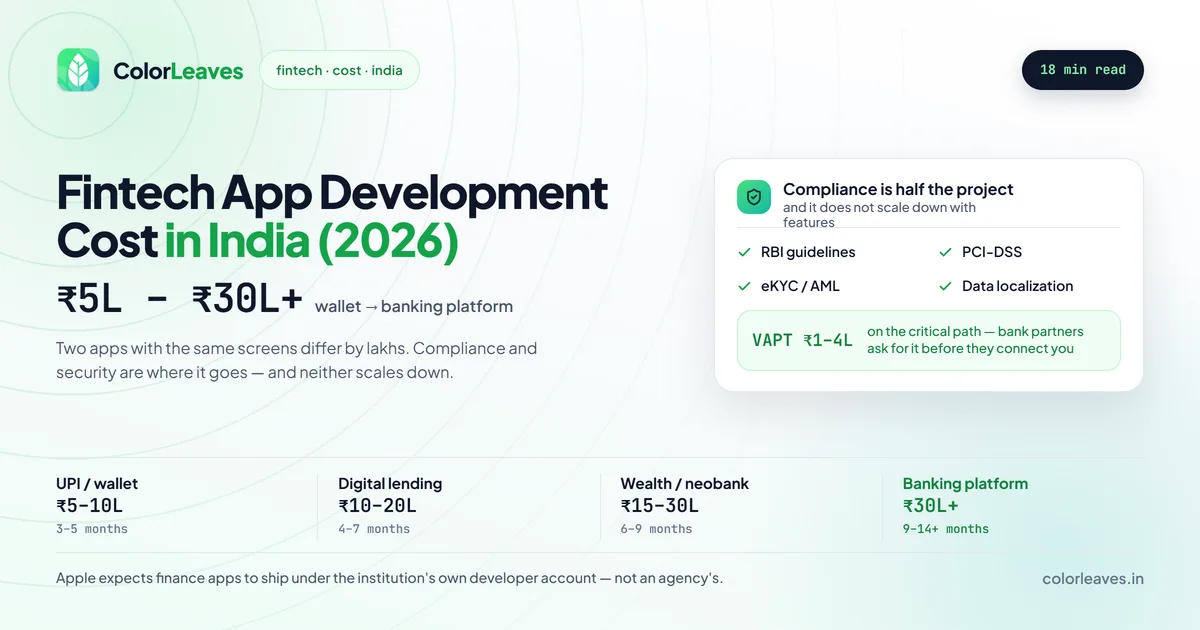
Key Takeaway: Building a fintech app in India costs about ₹5 to 10 lakhs for a UPI or digital wallet app, ₹10 to 20 lakhs for a digital lending app, ₹15 to 30 lakhs for an investment, wealth, or neobank app, and ₹30 lakhs and up for a full banking platform. Compliance and security drive a big chunk of that.
Types of Fintech Apps and What They Cost
Fintech is a wide category. A simple wallet app and a full neobank sit at opposite ends of the complexity scale, and the price gap reflects that. Here are the main types we build in India.
UPI / Digital Wallet apps: Peer-to-peer payments, bill splits, recharges, QR scan-and-pay, and a stored wallet balance. Think of the payment layer in apps like a smaller PhonePe or Paytm clone. These integrate with a UPI provider and a payment gateway rather than building the rails from scratch.
Digital Lending apps: Personal loans, BNPL, salary advances, and small-business credit. The complexity here isn’t the UI. It’s the credit decisioning, the loan management system, repayment scheduling, and the compliance around RBI’s digital lending guidelines.
Investment / Wealth / Neobank apps: Mutual funds, stocks, fixed deposits, goal-based savings, or a neobank front-end sitting on top of a partner bank. These need real-time data feeds, portfolio dashboards, and tight integration with banking and broker APIs. Our StockGenie case study covers what building one of these actually involves, where getting the market data right took more effort than the AI did.
Full Banking Platforms: Account opening, core banking integration, cards, multi-product dashboards, and the whole regulatory stack. This is the top tier, and the cost reflects the scale and the audits involved.
| App Type | Complexity | Estimated Cost Range | Timeline |
|---|---|---|---|
| UPI / Digital Wallet | Medium | ₹5 to 10 lakhs | 3 to 5 months |
| Digital Lending | Medium to High | ₹10 to 20 lakhs | 4 to 7 months |
| Investment / Wealth / Neobank | High | ₹15 to 30 lakhs | 6 to 9 months |
| Full Banking Platform | Very High | ₹30 lakhs and up | 9 to 14+ months |
For a wider view of how fintech compares with other categories, our complete app development cost breakdown covers the full spread.
Feature-Wise Cost Breakdown
The most useful thing we can hand a client early on is what each feature actually costs. Fintech apps share a lot of building blocks, so once you know these numbers, you can plan an MVP that fits your budget. Here’s what the core pieces run in India.
| Feature | Cost Range | Notes |
|---|---|---|
| UPI integration / payment gateway | ₹1.5 to 3 lakhs | UPI handle setup, collect and pay flows, gateway integration (Razorpay, Cashfree) |
| eKYC / Aadhaar verification | ₹1 to 2.5 lakhs | Aadhaar OTP, DigiLocker, video KYC, PAN verification |
| Digital wallet & balance | ₹1.5 to 3 lakhs | Stored balance, load and withdraw, transaction ledger, reconciliation |
| Lending / credit engine | ₹3 to 6 lakhs | Eligibility checks, credit scoring, loan management, EMI scheduling |
| KYC / AML verification | ₹1 to 2 lakhs | Document checks, AML screening, sanction list matching, audit logs |
| User & admin dashboards | ₹2 to 4 lakhs | Customer dashboard, transaction history, admin panel, reporting |
| Push notifications & alerts | ₹40K to 80K | Transaction alerts, EMI reminders, OTP delivery |
| Security layer (encryption, 2FA) | ₹1 to 2.5 lakhs | Data encryption, biometric login, fraud monitoring, device binding |
These are standalone figures. Bundle them into one project and you usually save 15 to 20% because of shared infrastructure and reusable components. The lending engine and the security layer are where most budgets get heavier than people expect, so plan around them early.
Cost Breakdown by App Tier
Here’s the picture most founders ask for first. This maps scope, platform, and price across the three tiers we see most often.
| Category | UPI / Wallet App | Lending / Neobank App | Full Banking Platform |
|---|---|---|---|
| Scope | Payments, wallet, basic KYC | Loans or wealth, full KYC, decisioning | Core banking, multi-product, cards |
| Platforms | Android + iOS (cross-platform) | Android + iOS + web admin | Android + iOS + web + back office |
| Key Features | UPI, wallet, QR pay, transaction history | Credit engine, eKYC, dashboards, repayments | Account opening, core banking APIs, cards |
| Compliance | PCI-DSS, basic KYC | RBI lending guidelines, KYC/AML | Full RBI stack, audits, data localization |
| Backend | Standard APIs | Scalable, secure architecture | Microservices, high-availability systems |
| Cost Range | ₹5 to 10 lakhs | ₹10 to 30 lakhs | ₹30 lakhs and up |
| Timeline | 3 to 5 months | 4 to 9 months | 9 to 14+ months |
Most early-stage fintech startups should launch lean. You don’t need every product line on day one. Ship a tight payment or lending flow that works flawlessly, get your compliance approvals sorted, then add features in version two once you have real users and real transaction data. Our MVP costing guide covers scoping that first version, though fintech is the category where “lean” has a hard floor, because the compliance work does not scale down with the feature list.
Getting a Finance App Through App Review
Fintech faces store rules no other category does, and finding out late is expensive.
Apple expects banking and financial apps to be submitted by the financial institution itself. Not by an agency, not by a contractor, not under a development partner’s account. If your app is built by an outside team and published under their Apple Developer account, that is grounds for removal regardless of how good the code is. The account must be registered to your company, which means sorting the D-U-N-S number early because it takes longer than teams expect. Our Apple Developer account guide covers the process, and who owns your code covers why this matters beyond compliance.
Reviews take longer here. Finance sits alongside health and kids as a category reviewers scrutinise more carefully, and they will ask you to demonstrate that the app does what it claims. Supply working test credentials with a funded demo account. A reviewer who cannot get past your KYC flow rejects, and that is entirely avoidable.
Expect questions about your regulatory standing. Apple and Google both ask financial apps to evidence the licences or partnerships they operate under. Have the NBFC or bank partnership documentation ready rather than assembling it during a review cycle.
Our breakdown of why apps get rejected covers the guidelines behind this, and the rejection rate data shows what a cycle costs in schedule. Build a fortnight of slack in rather than a few days, since fintech reviews routinely sit longer than the published averages. On the Android side, our Play Console guide covers the equivalent setup and the publishing cost breakdown covers the fees.
The Security Work, Itemised
“Security layer” appears as one line in most proposals. In fintech it is several distinct pieces of work, and knowing what they are lets you tell a serious quote from a hopeful one.
Root and jailbreak detection stops the app running on a compromised device, or degrades it to read-only. Standard for any app moving money.
Certificate pinning prevents traffic interception on a network you do not control. Straightforward to implement and easy to get subtly wrong, particularly in cross-platform frameworks where the networking layer sits behind an abstraction.
Code obfuscation and anti-tampering raise the cost of reverse engineering your APK, which is a real activity in the Indian lending space.
Screenshot and screen-recording blocking on sensitive screens. Cheap, and expected by most bank partners.
Device binding and session management. Tying an account to a known device, with a proper re-verification flow when somebody changes phone. Gets more product design attention than it sounds like it needs.
Secure local storage. Keychain on iOS, Keystore on Android, and a firm rule that tokens never touch shared preferences or plist files.
Then the audit. A VAPT engagement before launch runs roughly ₹1 to ₹4 lakhs depending on scope, and you should budget for a retest after fixes rather than assuming the first pass is clean. Bank and NBFC partners frequently require this before they will connect you to anything, so it belongs on the critical path rather than at the end.
Two more obligations that catch teams. CERT-In directions require certain incident reporting within six hours and log retention, which is an infrastructure decision rather than a policy one. And India’s Digital Personal Data Protection Act now sits alongside the RBI rules, so if you are working with an outside development team, production data access needs to be named, time-limited and logged rather than a shared credential. Who carries liability for a breach should be settled in the contract before it is tested, which our contract checklist covers.
Compliance Is Half the Project
This is the part that separates fintech from every other app category. You can build a beautiful payment app, but if it doesn’t clear the regulatory checks, it doesn’t go live. Budget time and money for this from the start, not as an afterthought.
RBI Guidelines
The Reserve Bank of India sets the rules for payments, wallets, and lending. If you’re issuing a wallet, you may need a PPI (Prepaid Payment Instrument) authorization or you partner with a licensed issuer. Lending apps must follow RBI’s digital lending guidelines, which cover how you disclose loan terms, how you handle data, and how you collect repayments. Working with a licensed NBFC or bank partner is the common route for startups, since getting your own license is slow and capital-heavy.
PCI-DSS
Any app that touches card data needs PCI-DSS compliance. Most teams avoid storing card numbers directly and instead use a compliant payment gateway, which shifts a lot of the burden. You still need secure handling of tokens, encrypted storage, and regular security testing. Budget for a security audit before launch.
KYC / AML
Know Your Customer and Anti-Money Laundering checks are mandatory. That means Aadhaar-based eKYC, PAN verification, video KYC for higher-value accounts, and ongoing screening against sanction and watchlists. The eKYC integration alone is a real line item, and you’ll want audit logs that hold up if a regulator asks questions.
Data Localization
RBI requires that payment data be stored within India. Your hosting, your databases, and your backups all need to sit on Indian servers or Indian regions of cloud providers like AWS Mumbai or Google Cloud Mumbai. This affects your infrastructure choices, so lock it down before you architect the backend.
Technology Stack for Fintech Apps
The stack matters more in fintech than almost anywhere else, because security and uptime aren’t optional. Here’s what we typically recommend.
Frontend
Cross-platform development with Flutter works well for most fintech apps. You get Android and iOS from one codebase and save 30 to 40% versus building two native apps. For apps with heavy security requirements or deep hardware integration, native (Kotlin and Swift) is worth the extra cost. Flutter versus React Native works through the tradeoff, and the hybrid development overview covers what either team looks like.
One caveat specific to this category. Several of the security items above sit closer to the platform than typical app code, so a cross-platform team needs somebody who can write and debug native modules. That is worth confirming during interviews rather than discovering when certificate pinning has to be implemented twice.
Test on real hardware too. Biometric prompts, secure storage and device binding all behave differently across manufacturers, and our piece on Android device fragmentation covers building a matrix that catches it. Get builds to your compliance and partner-bank contacts early through a Play internal track or TestFlight, because their feedback arrives slowly and you want it before code freeze.
Backend
Node.js handles concurrent transaction loads well and suits real-time payment flows. Java Spring Boot is the enterprise pick for lending and banking platforms that need rock-solid reliability and strong typing. Python works if you’re building credit scoring or fraud models on top.
Database & Infrastructure
PostgreSQL is the reliable choice for transactional, structured financial data. Host on AWS Mumbai or Google Cloud Mumbai to satisfy data localization. Add encryption at rest and in transit, plus proper key management. This isn’t where you cut corners.
Payment & KYC Partners
Razorpay and Cashfree cover UPI, cards, and payouts. For eKYC and verification, providers like Signzy, HyperVerge, and Karza handle Aadhaar, PAN, and video KYC through clean APIs, which saves you building those integrations from scratch.
Development Timeline
Fintech timelines run longer than a typical app because of testing, security audits, and compliance sign-offs. Here’s a realistic phase-by-phase view. For a deeper look at how we structure phases, read our mobile app development timeline guide.
| App Type | Discovery & Compliance | Design | Development | Testing & Audit | Total |
|---|---|---|---|---|---|
| UPI / Wallet | 2 to 3 weeks | 3 to 4 weeks | 8 to 12 weeks | 2 to 4 weeks | 3 to 5 months |
| Lending / Neobank | 3 to 5 weeks | 4 to 5 weeks | 12 to 20 weeks | 4 to 6 weeks | 4 to 9 months |
| Full Banking | 5 to 8 weeks | 5 to 7 weeks | 24 to 40 weeks | 6 to 10 weeks | 9 to 14+ months |
Add a 20 to 30% buffer. Regulatory approvals and partner bank onboarding often take longer than the code itself, and that’s outside your team’s control. Build it into the plan.
Why Build Your Fintech App in Pune
Pune is a strong base for fintech development, and the cost math is a big reason.
Development costs run 40 to 60% lower than Bangalore or Mumbai, and that saving reaches you directly without a drop in quality. Our city by city rate comparison shows where the gap comes from. Many Pune developers have built financial systems at firms like Persistent, TCS, and Infosys before moving to product work. Pune’s IT hubs in Hinjewadi, Kharadi, and Magarpatta hold a deep talent pool, including engineers who’ve worked on secure, regulated systems. That experience matters when you’re handling money and audits.
At Color Leaves, we’ve been building mobile apps from Pune for over a decade. Our team offers dedicated fintech app development services covering UPI integration, eKYC, lending engines, and the security and compliance work that keeps you on the right side of RBI. We’ve also written about cost patterns in adjacent categories, like our e-commerce app development cost guide and our ecommerce development page, since payment integration overlaps heavily between the two. The parallel worth knowing is healthcare, which is the other category where regulation shapes the architecture rather than sitting on top of it.
See some of our past work on our portfolio page. If you are shortlisting firms, our list of Pune app development companies includes competitors and how to choose a development company covers what to ask them. For fintech, ask who holds the developer account on their last finance project. The answer tells you whether they have shipped in this category at all.
Frequently Asked Questions
How much does it cost to build a UPI payment app in India?
A UPI or digital wallet app costs about ₹5 to 10 lakhs in India. That covers UPI integration, a stored wallet, QR pay, transaction history, basic KYC, and a cross-platform build for Android and iOS. The price moves up if you add bill payments, recharges, or split-payment features. Most of the cost sits in the payment integration and the security layer rather than the UI.
Why are fintech apps more expensive than other apps?
Compliance and security. A fintech app carries regulatory work that a regular app doesn’t: RBI guidelines, PCI-DSS, KYC/AML, data localization, and a pre-launch security audit. The lending engine, fraud monitoring, and encryption all add real development hours. Two apps with similar screens can differ by lakhs once you factor in the regulated parts.
Do I need an RBI license to launch a fintech app?
Not always. Many startups partner with a licensed bank or NBFC instead of getting their own license, which is slow and capital-heavy. A lending app usually works with an NBFC partner, and a wallet app either gets a PPI authorization or rides on a licensed issuer. Your compliance path should be decided before development starts, because it shapes the architecture.
How long does it take to build a fintech app?
A UPI or wallet app takes 3 to 5 months. A lending or neobank app takes 4 to 9 months. A full banking platform can run 9 to 14 months or more. These include design, development, testing, and security audits. Regulatory approvals and partner onboarding can stretch the real launch date, so plan a buffer.
What ongoing costs should I expect after launch?
Plan for these recurring costs once your fintech app is live:
- Server hosting (India region): ₹15,000 to 60,000 per month depending on traffic
- eKYC / verification fees: per-check pricing from your KYC provider
- Payment gateway fees: roughly 1.5 to 2% per transaction
- Security audits & compliance: annual audits and renewals
- App maintenance: 15 to 20% of build cost per year for fixes, OS updates, and new features
Total ongoing cost for a mid-level fintech app typically lands at ₹50,000 to 1.5 lakhs per month, excluding transaction commissions.
Two costs sit outside that list and both can dwarf it. eKYC is charged per attempt rather than per successful customer, so a clumsy onboarding flow where people fail and retry is a direct cash cost as well as a conversion problem. And fraud is an operating expense: chargebacks, failed collections, and the people needed to investigate them. Model both before you set pricing.
RBI also expects a grievance redressal mechanism with a named nodal officer and published turnaround times for payment and lending apps. That is a support function with a headcount attached, not a page in the app. Whoever handles your ongoing maintenance should have a defined support arrangement covering incident response, because “we will look at it tomorrow” is not an answer when money has moved.
Ready to Build Your Fintech App?
Maybe you’re a startup launching your first payment product, or an established lender ready to move from web to mobile. We can help you scope it properly, get the compliance right, and build something that holds up under real transaction volume.
At Color Leaves, we’ve delivered 50+ mobile apps over the past decade, including payment and finance products built around Indian regulations. We’ll help you pick the right features for your MVP, choose a secure stack, and ship an app your users trust with their money.
Get a free project estimate. Tell us what you’re building, and we’ll send back a detailed proposal with feature-wise pricing, a compliance plan, and a timeline.
Want to see our work first? Browse our portfolio.
Where Fintech Apps Usually Land
Two things shape this decision. Biometric authentication and secure storage go deeper on native, and if your users are American, iOS carries most of the spending. Plenty of fintech products end up native iOS first for those reasons alone.
Our iOS app development in India page covers how we keep PCI scope narrow and what App Review looks for in finance apps, and the Pune iOS team page has the same for local clients. Where Android matters equally, React Native covers both from one codebase.
If you are staffing a team rather than buying a build, what it costs to hire developers in India covers the rate bands and how to hire app developers in India covers the process. Fintech is the category where paying for seniority is most clearly worth it, because the expensive mistakes here are the ones nobody notices until they matter.