Almost everything written about the risks of offshore app development is written by someone with a stake in the answer. American agencies publish lists of reasons not to go offshore. Offshore agencies publish reassurance. Neither is much use when you are the one making the decision.
We build apps from Pune, so we have a stake too, in the other direction. What follows is the list we would want if the positions were reversed. Some of these are genuinely bad and cannot be engineered away. A few of the most commonly cited risks are, in our experience, not the real ones.
If you’re at the earlier question of whether to do this at all, our guide to hiring app developers in India covers the process and this covers what can go wrong with it. Read this one first. It’s the less flattering of the two.
Key Takeaway: The timezone gap is real and worse than most vendors admit, particularly for the US west coast. Quality variance across Indian firms is enormous, so averages tell you nothing about the one in front of you. Cross-border legal recourse is mostly theoretical, which makes the contract a prevention tool rather than a remedy. Offshore is the wrong answer for very small projects and for products that need same-day iteration on unclear requirements.
The Timezone Gap Is Worse Than the Brochures Say
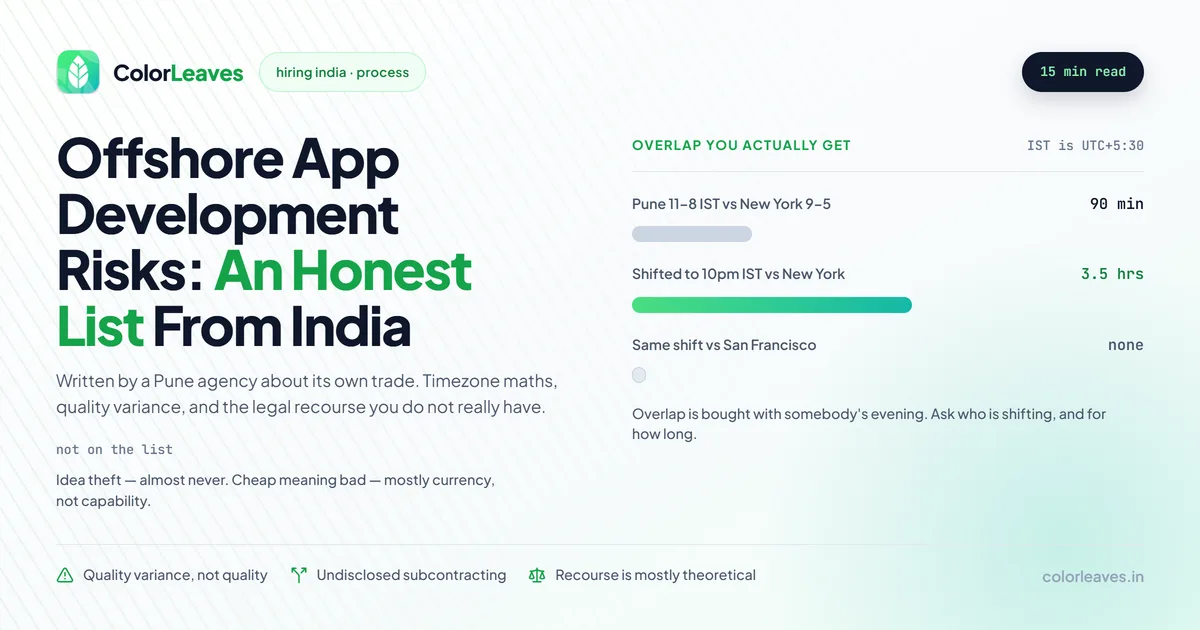
India Standard Time is UTC+5:30. From March to November that puts us 9 hours 30 minutes ahead of US Eastern and 12 hours 30 minutes ahead of US Pacific. In winter, add another hour to both.
Work the arithmetic through rather than trusting a phrase like “significant overlap”.
An Indian team working a normal day, say 11am to 8pm IST, finishes at 10:30am Eastern. Against a 9 to 5 Eastern day that is 90 minutes of overlap. To reach three or four hours, the Indian team has to work until roughly 10pm IST, every day, indefinitely.
For US Pacific it is harder. A team working until 10pm IST signs off at 9:30am Pacific, which is the moment your day begins. Meaningful Pacific overlap means Indian engineers working past midnight.
That is the honest position, and it has consequences worth stating plainly:
- Question and answer cycles stretch. A blocking question asked at 3pm Eastern is answered the next morning. Two ambiguous questions in a row can cost two days.
- Overlap is bought with someone’s evening. Any vendor promising a large overlap is describing a shifted schedule. Ask who is shifting and whether it is sustainable, because a team quietly working 2pm to 11pm IST for six months does not stay the same team.
- It punishes unclear requirements hardest. If your specification is solid, asynchronous work is efficient and the gap barely registers. If you are still discovering what you want, the gap is expensive.
There is a genuine upside people forget. Work handed over at the end of your day is often finished when you wake up, so a well run offshore engagement can feel faster than a local one on well defined work. That only holds when the work is well defined.
The gap also compounds against anything with a queue behind it. A build waiting on your approval, a store submission waiting on your metadata, a review rejection needing a decision about scope. Each of those turns a half day of work into two days of calendar. Factor it into the project timeline rather than discovering it in month three.
Quality Variance Is the Real Risk, Not Quality
India has an enormous number of software firms, from serious engineering companies to two people who will subcontract your project the day after signing. Both are marketed with the same words, the same stock photography and similar rates.
This is why aggregate statistics about Indian development quality are useless. There is no meaningful average. The distribution is what matters, and the distribution is wide.
The practical consequence is that vendor selection carries far more weight offshore than locally. If you hire a mediocre local agency you can drive to their office. If you hire a mediocre offshore agency you will discover it through a series of missed deadlines explained in increasingly vague emails.
What actually distinguishes firms is boringly checkable:
- Will they let you interview the specific engineers who will do the work, not a sales lead and a rotating cast afterwards
- Will they show you a repository with real commit history rather than a polished case study
- Will they start with a small paid piece of work instead of a six month commitment
- Do they say no to anything, or does every question get an enthusiastic yes
Interview the engineers yourself even if you are not technical. Our list of interview questions for mobile developers is written to be usable by someone who cannot read the code, and how a candidate handles a question they do not know the answer to tells you most of what you need.
Rates are a weak signal on their own but not a useless one. Our breakdown of what it costs to hire in India sets out the bands by seniority, and the comparison across Pune, Bangalore and Mumbai explains why the same role prices differently by city. A quote far below both is worth asking about rather than celebrating.
Our guide to choosing a development company covers the wider selection process, and the list of Pune firms includes our competitors, because a shortlist of one is not a shortlist.
Subcontracting You Were Not Told About
This deserves its own heading because it is common, rarely disclosed, and changes who you are actually hiring.
A firm wins work it does not have the capacity or the skills to do, then passes some or all of it to another firm. You still talk to the same account manager. The code is written by people whose names you never learn, at a company you never evaluated, under terms you never saw.
It is not automatically a disaster. Plenty of good agencies use specialist partners for a defined piece, a Flutter module or an iOS build inside a mostly Android project. Done openly, that’s a sensible use of a network. The problem is when it isn’t disclosed, because every check you ran was run against the wrong company.
Ask directly, in writing, whether any part of the work will be performed by anyone outside the company you are contracting with. Then compare the claimed team size against the headcount you can actually find. A firm advertising fifty engineers with twelve people findable is either exaggerating or subcontracting, and both are worth knowing.
Put a clause in the contract requiring written consent before any part of the work is subcontracted. Most reputable firms will agree without argument. The reaction to being asked is informative on its own.
Where Your Data Actually Lives
Barely discussed and increasingly the risk that carries real financial consequences.
Your development team will handle data. Test databases, production access during an incident, analytics, crash reports containing user records, screenshots in a support thread. Where that sits and who can reach it is a question you should be able to answer.
India’s Digital Personal Data Protection Act came into force in 2023, so there is now a genuine domestic framework rather than nothing. That’s an improvement, but it does not discharge your own obligations. If you have European users, GDPR makes you the controller and your development partner a processor, which requires a data processing agreement naming subprocessors and specifying where data is stored. If you’re American and building anything in healthcare, a business associate agreement is not optional and most Indian agencies have never signed one. Our healthcare development guide covers where those obligations differ by market.
Financial products carry their own version, including rules about where data physically resides. India requires certain payment data to stay in-country, which cuts both ways depending on where your users are.
The practical protections are unexciting. Developers work against synthetic or anonymised data by default. Production access is named, time-limited and logged rather than a shared credential. Cloud infrastructure sits in your accounts rather than theirs, so revoking access is something you can do unilaterally. None of this is expensive to set up at the start and all of it is painful to retrofit.
Legal Recourse Across Borders Is Mostly Theoretical
If an engagement goes badly wrong, your contract says you can sue. Consider what that means in practice: engaging Indian counsel, litigating in an Indian court under Indian procedure, and waiting. Commercial disputes in Indian courts routinely take years.
For a project in the tens of thousands of dollars, the cost of pursuing it exceeds what you would recover. Everyone in the industry knows this, which is precisely why it matters.
The conclusion is not that contracts are pointless. It is that the contract’s job is prevention rather than remedy. Structure the engagement so that a failure costs you one milestone rather than the project:
- Pay in short milestones, so the maximum you can lose is the work in flight
- Own the repository from the first commit, with the vendor added as collaborators
- Publish under your own Apple and Google Play developer accounts, never the vendor’s
- Take assignment of IP at each invoice rather than at project completion
We wrote those out properly in what to check before signing an offshore contract, and who owns your code explains why payment alone does not transfer copyright in either country. The point of all four is the same: make walking away cheap, because the ability to walk away is the only real power you will have.
Also worth doing, and frequently skipped: check that the company legally exists. Indian companies have a Corporate Identification Number and their filings are public through the Ministry of Corporate Affairs. It takes ten minutes.
”Yes” Does Not Always Mean Yes
Indian professional culture is generally less comfortable with direct disagreement than American or German business culture. Saying no to a client, particularly a paying overseas client, does not come naturally to a lot of engineers here.
The failure mode is not dishonesty. It is that “yes, we can do that” sometimes means “I have understood the request” or “I do not want to disappoint you in this meeting”. You find out at the deadline.
This one is manageable, and how a vendor handles it tells you a great deal:
- Ask questions that cannot be answered with yes. “What worries you about this timeline” gets further than “can you hit this timeline”.
- Treat an estimate with no caveats as a warning sign rather than confidence.
- Watch what happens the first time you propose something technically unwise. A team that pushes back in week two will push back in month six, when it matters more.
We would rather lose a pitch by saying a deadline is not realistic than win it and miss. That is easy to write on a website, so judge it on the call instead.
Turnover Can Hand Your Project to a Stranger
Attrition in Indian technology services runs high compared with equivalent US employers, and it is worst at large firms where an engineer’s fastest route to a raise is a new job.
For you, the risk is not the resignation itself. It is the silent replacement: the engineer who knew why your payment retry logic is shaped the way it is leaves, someone new is assigned, and the knowledge is gone. Nobody tells you, because on paper the headcount is unchanged.
Reasonable protections are simple. Ask the attrition question directly and ask for tenure of the specific people on your project. Insist that documentation and commit history live in your repository rather than in a shared drive you cannot see. Ask what the handover process is when someone does leave, and treat “that does not happen here” as a bad answer, because it does happen everywhere.
Smaller firms are not automatically better on this, but the answer is easier to verify, because you can ask how long the five people in the room have worked together.
The structural defence is that the work should not depend on anybody remembering things. Tests that describe intended behaviour, a readable commit history, decisions written down where they were made rather than in a chat thread. Teams that work this way survive a resignation. Teams that don’t lose a month per departure, and you pay for that month.
Ask to see the documentation from a finished project before you sign. Not a template, an actual one. Our walkthrough of the development process covers what should exist at each stage, and a firm that produces none of it is running on memory.
Long-lived products feel this most. Whoever holds your ongoing maintenance two years from now is almost certainly not the person who wrote the code, even if the logo on the invoice hasn’t changed.
What Does Not Belong on This List
Two fears come up constantly and neither matches what actually goes wrong.
Somebody will steal my idea. Almost never. Execution is the hard part and an agency stealing a client’s product would be destroying its own business to enter a market it does not understand. The genuine version of this risk is far more boring: you never get clean ownership of the code because the paperwork was sloppy, the repository stayed with the vendor, or the app was published under the agency’s store account. That is an administrative failure, not theft, and it is preventable in an afternoon.
Cheap means bad. The rate difference is mostly cost of living and currency, not a discount on capability. A senior engineer in Pune costs less because rent, food and transport cost less. What is true is that the cheapest offers are usually bad, because below a certain rate the only way to deliver is juniors with no supervision. Suspiciously low is a real signal. Lower than the US is not. Our breakdown of app development costs in India shows where the market actually sits, which is the number a quote should be judged against rather than against US pricing.
When Offshore Is the Wrong Answer
We turn work away for these reasons, so they are not hypothetical.
Very small projects. Below roughly fifteen thousand dollars, the coordination overhead of a timezone gap eats the saving. A local freelancer you can call is a better answer, and we will say so. If the budget is small because the scope is genuinely small, our MVP costing guide is a more useful starting point than any vendor conversation.
Products still being discovered. If the requirements will change weekly based on user conversations you are having, you want the builder in the room. Come back when the shape is clearer.
Work that must be physically present. Hardware integration, on-site installations, anything requiring someone at your facility regularly. Factory and warehouse systems often fall here, at least for the first phase, because somebody has to stand next to the machine.
Sub-24-hour incident response as a hard requirement. Possible to staff, expensive to staff honestly, and many vendors will promise it without the rota to support it. If uptime genuinely matters, price a real support arrangement separately and ask who is awake at 3am your time.
If none of those apply, the economics are genuinely good. If one of them does, no amount of process fixes it.
The Cheapest Way to Test All of This
Everything above is checkable in two weeks for a small fraction of a project budget.
Run a paid pilot. Give a candidate vendor a real, contained piece of work from your actual backlog. Not a take-home exercise, and not a proof of concept nobody will use. Something you genuinely need built, small enough to abandon.
Two weeks of that answers the questions no reference call will. You see how they estimate, whether they ask good questions, what their code looks like in your repository, how they behave when something takes longer than expected, and how the overlap hours feel in practice rather than on a slide.
Ask for a build you can install at the end of it, not a demo. Getting something onto TestFlight or a Play internal track exercises the whole pipeline, and a team that cannot get a build onto your phone in two weeks will not be faster in month six.
It is also the answer to the legal recourse problem. If the pilot goes badly you have lost two weeks and a small invoice, which is the point.
That is how our own dedicated developer engagements start, and we would suggest the same structure with any firm you are considering, including ones we are competing against. A vendor unwilling to start small is telling you something.
If you already know the stack, the specific pages are more useful than this one: React Native, Android and iOS each cover what that engagement looks like. StockGenie is a finished example, built in two months with four people and still holding a 4.5 rating.
If you want to talk through whether your project is a sensible fit for offshore work, get in touch. If it is not, we will say that too.