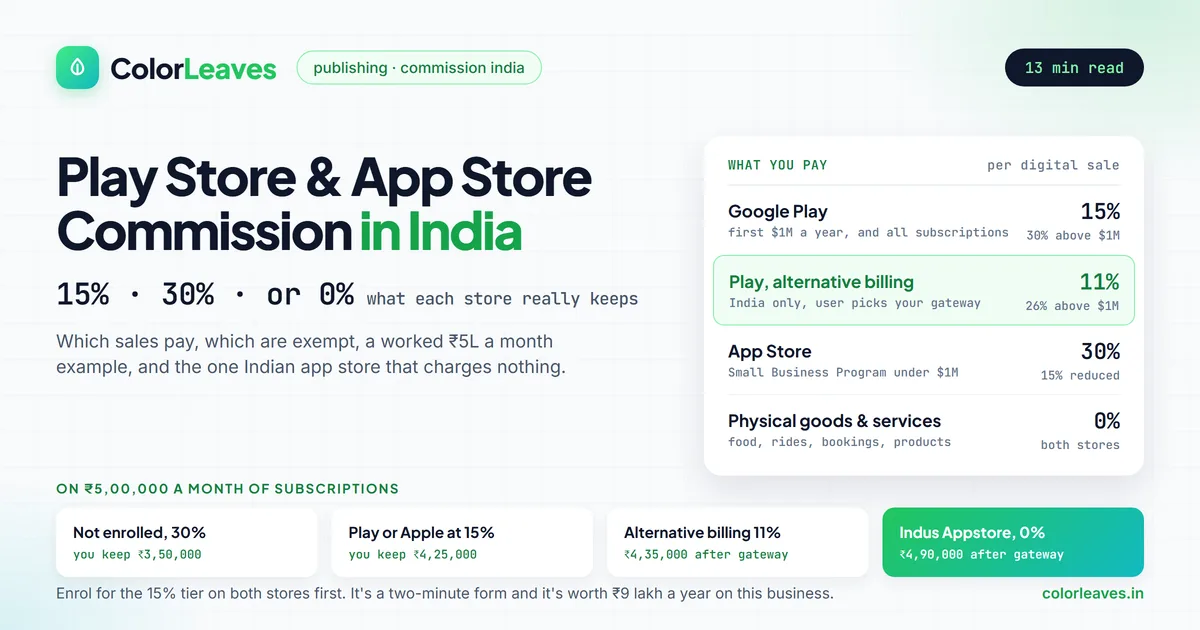
Play Store and App Store commission in India works out like this. Google keeps 15% of what your app earns from digital sales up to $1 million a year and 30% above that, or 11% and 26% if you offer an Indian payment option alongside Google’s. Apple keeps 30%, which drops to 15% if you earned under $1 million the year before. And if your app sells anything physical, or a service someone turns up to, both stores take nothing at all.
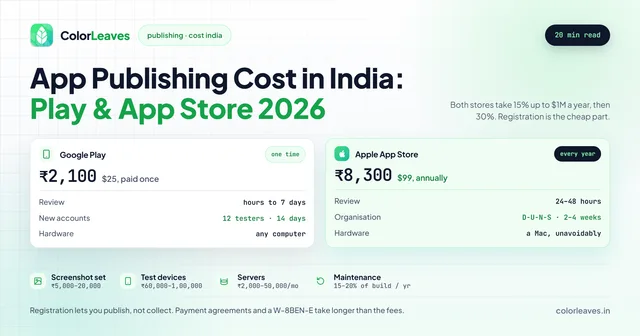
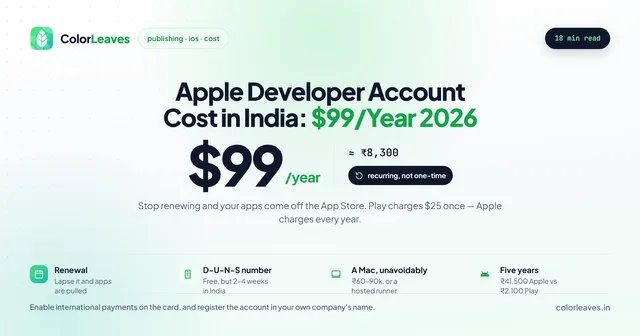
That last sentence is the one most founders miss. The commission question gets asked as if every rupee that passes through an app loses 30 paise to Google or Apple, and for most Indian apps that’s simply not how it works. This guide sets out what each store charges in 2026, which sales the cut applies to, what the numbers look like on a real subscription business in rupees, and the honest list of ways to pay less, including the one Indian app store that charges nothing. The account fees themselves, $25 once for Google and $99 a year for Apple, are a separate subject covered in our app publishing cost guide.
Key Takeaway: Google Play commission in India is 15% on the first $1M a year and 30% after, with subscriptions at 15% from day one. Offer alternative billing and both rates fall by four points to 11% and 26%. The App Store charges 30%, or 15% under the Small Business Program for developers under $1M in prior-year earnings, and Apple offers no alternative billing in India. Physical goods and real-world services pay 0% on both stores.
What Google Play Charges in India
Google’s fee is a share of each sale, not a bill it sends you. It comes off before the money reaches your payments profile, so you’ll see it as a smaller payout rather than a charge.
| Sale type | Standard rate | With alternative billing |
|---|---|---|
| In-app purchases, first $1M a year | 15% | 11% |
| In-app purchases, above $1M a year | 30% | 26% |
| Auto-renewing subscriptions (any revenue) | 15% | 11% |
| Paid app downloads | 15%, then 30% above $1M | 11%, then 26% |
| Physical goods and real-world services | 0% | 0% |
Two of those rows need explaining. The 15% rate on the first $1 million isn’t automatic. You enrol for it in the Play Console under account details, declare any other accounts you control so the threshold applies across all of them, and Google applies the lower rate from then on. Miss the enrolment and you pay 30% on everything. It takes two minutes and we’ve seen developers skip it for a year. At about ₹84 to the dollar the threshold is roughly ₹8.4 crore a year of digital revenue, which puts nearly every Indian app in the 15% tier.
The second is alternative billing, and it’s specific to India. Since January 2023 Google has let developers here offer their own payment system inside the app next to Google Play billing, a result of the Competition Commission of India fining Google ₹936.44 crore in October 2022 over exactly this. When a user picks your option, Google’s fee on that transaction drops by four percentage points: 15% becomes 11%, 30% becomes 26%. You still pay your own gateway on top, so the real saving is closer to two or three points once Razorpay or PayU takes its share. The Play Console setup guide covers the account side; alternative billing is a build decision you make after the account exists, and it needs the alternative billing API wired in and transactions reported to Google within 24 hours.
Both stores act as the seller of record in India, so they collect GST on the sale and pay it on. Your share is worked out on the price net of that tax, which is why a ₹299 subscription never produces ₹254 in your account even at 15%.
What the App Store Charges in India
Apple’s structure is simpler and more expensive.
| Sale type | Standard rate | Small Business Program |
|---|---|---|
| Paid apps and in-app purchases | 30% | 15% |
| Subscriptions, subscriber’s first year | 30% | 15% |
| Subscriptions, after a subscriber’s first year | 15% | 15% |
| Physical goods and real-world services | 0% | 0% |
The 30% headline rate applies unless you’re in the App Store Small Business Program. Eligibility is earning under $1 million in net proceeds across all your apps in the previous calendar year. You apply at developer.apple.com, declare any associated accounts, and the 15% rate takes effect 15 days after the end of the fiscal month in which Apple approves you. Cross $1 million during the year and the standard 30% applies to everything from that point, though you can re-qualify the following year if proceeds fall back under the line. For Indian developers this is the single most valuable form you’ll fill in after the Apple Developer Program enrolment itself. Apply the same week the account is approved.
There’s no alternative billing on iOS in India. Apple’s external payment options exist in the EU, the US and a handful of other markets under court or regulatory pressure, and India isn’t among them yet. The CCI’s investigation report in 2024 found Apple had abused its position through the mandatory 30% and forced in-app payment, and a penalty decision has been pending since, slowed by Apple’s challenge in the Delhi High Court over whether the fine should be based on its India revenue or global turnover. If that lands the way the Google case did, iOS alternative billing in India follows. Until then, 30% or 15% are the only rates.
Which Sales Pay Commission and Which Don’t
This is where the money is, so it’s worth being precise.
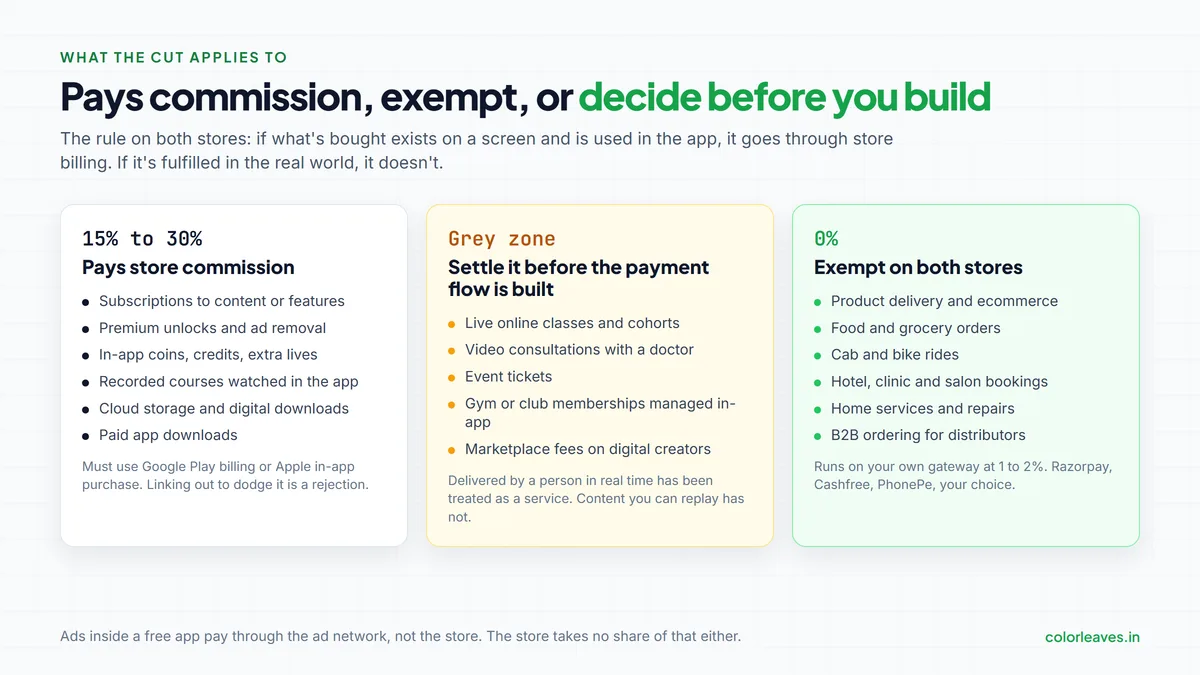
Commission applies to digital goods and services consumed inside the app. Subscriptions to content or features, premium unlocks, in-app currency, extra lives, ad removal, online courses watched in the app, cloud storage. If the thing being bought exists on a screen, it goes through store billing and pays the cut.
Commission does not apply to physical goods or services delivered outside the app. Groceries, clothes, food delivery, cab rides, a plumber booked for Tuesday, a hotel room, a doctor’s appointment in a clinic. These run through your own payment gateway, Razorpay, Cashfree, PhonePe, whichever you like, and neither store touches the money. Google and Apple both say so in their policies, and they mean it. An ecommerce app selling sarees pays 0% to the Play Store however many crores it moves.
The grey zone is anything consumed partly in the app and partly outside. Video consultations with a doctor, live-streamed classes, event tickets, a gym membership managed through the app. The rule of thumb that has held up is this: if the service is delivered by a person in real time or in the physical world, it’s exempt; if the service is the content itself, it’s digital. Teleconsultation has been treated as exempt. Recorded course videos have not. The fintech cost guide carries the special case of financial products, which are services and therefore outside store billing even though they’re consumed on a screen. Get this classification settled before anyone writes the payment flow, because unpicking Razorpay from a checkout and replacing it with store billing after a rejection is weeks of work.
One more thing that isn’t commission but gets confused with it. Ads inside your app pay you through AdMob or whichever network you use, and the store takes no share of that. The network takes its own cut, typically around 30% for AdMob, but that’s the ad business, not the store.
What It Costs on a Real Subscription Business
Numbers in rupees, because the percentages hide how different the routes are.
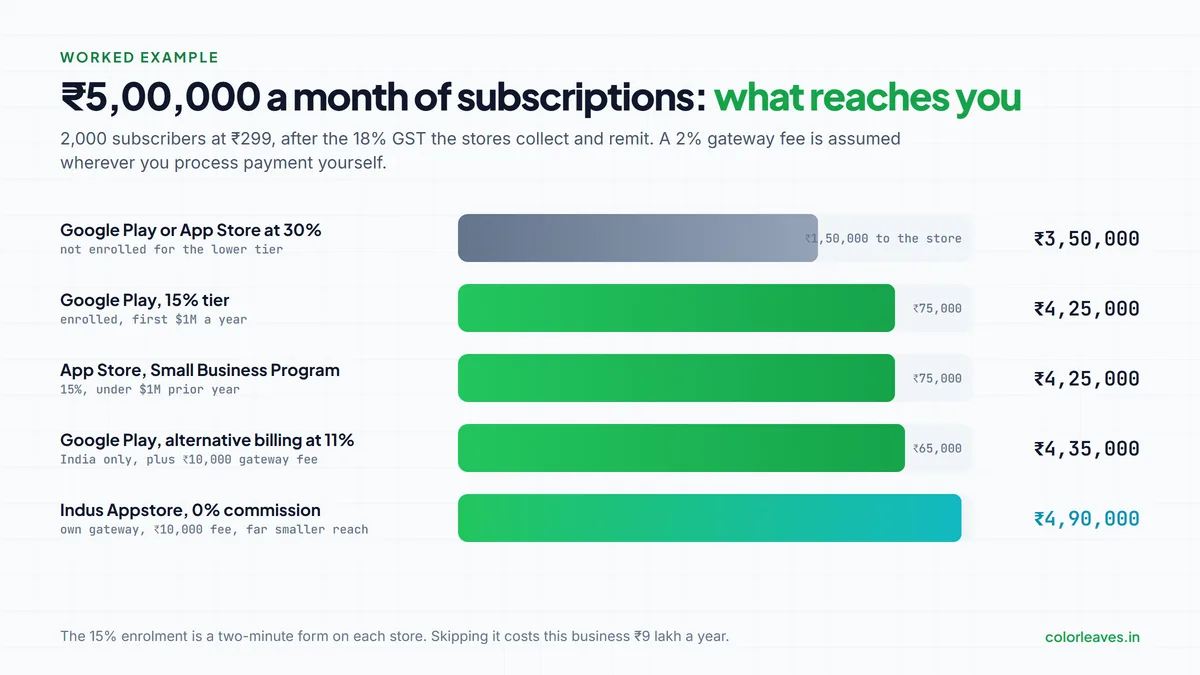
Take a learning app with 2,000 subscribers paying ₹299 a month. Gross billing is ₹5,98,000. The stores strip 18% GST first and pay it on your behalf, which leaves about ₹5,00,000 of net revenue a month to split. Here’s what reaches you under each arrangement, with a 2% gateway fee assumed where you process payment yourself.
| Route | Store commission | Gateway fee | You keep each month |
|---|---|---|---|
| Google Play billing, 15% tier | ₹75,000 | ₹0 | ₹4,25,000 |
| Google Play, 30% (not enrolled) | ₹1,50,000 | ₹0 | ₹3,50,000 |
| Google Play, alternative billing at 11% | ₹55,000 | ₹10,000 | ₹4,35,000 |
| App Store, standard 30% | ₹1,50,000 | ₹0 | ₹3,50,000 |
| App Store, Small Business Program | ₹75,000 | ₹0 | ₹4,25,000 |
| Indus Appstore, own gateway | ₹0 | ₹10,000 | ₹4,90,000 |
Three things jump out. Not enrolling for the 15% tier on either store costs ₹75,000 a month on a business this size, ₹9 lakh a year, for want of a form. Alternative billing on Google saves about ₹10,000 a month after gateway fees, worthwhile but not transformative, and it costs engineering time to build and maintain two checkouts. And the zero-commission store keeps ₹65,000 more than Google does, which sounds decisive until you ask how many of those 2,000 subscribers you’d have found there.
On a bigger business the shape changes. Cross $1 million a year and Google’s rate on the excess doubles to 30%, Apple’s goes to 30% on everything, and alternative billing’s four points start to matter. At ₹20 crore of annual digital revenue, four points is ₹80 lakh. That’s the stage at which building your own billing stack pays for itself many times over.
How to Publish an App Without the High Commission
The question people type into Google is usually “publish app without high commission”, and the honest answer has five parts. Only one of them is a trick, and it doesn’t work.
Sell things the stores can’t take a cut of
If your business model allows it, this is the whole answer. Sell physical products, bookings, deliveries, professional services, anything fulfilled in the real world, and you pay 0% to both stores by policy. A food delivery app, a home services marketplace, a clinic booking app, a B2B ordering tool for distributors, all of these run entirely on Indian payment gateways at 1 to 2%. If you’re deciding between selling a course as recorded videos (digital, 15 to 30%) or as live cohort sessions (a service, 0%), the commission alone can tip the model.
Enrol for the lower tier on both stores
Not a way around the commission, but the way to halve it. The Google Play 15% tier and the Apple Small Business Program are opt-in. Both take minutes. Both are skipped constantly. If you do nothing else after reading this, check your enrolment status on both consoles this week.
Offer alternative billing on Android
Legal in India since 2023, cuts Google’s rate by four points on every transaction where the user chooses your option. Worth it once digital revenue passes a few lakhs a month, because the engineering cost is real: you integrate the alternative billing API, keep Google Play billing available as a parallel option, report each transaction within 24 hours, and carry PCI DSS responsibility for the payment flow. Below that revenue the saving doesn’t cover the build.
List on a zero-commission app store in India
PhonePe’s Indus Appstore launched in February 2024 and charges developers no commission on in-app purchases or subscriptions. You plug in your own payment gateway, UPI included, and keep everything after gateway fees. Listing was free for the first year with a small annual fee signalled after that, in low single digits rather than a percentage of revenue. It comes preinstalled on some Xiaomi phones in India and supports twelve Indian languages, and around two lakh apps are listed.
The catch is reach. The Play Store is on every Android phone sold in India; Indus is on a fraction, and users have to be told to look there. Treat it as an additional channel for an app that already exists, not a replacement for the Play Store. For an app with a strong Hindi-belt or Tier 2 audience it can be a meaningful second channel at no extra engineering cost, since the same Android build uploads to both.
What doesn’t work: linking out for digital goods
The trick people try is to sell digital content through a web page and tell users in the app to go pay there, or to detect the platform and skip store billing. On the App Store that’s a rejection under guideline 3.1.1, and it’s one of the most common rejection reasons we see on first submissions. On Google Play it’s a policy violation that can suspend the account, and a terminated Play account takes every app on it down with it and allows one appeal. The rules allow a web version of your product to exist and sell independently. They don’t allow the app to steer users to it. Build the website by all means, and let people find it; just don’t put a button in the app.
What’s Changing in 2026 and 2027
Three things are in motion, and two of them matter to Indian developers soon.
Google restructured its fees on 30 June 2026, splitting the old single rate into a service fee and a billing fee. In the United States, the United Kingdom and the European Economic Area, the service fee is now 10% on the first $1 million a year and on all subscriptions, with a 5% billing fee added only when the sale goes through Google Play billing. Use alternative billing or an external web link there and the billing fee is zero. Google has said it will expand this to other markets in stages and hasn’t put a date on India. Note that the fee follows the buyer, not the developer, so an Indian-built app with paying users in the US, the usual shape for the products our React Native team ships for overseas founders, is already on the new rates for those users. Until the rollout reaches India, the 15 and 30% tiers, and the 11 and 26% alternative billing rates, stand for Indian buyers.
The Google Play billing case is back in the Supreme Court. The National Company Law Appellate Tribunal upheld the CCI’s abuse finding in March 2025 but cut the penalty to ₹216.69 crore, and a bench heard arguments on 3 November 2026 on whether developers can opt out of Google’s billing system entirely rather than merely offer an alternative beside it. The next hearing is 1 December 2026. If the court sides with developers, the four-point discount could become a choice to bypass Google Play billing altogether.
And the CCI’s Apple case is approaching a penalty decision after Apple agreed in mid-2026 to hand over its India financials. Whatever the fine, the remedy to watch is whether Apple is directed to permit alternative payment on iOS in India as Google was. That would be the first real change to the App Store’s 30% here since the Small Business Program in 2021, and it would change the payment architecture conversation on every iOS build for the Indian market.
Frequently Asked Questions
The answers below cover the commission question on its own. If you’re also pricing the build, the app development cost guide for India carries the figures that sit alongside these, and the maintenance cost guide covers what it takes to keep a paid app compliant year to year.
What is the Google Play commission in India?
Google Play takes 15% of digital sales up to $1 million a year and 30% above that, with auto-renewing subscriptions at 15% at any revenue. Developers who offer an alternative billing system in India pay four points less, 11% and 26%, on transactions where the user picks it. Physical goods and real-world services pay no commission.
What is the App Store commission in India?
Apple takes 30% of paid apps, in-app purchases and first-year subscriptions, and 15% on subscriptions after a subscriber’s first year. Developers who earned under $1 million the previous calendar year can join the Small Business Program and pay 15% on everything. There’s no alternative billing on iOS in India.
Does Play Store charge commission on free apps?
No. A free app with no in-app purchases pays nothing beyond the one-time $25 (about ₹2,100) developer account fee. Ad revenue inside a free app goes through the ad network, not the store, so Google Play takes no share of that either.
Is Google Play commission 15% or 30%?
Both, depending on revenue and whether you’ve enrolled. The 15% rate applies to your first $1 million a year in digital sales and to all subscriptions, but only after you opt in through the Play Console. Without enrolment you pay 30% from the first rupee. Above $1 million a year the rate is 30% on the excess.
Do I pay commission on physical goods sold through my app?
No. Both stores exempt physical goods and services consumed outside the app: product deliveries, food, rides, bookings, appointments. These must use your own payment gateway rather than store billing, and the store takes nothing from the sale.
Is there a zero-commission app store in India?
Yes. PhonePe’s Indus Appstore charges no commission on in-app purchases and lets you use your own payment gateway. Listing was free in the first year with a nominal annual fee after. Its reach is far smaller than the Play Store’s, so it works as a second channel rather than a replacement. The same Android build uploads to both, so for a Kotlin app built in Pune it’s an afternoon’s work rather than a second project.
Can I avoid commission by sending users to my website to pay?
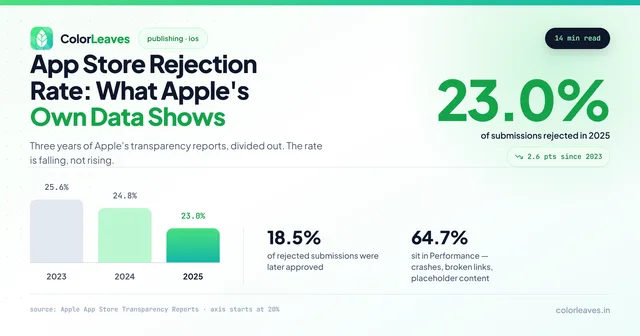
Not for digital goods. Steering users from inside the app to an external payment page for content or features consumed in the app breaks both stores’ rules, and on the App Store it’s one of the most frequent rejection reasons, on a platform that already rejects about one submission in four. Your website can sell independently; the app can’t point to it for that purpose.
Will Google Play’s new 10% fee apply in India?
Not yet. The service fee and billing fee split that began on 30 June 2026 covers the US, UK and European Economic Area, and applies based on where the buyer is. Google has said it will expand to other markets in stages without naming a date for India. Indian buyers stay on the 15% and 30% tiers until then.
Building Something That Sells In-App?
Payment architecture is the decision on a paid app that’s hardest to change later, and it’s where we spend the first working session with a client. Which sales go through store billing, which go through Razorpay, whether alternative billing is worth the extra checkout, how subscriptions are restored across devices. Get it right and the commission becomes a line in the model instead of a surprise in the payout.
We’ve shipped 50+ apps from Pune over ten years, including subscription products and marketplaces on both stores. You can see the paid apps in our portfolio before you talk to anyone, and when you’re ready, book a scoping call and we’ll come back with a feature-by-feature estimate within a working day.
Where the Commission Sits in the Bigger Budget
The store’s share is one line in a plan that also includes the build, the account fees, and the first year of updates. If you’re still deciding what to build, our hire app developers in India page covers engagement models and rates for teams outside India, and the hybrid app development overview explains how one Flutter or React Native codebase reaches both stores, which matters when you’re paying two different commissions on the same product. Businesses in Pune selling goods or services through an app, and therefore paying no commission at all, should look at our ecommerce and on-demand app development pages for what those builds involve.