iOS app development cost in India runs from about ₹2 lakhs for a simple iPhone app to ₹18 lakhs and beyond for one with payments, live data and a real backend. In dollars that’s roughly $2,400 to $21,000, which is a fifth of what the same build costs from a US studio. The spread is wide because “an iOS app” covers everything from a four-screen booking tool to a trading platform, so the useful question isn’t what an app costs. It’s what yours costs, and why.
This guide gives you the tier figures we quote from Pune, the feature-by-feature prices behind them, a worked example of an ₹8 lakh build, and the three things that make iPhone apps cost more than Android ones in India. If you want the Android and cross-platform figures alongside, the general app development cost guide has all three. Figures are in rupees with dollar equivalents at about ₹84 to the dollar, because half the people asking this question are outside India.
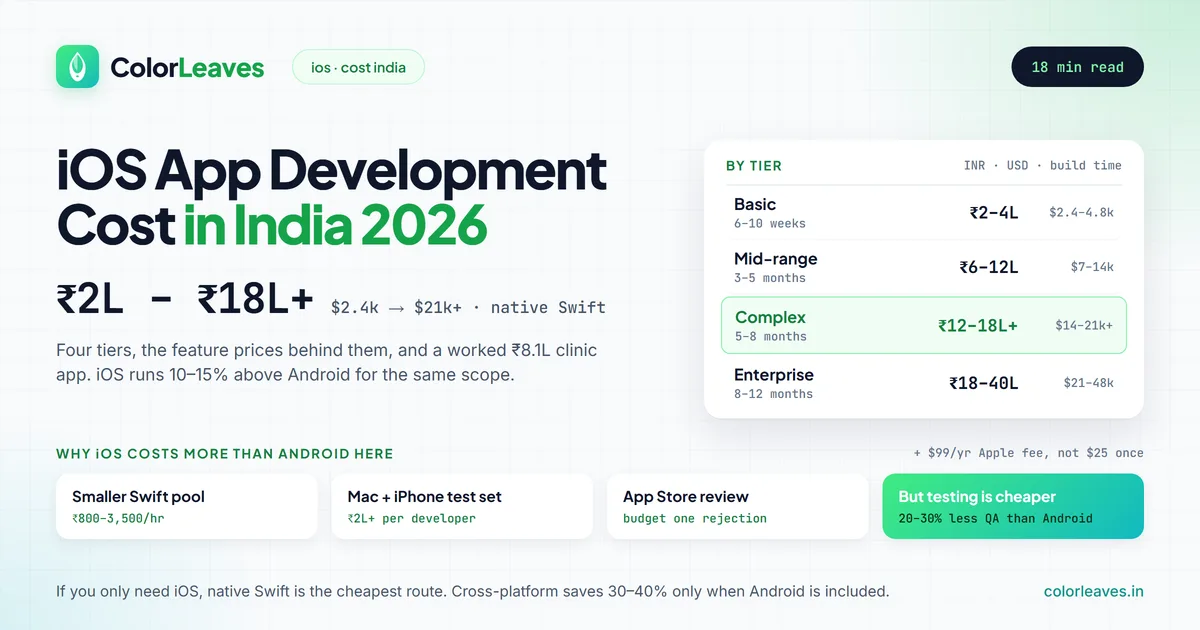
Key Takeaway: A basic iOS app costs ₹2 to 4 lakhs ($2,400 to $4,800) in India, a mid-range app ₹6 to 12 lakhs ($7,000 to $14,000), and a complex app ₹12 to 18 lakhs or more ($14,000 to $21,000+). iOS runs 10 to 15% above Android for the same scope. Add $99 a year for the Apple Developer Program and 15 to 20% of the build cost per year for maintenance.
How Much Does It Cost to Develop an iOS App in India?
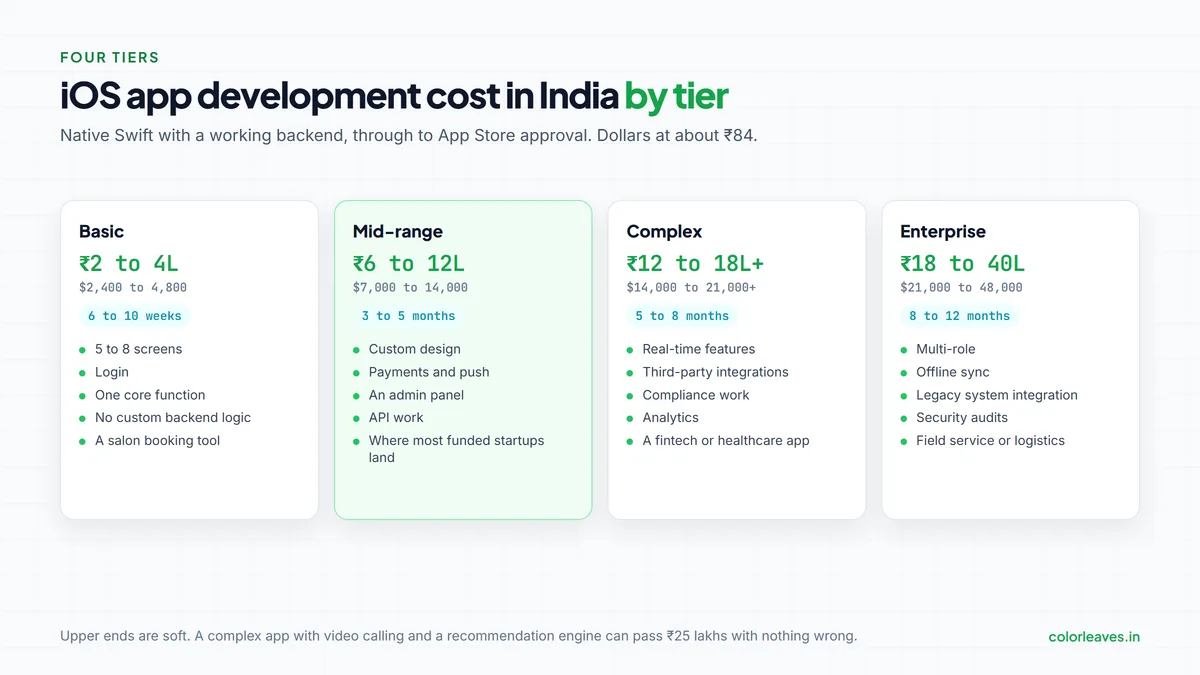
Four tiers cover almost everything we’ve been asked to build. The figures are for a native Swift app with a working backend, through to App Store approval. They match what we quote on our iOS app development page, so there’s no gap between the blog number and the real one.
| Tier | Cost in India | In USD | Build time | What it looks like |
|---|---|---|---|---|
| Basic | ₹2 to 4 lakhs | $2,400 to $4,800 | 6 to 10 weeks | 5 to 8 screens, login, one core function, no custom backend logic |
| Mid-range | ₹6 to 12 lakhs | $7,000 to $14,000 | 3 to 5 months | Custom design, payments, push, an admin panel, API work |
| Complex | ₹12 to 18 lakhs+ | $14,000 to $21,000+ | 5 to 8 months | Real-time features, third-party integrations, compliance, analytics |
| Enterprise | ₹18 to 40 lakhs | $21,000 to $48,000 | 8 to 12 months | Multi-role, offline sync, legacy system integration, security audits |
A basic app is something like a salon booking tool: pick a service, pick a slot, pay, get a reminder. Mid-range is where most funded startups land, a marketplace or a subscription product with a proper design pass and a backend someone has to maintain. Complex is a fintech or healthcare app, where the compliance work costs as much as some whole basic apps. Enterprise is a field-service or logistics tool that has to talk to an ERP nobody has documented.
Two caveats on the table. The upper ends are soft, because a complex app with video calling and a recommendation engine can run past ₹25 lakhs without anything being wrong. And the timelines assume you’re ready: content, API access and the Apple account sorted before week one. Our timeline guide covers how often that assumption fails.
Why iPhone App Development Costs More Than Android in India
Ask three Indian agencies and you’ll get three answers on the Android versus iOS gap. Ours, measured across the apps we’ve shipped on both, is 10 to 15% more for iOS at equal scope. The reasons are specific.
The Swift talent pool is smaller. India produces far more Android developers than iOS ones, because Android is 95% of the domestic market (StatCounter) and most engineers learn on what they use. A good Swift developer in Pune commands ₹800 to ₹3,500 an hour against ₹700 to ₹3,000 for Kotlin, and the senior end of that range is where the gap is widest. Our developer rate guide breaks the bands down by seniority.
The hardware costs more. Every iOS developer needs a Mac, and Xcode only runs there. A Mac mini that can build a real app is ₹60,000 to ₹1,00,000, an iPhone test set another ₹1,50,000 or so for three current and older models. An agency absorbs that into its rate, but it’s in there.
Review is a real cost, not a formality. Apple’s reviewers reject more and explain less than Google’s. Each rejection costs a day or two of developer time to diagnose, fix and resubmit, and a first release typically eats one. We wrote up the reasons apps get rejected and the actual rejection rate data, and the short version is that budgeting zero rejections is budgeting wrong.
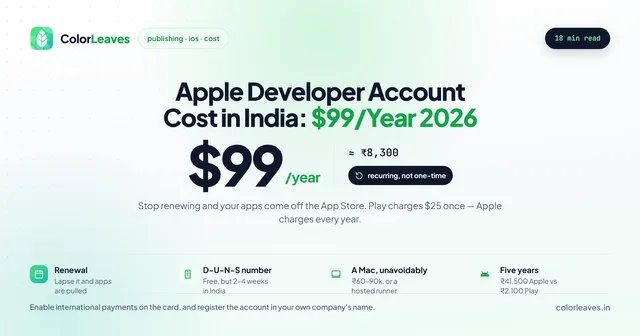
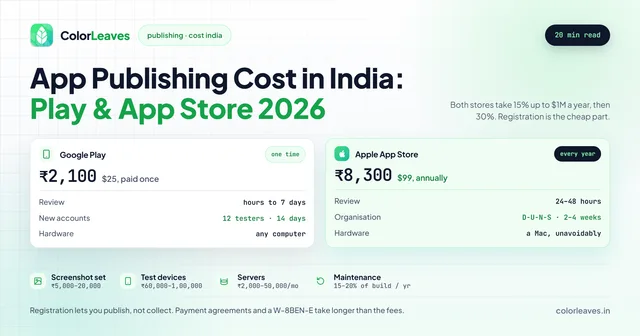
The account fee is 33 times higher. Google charges $25 once. Apple charges $99 every year, about ₹8,300, and your app leaves the store if you stop paying. It’s small against a ₹10 lakh build but it’s recurring, and our Apple Developer account guide covers the organization enrollment and D-U-N-S number that stall Indian companies for weeks.
What works in iOS’s favor is testing. There are perhaps a dozen iPhone models and three iOS versions that matter, against the thousands of Android devices and the fragmentation that comes with them. On a mid-range app, QA on iOS costs 20 to 30% less than on Android, which claws back some of the developer premium.
What Drives the Cost of an iOS App
The tier table is the summary. This is the detail underneath it, priced the way we actually quote, feature by feature, for a mid-range build.
| Feature | Added cost | Notes |
|---|---|---|
| Sign in with Apple, email, phone OTP | ₹30,000 to ₹60,000 | Apple requires Sign in with Apple if you offer any third-party login |
| Custom UI design (10 to 15 screens) | ₹80,000 to ₹2,00,000 | Human Interface Guidelines compliance, dark mode, Dynamic Type |
| Payments (Razorpay, Stripe, Apple Pay) | ₹50,000 to ₹1,20,000 | Add 30 to 50% if subscriptions go through StoreKit |
| Push notifications (APNs) | ₹20,000 to ₹40,000 | Includes segmentation and a scheduling backend |
| Maps and live location | ₹60,000 to ₹1,50,000 | MapKit is free; the backend for live tracking is not |
| In-app chat | ₹80,000 to ₹2,00,000 | Sockets, read receipts, media, moderation |
| Admin web panel | ₹1,00,000 to ₹3,00,000 | Often the second-largest line after the app itself |
| Offline mode with sync | ₹1,00,000 to ₹2,50,000 | Conflict handling is the expensive part |
| Analytics and crash reporting | ₹15,000 to ₹30,000 | Firebase or Mixpanel, with event design |
| Third-party API integration | ₹25,000 to ₹80,000 each | CRM, ERP, SMS, KYC providers |
Three of those lines surprise people. The admin panel, because it’s a web app nobody mentioned when they said “iOS app”. Subscriptions through StoreKit, because Apple’s billing has its own sandbox, receipt validation and edge cases around family sharing and refunds. And offline sync, because “the app should work without internet” sounds like a checkbox and is in fact a distributed systems problem.
Design deserves its own note. iOS users notice design more than Android users do, and Apple’s reviewers do too. An app that ignores the Human Interface Guidelines feels wrong to iPhone owners in a way that’s hard to articulate and easy to see in the one-star reviews. A proper UI/UX pass is 15 to 20% of a mid-range budget and it’s the line we’d cut last.
iOS Developer Hourly Rates in India
Most of the cost is people, so the rates matter. These are the bands we see in Pune and across India in 2026:
| Role | Hourly rate | In USD |
|---|---|---|
| Junior iOS developer (1 to 2 years) | ₹800 to ₹1,500 | $10 to $18 |
| Mid-level iOS developer (3 to 5 years) | ₹1,500 to ₹2,500 | $18 to $30 |
| Senior iOS developer (6+ years) | ₹2,500 to ₹3,500 | $30 to $42 |
| UI/UX designer | ₹800 to ₹2,000 | $10 to $24 |
| QA engineer | ₹600 to ₹1,500 | $7 to $18 |
| Backend developer | ₹1,000 to ₹2,500 | $12 to $30 |
A mid-range app takes about 1,000 to 1,400 hours across those roles. Run that at blended rates and you land in the ₹8 to 12 lakh range, which is where the tier table puts it. The hour count is the number to interrogate when a quote looks cheap. A ₹4 lakh quote for a payments app either has 400 hours in it or has a junior doing everything, and both show up later.
Hiring a dedicated developer instead of a project team changes the maths. A mid-level iOS developer on a monthly contract costs ₹1,20,000 to ₹2,00,000 a month, which is the better model if you have a product manager and the app will keep evolving. Our page on hiring iOS developers in India covers how that engagement works for overseas teams.
A Worked Example: What an ₹8 Lakh iPhone App Actually Buys
Abstract tiers are easy to nod along to. Here’s a real shape, lightly anonymized, for a clinic chain that wanted patients booking and paying on iPhone.
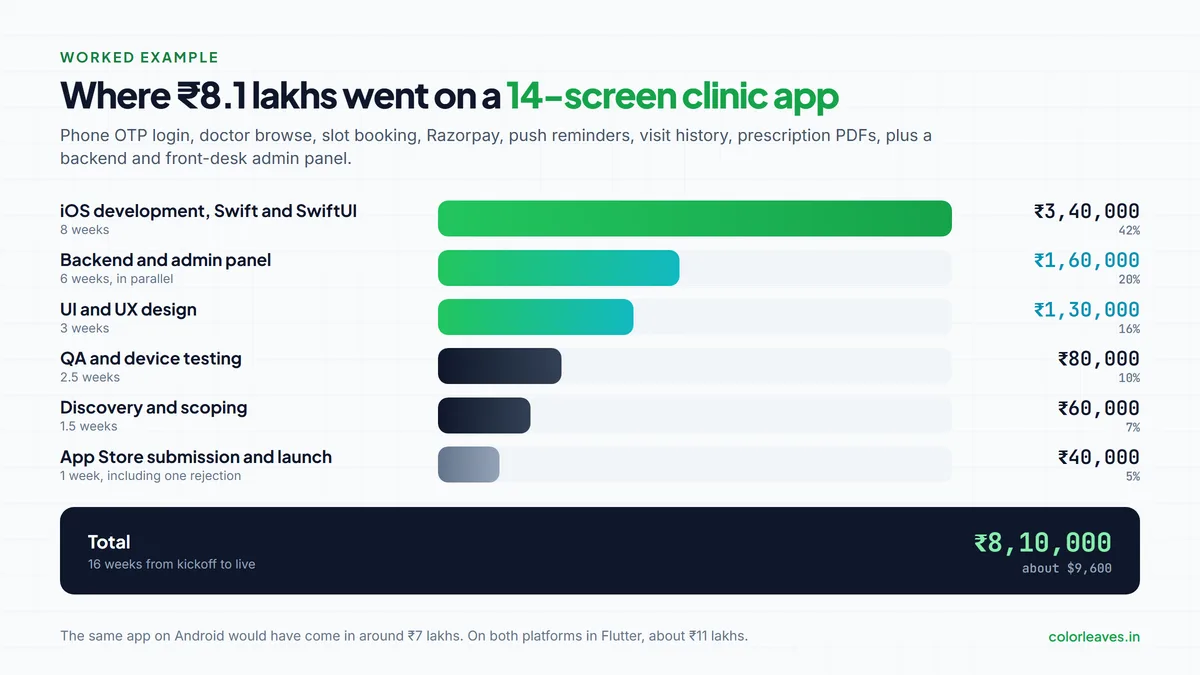
The app: 14 screens. Phone OTP login, clinic and doctor browse, slot booking with a calendar, Razorpay payment, appointment reminders by push, a visit history, and a prescription PDF viewer. Behind it, a backend that syncs with the clinics’ existing scheduling software through its API, and a small admin panel for the front desk to block slots.
| Phase | Weeks | Cost | Share |
|---|---|---|---|
| Discovery and scoping | 1.5 | ₹60,000 | 7% |
| UI/UX design | 3 | ₹1,30,000 | 16% |
| iOS development (Swift, SwiftUI) | 8 | ₹3,40,000 | 42% |
| Backend and admin panel | 6 (parallel) | ₹1,60,000 | 20% |
| QA and device testing | 2.5 | ₹80,000 | 10% |
| App Store submission and launch | 1 | ₹40,000 | 5% |
| Total | 16 weeks | ₹8,10,000 |
Three things about that budget. The backend was a fifth of it even though the client only ever said “iOS app”. The design phase ran three weeks because booking flows on a phone are where users abandon, and that money came back as a 71% booking completion rate against the 40% their web form managed. And the submission week includes one rejection, for a missing account-deletion option, which is now the most common first-submission rejection we see.
The same app on Android would have come in around ₹7 lakhs. On both platforms in Flutter, about ₹11 lakhs. Which is the next question.
Native Swift vs Flutter vs React Native for iOS
If you only need iOS, native Swift is usually the cheapest route and always the best one. Cross-platform frameworks earn their keep when you need both stores, and for a single platform they add a layer without removing any work.
| Approach | iOS only | iOS and Android | Best when |
|---|---|---|---|
| Native Swift | ₹6 to 12 lakhs | ₹12 to 22 lakhs (two native apps) | iPhone-first product, heavy use of camera, ARKit, HealthKit, widgets |
| Flutter | ₹7 to 13 lakhs | ₹8 to 15 lakhs | Both platforms, design-led app, one team |
| React Native | ₹7 to 13 lakhs | ₹8 to 15 lakhs | Both platforms, existing React web team |
So the saving from going cross-platform is 30 to 40% against two native apps, and roughly nothing against one. That’s the number the competitor guides never quantify. Where native pulls ahead on iOS specifically is anything that leans on Apple’s own frameworks. HealthKit, ARKit, Live Activities, App Clips and widgets are all possible from Flutter and React Native through platform channels, and all cost more there than in Swift because you’re writing the native code anyway and then bridging it.
The Flutter versus React Native comparison goes deeper on the frameworks themselves, and if you haven’t settled on a platform at all, Android or iOS first is the earlier decision. For Indian consumer apps the answer is usually Android first. For apps selling to Americans it’s iOS, where the per-user revenue runs two and a half times higher.
Costs After Launch: App Store Fee, Hosting and Maintenance
The build is the headline, not the total. A live iOS app has four recurring lines.
Apple Developer Program, $99 a year. Non-negotiable, and the renewal failing is the most common reason an app silently vanishes from the store. Put it on a company card that doesn’t expire mid-year.
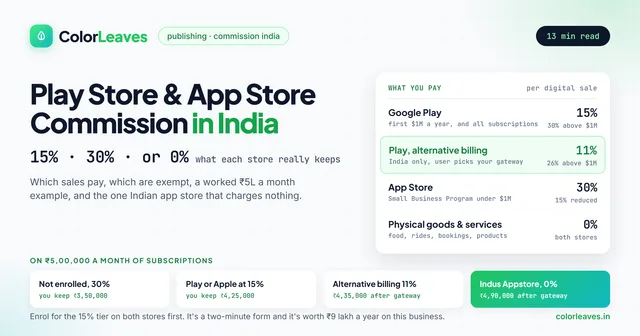
Apple’s commission, 15 or 30%. Any digital content sold inside the app goes through StoreKit, and Apple takes 30%, or 15% under the Small Business Program if you earned under $1 million last year. Physical goods and real-world services, a clinic visit or a food order, don’t pay it. Our publishing cost guide covers where that boundary falls.
Hosting, ₹2,000 to ₹50,000 a month. This is the backend, not the app. Apple hosts the binary free. A basic app on Firebase’s free tier costs nothing to run. A mid-range app with a few thousand daily users on AWS Mumbai runs ₹15,000 to ₹40,000 a month.
Maintenance, 15 to 20% of the build cost per year. On an ₹8 lakh app that’s ₹1.2 to 1.6 lakhs annually, and iOS has a fixed deadline the Android world doesn’t. Apple ships a major iOS version every September, and apps that haven’t been rebuilt against the new SDK start breaking on new iPhones within weeks. One compatibility release a year is the floor. The maintenance cost guide breaks the year down, and a support retainer agreed before launch is cheaper than an emergency fix in October.
iOS App Development Cost in India vs the US and UK
The reason this search exists. An iOS developer in India bills $10 to $42 an hour. In the US it’s $90 to $180, in the UK $80 to $160. The clinic app above, at ₹8.1 lakhs or about $9,600, would quote at $55,000 to $85,000 from a mid-sized American studio.
| Region | Senior iOS rate | The ₹8 lakh clinic app |
|---|---|---|
| India (Pune) | $30 to $42/hr | $9,600 |
| Eastern Europe | $45 to $70/hr | $25,000 to $35,000 |
| UK | $80 to $160/hr | $50,000 to $75,000 |
| US | $90 to $180/hr | $55,000 to $85,000 |
The gap is cost of living and operating, not skill. A senior developer in Pune writes the same Swift as one in Austin, and has usually shipped more apps, because the volume of work here is higher. What doesn’t change by geography: the $99 fee, the review process, the September deadline, and the calendar. An Indian team doesn’t build faster, it builds cheaper.
What an overseas buyer should price in is the overlap. Pune is 9.5 hours ahead of New York, so a standard Indian working day gives you about two hours of shared time in the US morning. Teams that work with American clients shift later, and you should ask any vendor what their actual overlap window is rather than assume. Our iOS development page for overseas clients spells out ours, along with the contract, IP and W-8BEN-E details that US finance teams ask about.
How to Keep iPhone App Development Costs Down
Five things work. None of them is “find a cheaper quote”.
Scope an MVP, not a product. The single biggest saving available. A first release with one job and six screens costs ₹3 to 5 lakhs and tells you in eight weeks whether anyone wants the thing. The MVP cost guide shows how to cut a feature list down without cutting the idea.
Use SwiftUI. For a new app in 2026 it’s faster to build in than UIKit, by 20 to 30% on screen-heavy work, and easier to maintain. The only reason to start in UIKit now is a hard requirement for iOS 14 support, which almost nobody has.
Rent the backend. Firebase, Supabase or AWS Amplify replace a custom backend for most basic and mid-range apps and save ₹1 to 2 lakhs up front. You’ll outgrow them at scale, and that’s a good problem to budget for later.
Fix the scope before the price. Every change after design sign-off costs three to five times what it would have cost in discovery. Agencies that quote without a written scope are quoting a number they’ll revise.
Start the Apple account on day one. Organization enrollment needs a D-U-N-S number, which takes two to four weeks in India. Apps have sat finished for a month waiting on it. Open it during discovery, not after QA, and get a TestFlight build in front of real users before the store submission rather than after.
Why Pune for iOS App Development
iOS app development cost India-wide varies more by city than by agency. Rates in Pune run 30 to 50% under Bangalore and Mumbai for the same seniority, and the city’s iOS pool is deeper than its size suggests, because a lot of engineers trained at large product companies in Hinjewadi and Kharadi before moving to studios. The city-by-city comparison has the salary and office-cost numbers behind that.
For a buyer, the practical difference is that an ₹8 lakh app in Pune is a ₹11 to 12 lakh app in Bangalore with the same team quality. For an Indian client it also means a team you can visit. Most of our clinic client’s design reviews happened in a room in Shaniwar Peth with the front-desk staff who’d use the admin panel, which is how the three-week design phase paid for itself.
Frequently Asked Questions
The answers below are for iOS in general. If your app sits in a regulated or specialized category, the fintech, healthcare and ecommerce cost guides carry the category-specific lines, like KYC flows or cash-on-delivery handling, that this page leaves out.
How much does iOS app development cost in India?
A basic iOS app costs ₹2 to 4 lakhs ($2,400 to $4,800) in India, a mid-range app with payments and a backend ₹6 to 12 lakhs ($7,000 to $14,000), and a complex app ₹12 to 18 lakhs or more ($14,000 to $21,000+). Enterprise builds with offline sync and legacy integrations run ₹18 to 40 lakhs. The feature list, design depth and backend decide where you land.
Is iOS app development more expensive than Android in India?
Yes, by 10 to 15% at the same scope. Swift developers are scarcer than Kotlin developers in India, every iOS developer needs a Mac, and App Store review rejects more often. Testing is cheaper on iOS because there are far fewer devices, which narrows the gap a little.
How much does an iOS developer cost per hour in India?
₹800 to ₹3,500 an hour, or $10 to $42, depending on seniority. A mid-level Swift developer with three to five years of experience sits at ₹1,500 to ₹2,500. On a monthly dedicated contract, budget ₹1,20,000 to ₹2,00,000 for a mid-level developer.
How much does it cost to put an app on the App Store in India?
$99 a year, about ₹8,300, for the Apple Developer Program. There’s no per-app or per-update charge. If you sell digital content inside the app, Apple takes 15 to 30% of each sale. Physical goods and services are exempt.
How long does it take to build an iOS app?
Six to ten weeks for a basic app, three to five months for mid-range, five to eight months for complex. Add two to four weeks if your company needs a D-U-N-S number for the Apple account and doesn’t have one.
Is it cheaper to build an iOS app in Flutter than in Swift?
Not for iOS alone. Native Swift costs about the same or slightly less for a single platform, and handles Apple-specific features like HealthKit and widgets more cheaply. Flutter and React Native save 30 to 40% only when you need Android as well, because one codebase serves both.
What does an iOS app cost to maintain per year?
Plan for 15 to 20% of the original build cost. On an ₹8 lakh app that’s ₹1.2 to 1.6 lakhs a year, covering bug fixes, the annual iOS version update every September, library upgrades and small features. Hosting is separate and runs from zero to ₹50,000 a month depending on users.
Ready to Price Your iOS App?
The fastest way to get a real number is a 30-minute scoping call. Tell us what the app has to do, who uses it, and what it talks to, and we’ll come back with a feature-by-feature estimate in rupees or dollars with the hour count behind every line.
We’ve shipped 50+ apps from Pune over ten years, a good share of them iPhone-first, and you can see the iOS work in our portfolio before you talk to anyone. When you’re ready, request an estimate and we’ll reply within a working day.
If You Need Android Too
Most Indian consumer products do, and for those the native iOS figures above are only half the budget. The hybrid app development overview sets Flutter and React Native against each other on cost and hiring for teams that need both stores, and our Flutter and React Native pages cover each route for overseas clients. If you’re staying native on both, the Android development page carries the Kotlin side of the same tier table, and the general cost guide for India puts all three routes side by side.